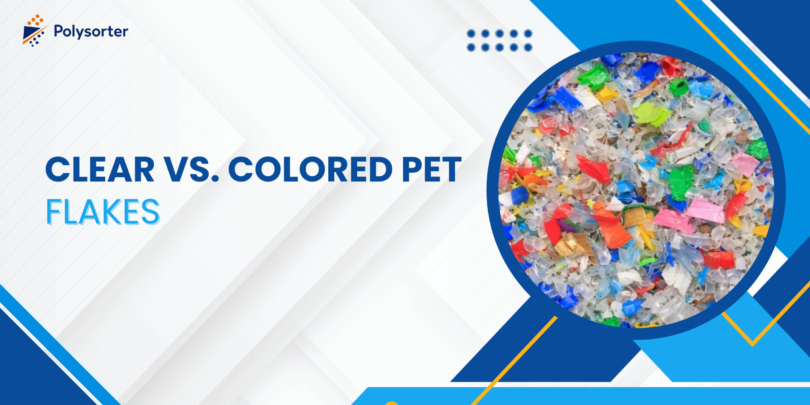
In plastic recycling, the difference between clear and colored PET flakes can significantly influence recycled material quality, production consistency, and market opportunities. Although both materials are made from polyethylene terephthalate (PET), their color characteristics determine how easily they can be reused in different manufacturing applications.
Understanding Clear vs. Colored PET Flakes is especially important for recycling facilities producing recycled PET (rPET) for bottles, packaging, polyester fibers, sheets, and other industrial products. Even after washing, unwanted colored particles may remain in a clear PET stream, affecting the appearance and consistency of the final material.
For recycling operators, this raises an important question: How much does color separation actually improve recycling quality, and when is an optical sorting machine necessary?
The answer depends on the incoming material, required purity, production capacity, and intended application. Modern PET flake color sorting technology helps recycling facilities separate different color fractions, reduce visible contamination, and recover valuable materials more efficiently.
This guide explains how PET color affects recycling quality, how optical sorting technology works, and what buyers should consider when selecting a suitable sorting solution.
Clear vs. Colored PET Flakes: Understanding the Key Differences
PET flakes are typically produced by shredding collected PET bottles and other suitable packaging materials. After washing, separation, and drying, these flakes can be processed into recycled plastic products.
However, PET flakes are not all visually identical. Their original pigments influence which recycling applications they can serve.
Clear PET Flakes
Clear PET flakes generally originate from transparent, uncolored bottles and packaging.
Their main advantage is versatility. Because they contain little or no intentional pigment, manufacturers can use them in transparent products or introduce controlled colors during subsequent processing.
Common applications include transparent packaging, plastic sheets, polyester fibers, and selected bottle-to-bottle recycling processes.
Nevertheless, transparency alone does not guarantee material quality. Clear PET must also meet relevant requirements for polymer purity, moisture, intrinsic viscosity, and contamination levels.
Colored PET Flakes
Colored PET flakes originate from packaging containing pigments or colorants.
Common categories include:
- Light-blue PET: Often found in beverage bottles and sometimes accepted within clear or light-blue recycling specifications.
- Green PET: Common in beverage packaging and suitable for selected colored recycling applications.
- Brown or amber PET: Used in certain bottles and packaging, with applications depending on color requirements.
- Opaque PET: Contains additives or pigments that limit transparency and may require separate processing.
- Mixed-color PET: Contains multiple colors, usually offering less flexibility for transparent finished products.
Importantly, colored PET is not inherently inferior to clear PET. Its recycling value depends on material quality, color consistency, and downstream demand.
For example, a clean green PET fraction may be suitable for producing colored strapping or polyester products. However, introducing the same material into a transparent PET stream could create unwanted coloration.
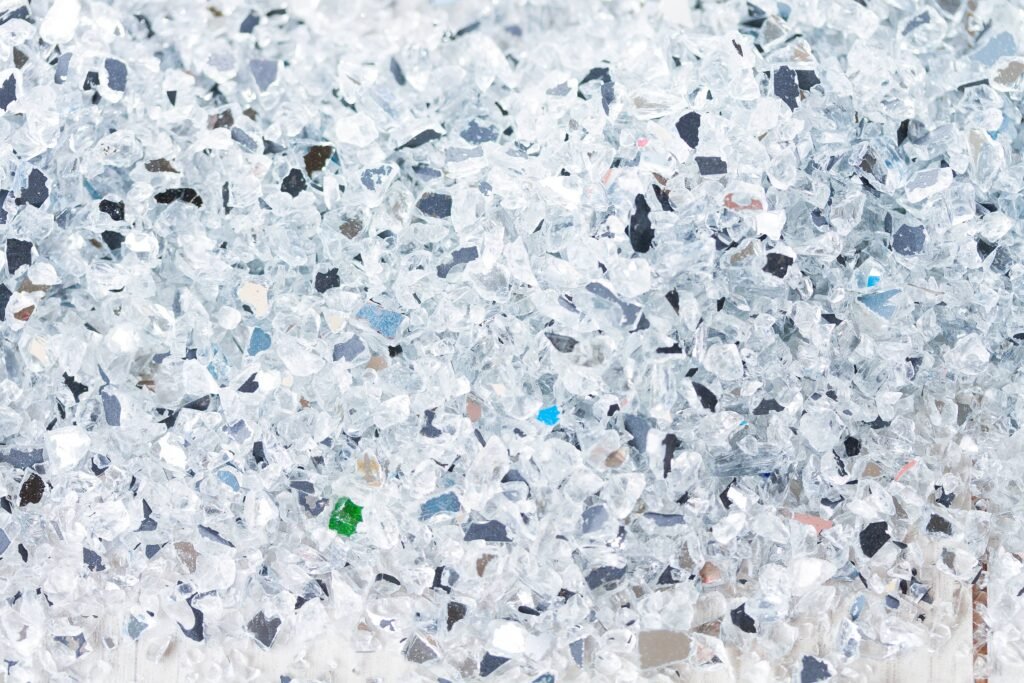
Clear and Colored PET Flakes Comparison
| Characteristic | Clear PET Flakes | Colored PET Flakes |
| Appearance | Transparent or nearly colorless | Blue, green, brown, or other shades |
| Color flexibility | High | Restricted by existing pigments |
| Common applications | Transparent packaging, sheets, bottles, fibers | Colored packaging, fibers, strapping, industrial products |
| Main quality concern | Unwanted colors and visible defects | Inconsistent color composition |
| Sorting objective | Maintain clear-grade specifications | Produce consistent colored fractions |
| Commercial potential | Broad, depending on quality | Depends on color grade and market demand |
The key consideration is whether the recycled material meets the requirements of its intended customer.
How Does PET Flake Color Affect Recycled Plastic Quality?
Color influences more than the visual appearance of individual PET flakes. It can affect transparency, product consistency, and the range of manufacturing applications available to recycled materials.
Transparency and Color Contamination
For manufacturers producing transparent packaging, color consistency is an important quality requirement.
When green, brown, or strongly pigmented flakes enter a clear PET stream, their pigments may affect the appearance of the material after melting and extrusion.
Even a relatively small proportion of colored particles can create noticeable color changes, depending on pigment type, concentration, and processing conditions.
This makes effective color separation especially valuable for facilities supplying transparent or color-sensitive products.
Color Consistency Between Production Batches
Incoming PET materials rarely have identical compositions.
One batch may contain predominantly transparent bottles, while another includes more green or blue packaging.
Without effective separation, these variations can affect the appearance of recycled pellets or finished products.
Manufacturers may evaluate color consistency using visual inspection or instrumental measurements, including standardized color coordinates and color differences.
Optical sorting reduces unwanted color variations in the feedstock and supports more predictable downstream processing.
Yellowing and Discoloration
Yellowing is another important quality concern in recycled PET.
However, not all yellowing results from colored PET contamination. Thermal degradation, oxidation, previous processing history, and certain contaminants can also contribute to discoloration.
Optical sorting may remove visibly yellowed or discolored flakes when their appearance can be distinguished reliably.
It cannot reverse molecular degradation or restore material properties that have already deteriorated.
Therefore, sorting should complement appropriate washing, drying, extrusion, and process control.
Color Purity Versus Polymer Purity
A transparent PET flake and a transparent PVC flake may appear similar, despite having different chemical structures.
Visible-light color sorting cannot reliably distinguish materials solely by polymer composition when their optical appearances overlap.
Likewise, clear PET may still contain contaminants that affect processing performance.
This highlights an important distinction:
Color purity describes visual consistency, while polymer purity describes the chemical composition of the material stream.
Both can influence recycled PET quality, but they require different inspection and quality-control approaches.
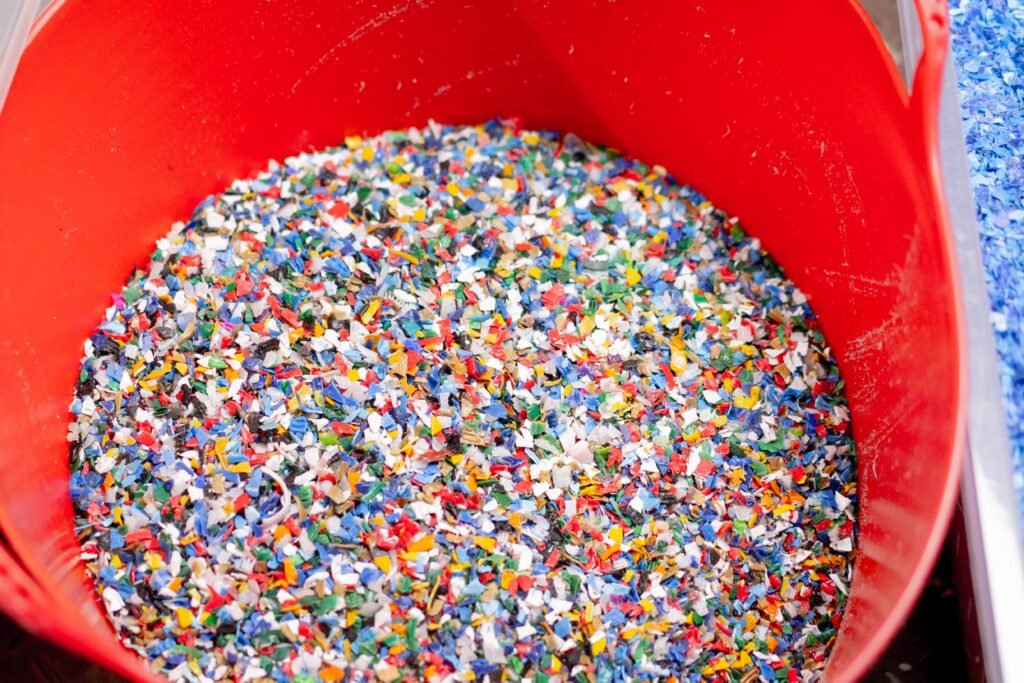
How Does Optical Color Sorting Separate Clear and Colored PET Flakes?
Manual inspection becomes increasingly difficult after PET bottles are crushed into small flakes.
Modern optical sorting machines automate this process by analyzing individual particles and separating them according to selected visual characteristics.
Preparing PET Flakes for Accurate Sorting
Before sorting, PET flakes generally require appropriate cleaning, screening, and moisture control.
Dust, residual labels, surface contamination, and excessive moisture can interfere with optical inspection.
A controlled feeding system distributes flakes across the inspection area, helping reduce particle overlap.
Uniform material presentation is especially important when processing small, lightweight flakes.
Optical Detection and Color Recognition
As PET flakes move through the detection area, high-resolution cameras capture their visible characteristics under controlled illumination.
Depending on the equipment configuration, the system can identify differences in:
- Clear and pigmented PET flakes
- Light-blue, green, brown, and other color shades
- Brightness and visible surface appearance
- Opaque or strongly discolored particles
The sorting software evaluates these characteristics against predefined acceptance criteria.
For example, a facility producing clear PET may configure its sorting process to reject green, brown, and other unwanted colors while retaining acceptable transparent material.
Why Transparent PET Flakes Are Challenging to Sort
Transparent flakes present several optical challenges.
First, their appearance can change depending on illumination, background contrast, thickness, and orientation.
Second, light-blue flakes may closely resemble clear PET, making subtle color differences more difficult to detect.
Third, overlapping particles can reduce inspection accuracy because one flake may partially conceal another.
Finally, dust and moisture can alter how light passes through or reflects from the material.
For these reasons, sorting performance depends on more than camera resolution. Illumination design, feeding stability, software classification, and ejector precision also matter.
Automatic Separation and Polymer Identification
After identifying an unwanted flake, the system calculates its position and activates a high-speed air ejector to redirect it into a separate collection stream.
Accepted material continues through the machine.
For recycling lines containing non-PET plastics, additional polymer identification may be required.
Near-infrared (NIR) technology can distinguish selected polymer types using their spectral characteristics, although its effectiveness depends on material properties and operating conditions.
A combined or multi-stage sorting solution may therefore be appropriate when both color separation and polymer purification are necessary.
How Does PET Color Sorting Improve Recycling Efficiency and Material Recovery?
Effective color sorting helps recycling facilities manage material quality while reducing unnecessary losses.
Its economic value comes from the relationship between output specifications, usable material recovery, processing efficiency, and market demand.
Improving Recycled PET Quality
By separating unwanted colors, recycling facilities can produce fractions that more closely match customer specifications.
A clear PET fraction with fewer visibly colored particles may be better suited to transparent applications, provided that other quality requirements are also satisfied.
Meanwhile, colored fractions can be managed according to their own intended uses.
This allows operators to develop more consistent material grades instead of processing every PET flake as one mixed stream.
Recovering Usable Colored Materials
Colored PET should not automatically be treated as waste.
When sufficient material volume and suitable markets exist, separate color fractions may offer additional recycling opportunities.
For instance, a facility may recover green PET for selected colored-product applications rather than mixing it with other shades.
The commercial benefit depends on local demand, achievable purity, additional processing requirements, and sorting costs.
Balancing Sorting Purity and Recovery Rate
Higher rejection rates do not necessarily mean better sorting results.
An overly aggressive sorting configuration may remove unwanted colors but also reject acceptable clear flakes.
This reduces material recovery and increases the quantity of usable PET entering the reject stream.
An effective sorting process must balance purity, recovery, and throughput.
| Performance Indicator | What Buyers Should Evaluate |
| Color purity | Whether accepted material meets required color specifications |
| Recovery rate | Percentage of acceptable PET successfully recovered |
| Good-material loss | Valuable PET incorrectly entering the reject fraction |
| Processing capacity | Sustainable throughput under realistic feed conditions |
| Sorting stability | Consistency across different batches and operating periods |
These indicators should be evaluated together during equipment testing.
For recycling operators, achieving a slightly higher purity level may not justify excessive losses of otherwise acceptable material.
Supporting Downstream Production
Consistent color fractions can simplify color management during extrusion, pelletizing, and manufacturing.
However, optical sorting cannot replace drying, melt filtration, or other essential purification processes.
Its primary contribution is removing detectable unwanted particles before further processing.
How to Choose the Right PET Flake Color Sorting Machine
Selecting an optical sorting machine requires a clear understanding of the recycling facility’s feedstock and production objectives.
Equipment specifications alone cannot determine whether a sorting system will perform effectively under actual operating conditions.
Identify the Main Sorting Requirement
The first step is defining what needs to be separated.
A facility producing transparent PET may focus on removing unwanted colored flakes.
Another facility may need to separate green, blue, and other shades into individual fractions.
A mixed-plastic recycling operation may additionally require polymer identification.
These applications involve different detection requirements and should not automatically be treated as identical sorting tasks.
Match Sorting Technology to the Application
| Recycling Requirement | Recommended Evaluation Focus |
| Clear PET purification | Fine color recognition and low good-material loss |
| Clear and green PET separation | Color classification accuracy and recovery rate |
| Clear and light-blue PET grading | Sensitivity to subtle color differences |
| Mixed PET and non-PET plastics | Suitable polymer identification technology |
| High-capacity PET processing | Stable throughput and feeding consistency |
| High-quality rPET production | Multi-stage separation and downstream quality verification |
Visible-light sorting is generally appropriate for separating detectable colors.
Where polymer contamination is significant, NIR or another suitable identification method may be necessary.
The appropriate system should reflect the actual material stream rather than simply offering the largest number of detection features.
Evaluate Flake Size and Material Conditions
PET flake characteristics can influence sorting performance.
Buyers should consider particle size distribution, moisture, dust, contamination levels, and the proportion of transparent or lightly tinted flakes.
Irregular or overlapping particles can make reliable inspection more difficult.
It is therefore important to evaluate whether the feeding and detection systems can handle representative production materials.
Conduct Sorting Trials Before Purchasing
Material testing is one of the most practical ways to evaluate a PET flake sorting solution.
A representative test should include typical color variations and contamination found in daily production.
The resulting accepted and rejected fractions should be examined to determine:
- Whether the required color purity is achieved
- How much acceptable PET is recovered
- How much good material enters the reject stream
- Whether throughput meets production requirements
- Whether performance remains consistent across different samples
For buyers comparing multiple machines, equivalent testing conditions are important.
A suitable sorting machine should deliver the required separation performance while maintaining practical recovery rates and operating efficiency.
Frequently Asked Questions About Clear and Colored PET Flakes
1. Are clear PET flakes better than colored PET flakes?
Clear PET generally offers greater flexibility for transparent and color-sensitive products. However, colored PET remains valuable when its quality and appearance meet the requirements of suitable recycling applications.
2. Why should clear and colored PET flakes be separated?
Color separation helps maintain consistent recycled PET grades, reduces unwanted pigmentation in transparent products, and supports the recovery of useful colored materials.
3. Can colored PET flakes be recycled into new bottles?
Potentially, yes. Suitability depends on material quality, color requirements, processing methods, and applicable regulations. Color separation alone does not establish food-contact suitability.
4. Can optical sorting machines distinguish light-blue PET from clear PET?
Suitable systems can identify many light-blue and clear PET flakes. Performance depends on shade differences, illumination, particle characteristics, and sorting conditions.
5. Does PET color sorting remove PVC contamination?
Visible-light sorting cannot reliably identify PVC solely by its appearance when it resembles PET. Polymer-sensitive technology, such as suitable NIR sorting, may be required.
6. Should PET flakes be washed before optical sorting?
Clean, adequately dried flakes generally provide better conditions for optical inspection. However, the appropriate sorting stage depends on the recycling process and equipment configuration.
7. Can PET flake color sorting improve recycling profitability?
It can support profitability by producing consistent material grades and recovering usable PET. Actual returns depend on market demand, equipment costs, sorting efficiency, and recovery performance.
8. What should buyers consider when choosing a PET flake sorting machine?
Important factors include material characteristics, required purity, detection technology, processing capacity, recovery rate, maintenance requirements, and results from representative material testing.
Conclusion
Understanding Clear vs. Colored PET Flakes helps recycling facilities make informed decisions about material separation, product quality, and downstream applications.
Clear PET offers greater flexibility for transparent products, while colored PET remains a useful resource for suitable manufacturing applications.
Optical color sorting can help reduce visible contamination, produce consistent color fractions, and improve material recovery. However, successful recycling also depends on proper material preparation, suitable polymer identification, and effective downstream quality control.
The most appropriate sorting solution is one that meets the facility’s required quality standards without creating unnecessary material losses or operating costs.
PolySorter provides optical sorting solutions for plastic recycling, including PET flake color separation and material purification applications. Explore our solutions at PolySorter or contact our team to discuss your PET samples, required processing capacity, and sorting objectives.