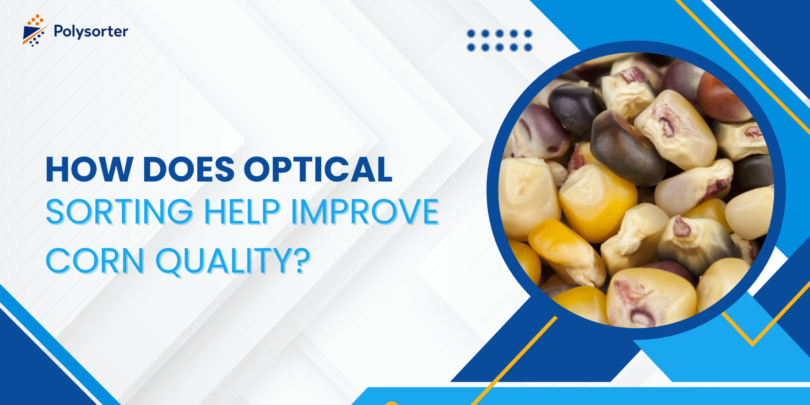
Corn quality directly affects product grading, processing efficiency, and buyer confidence. Yet harvested corn often contains discolored kernels, insect damage, broken grains, and foreign material, even after routine cleaning. Optical sorting for corn helps processors separate many visually detectable defects from usable grain, creating a cleaner and more consistent product stream.
For buyers comparing grain color sorters, the important question is not simply how fast a machine runs. It is whether the equipment can meet a defined quality target without wasting healthy corn. This guide explains where optical sorting adds value, how the technology works, and what to verify before investing.
Why Corn Quality Problems Require More Than Conventional Cleaning
Corn enters processing plants with varying moisture levels, varieties, harvest histories, and storage conditions. These differences can produce inconsistent batches. A shipment may contain dark or stained kernels, visibly mold-affected grain, insect-damaged pieces, and plant fragments. Even a small proportion of obvious defects can affect appearance and customer acceptance when specifications are strict.
Different customers also judge quality differently. Food processors may emphasize appearance and uniformity, while feed producers may focus on usable material, safety requirements, and production economics. In both cases, the buyer needs a repeatable method for separating specified defects rather than relying only on visual spot checks.
Mechanical cleaners remain essential. Screens classify particles by size; aspirators remove lighter material; and gravity separators exploit differences in density. However, a stained kernel can be almost identical in size and weight to an acceptable one. Traditional equipment may therefore leave defects that are visually obvious but physically similar to good grain.
Optical inspection addresses this gap. It evaluates kernels based on detectable appearance or, with appropriate sensors, spectral differences. It complements rather than replaces preliminary cleaning, moisture management, and final quality testing. Establishing this division of labor is the first step toward designing an efficient corn processing line.
How Optical Sorting for Corn Works
A typical chute-type corn color sorter separates kernels in a continuous sequence: controlled feeding, imaging, classification, and targeted ejection. Each stage influences the result.
Feeding and Inspection
Corn enters a vibrating feeder or another controlled distribution system. Kernels move into the inspection area, where cameras capture images under stable lighting. An even layer matters: overlapping kernels can hide defects and make precise rejection harder. Dust on optical windows also reduces image clarity, so cleaning is part of normal operation.
Visible-light cameras distinguish color, brightness, and surface patterns. Depending on camera resolution and software, the system may also use visible shape information to recognize certain broken or malformed kernels. These capabilities are strongest when defects have a detectable contrast with acceptable corn.
Classification and Rejection
Software compares the captured information with configured sorting criteria. Conventional image processing uses defined features or thresholds; AI-assisted recognition can classify more complicated patterns from image data. AI is an analysis method, not a separate sensor: it may operate on visible-light images or other suitable sensor inputs.
When the controller identifies a reject target, timed compressed-air ejectors divert that kernel into a separate stream. Acceptable corn follows the normal discharge path. Accurate timing, reliable air supply, and stable material flow are therefore as important as image recognition.
The sorting recipe should reflect the customer’s target. Removing every unusual-looking kernel is not always economical. Operators normally inspect both the accepted and rejected streams and adjust sensitivity to balance cleanliness against recoverable grain loss.
How Optical Sorting Improves Corn Quality
Better Color Consistency and Fewer Visible Defects
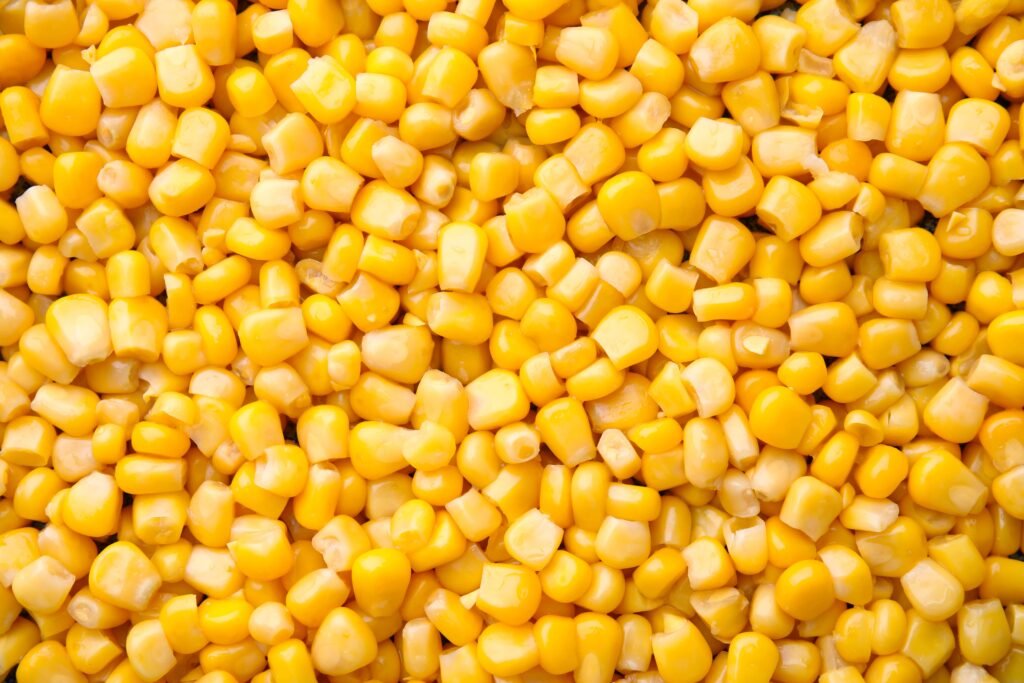
One immediate benefit is a more uniform appearance. The machine can target darkened, stained, or unusually colored kernels that remain after conventional cleaning. With appropriate settings, it may also reject visibly damaged kernels and foreign particles whose appearance differs sufficiently from corn.
The exact range of detectable defects depends on the installed imaging system and the condition of incoming grain.
This can support more consistent customer grading and reduce variation between production batches. However, optical sorting does not restore damaged kernels or correct poor drying and storage practices.
Better Recovery Through Selective Rejection
Optical sorting for corn should improve the accepted fraction without unnecessarily discarding marketable kernels. Increasing sensitivity may remove more defects, but it can also raise the amount of healthy corn in the reject stream. Conversely, settings designed only to maximize throughput may leave unacceptable defects behind.
A useful comparison therefore looks at both purity and recovery. Processors should calculate how many targeted defects remain in the accepted material and how much good grain is lost during ejection.
Where feasible, a second pass through the reject stream may recover acceptable kernels, although the economics depend on additional handling and processing costs.
Support for Contamination-Risk Management
Some visibly mold-affected or damaged kernels can be associated with higher mycotoxin risk. Research has shown that certain validated optical or multispectral approaches can reduce contamination in particular maize lots by rejecting higher-risk kernels.
That does not mean every color sorter measures aflatoxins or fumonisins.
Standard visible-light systems observe surface appearance, not toxin concentrations. Kernels that look normal may still contain mycotoxins, and visibly abnormal kernels are not automatically contaminated.
Even specialized spectral approaches require validation for the grain and contamination pattern being processed. Representative sampling, laboratory testing, and appropriate storage controls remain necessary for food and feed safety decisions.
More Consistent Quality Control
Unlike manual inspection alone, an automated sorter can apply configured criteria across a continuous stream. This helps facilities handling changing incoming corn quality or multiple suppliers.
Consistency still depends on setup, maintenance, periodic sampling, and adjustments when varieties or defect patterns change. Automation makes quality control more repeatable; it does not eliminate the need for operators.
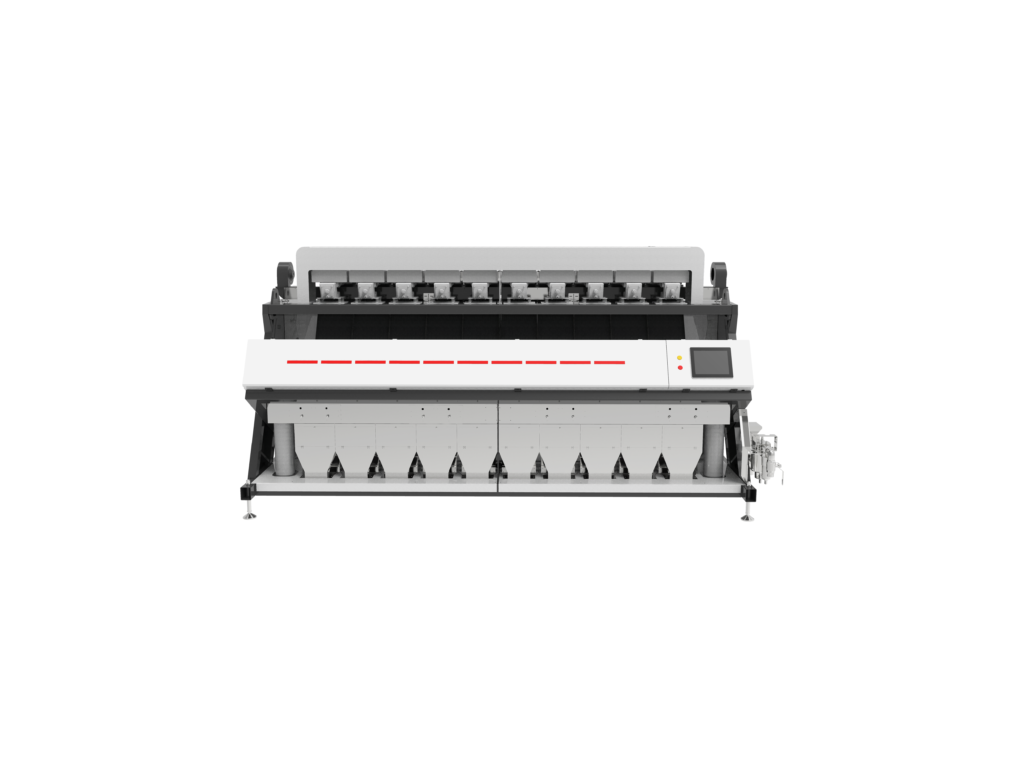
How to Choose the Right Corn Optical Sorting Machine
Choosing among grain sorters starts with the defect, not the technology label.
Buyers should first identify their corn variety, initial defect percentage, desired accepted-product specification, and daily processing requirement. Next, they should ask suppliers to demonstrate performance on representative samples.
Understand What Each Technology Contributes
| Component or Method | What It Does | Practical Buying Consideration |
| Visible-Light Imaging | Captures color and observable surface details | Suitable for visually distinct defects; hidden problems may remain |
| NIR or Other Spectral Sensing | Measures responses at selected wavelengths | May help with certain hard-to-distinguish materials; capability must be demonstrated |
| AI-Assisted Recognition | Classifies patterns in the images or sensor data | An algorithmic capability, not proof of a particular sensor or guaranteed accuracy |
| Compressed-Air Ejection | Physically diverts selected kernels | Requires precise timing, consistent feed, and dependable compressed air |
More sensors or AI functions do not automatically translate into better commercial performance.
A correctly configured visible-light system may satisfy a processor whose main concern is discoloration. More complex raw material may justify additional imaging capabilities, but only testing can establish the benefit.
Evaluate Performance With Measurable Acceptance Criteria
A meaningful sample trial should use corn collected from multiple realistic lots rather than a handful of carefully selected defective kernels.
Record the initial defect content, material moisture, sample mass, and target grade. Then test the machine at a feed rate representative of normal operation.
At minimum, compare these three measures:
- Defect Removal Rate: The proportion of targeted incoming defects diverted from the accepted stream.
- Good Grain Loss: The amount of acceptable corn mistakenly sent into the reject stream, expressed against an agreed basis.
- Throughput at Target Quality: The sustained processing rate while the accepted corn meets the specified defect limit.
Also examine accepted and rejected samples rather than trusting a single advertised accuracy percentage.
For example, a machine may achieve a clean accepted stream by throwing away too much good corn. Another may claim high hourly capacity only under unusually clean feed conditions.
Neither figure alone tells a buyer the cost of meeting the finished-grade requirement.
Ask the supplier to state measurement methods, sampling procedures, number of passes, and whether figures apply to the exact configuration offered. These details make competing quotations easier to compare.
Check Operating and Service Requirements
Beyond purchase price, consider electricity, compressed-air demand, dust management, cleaning access, spare parts, and operator training.
Determine how easily recipes can be adjusted for another corn variety and whether local service support is available.
Total cost per tonne of acceptable output is often a more useful decision metric than headline throughput.
Where Optical Sorting Fits in a Corn Processing Line
A typical dry corn handling process may follow this sequence:
Receiving and Sampling → Preliminary Cleaning → Drying or Conditioning (Where Needed) → Size or Density Separation → Optical Sorting → Final Inspection → Storage or Onward Processing
The exact order varies with the facility and end product.
Placing the sorter after suitable upstream cleaning can reduce unnecessary loading by large debris and fines. Consistent feeding then gives the camera system a clearer view of individual kernels.
For some operations, multiple sorting passes are justified when the quality target is particularly demanding. Each extra pass should be evaluated against recovery, energy, labor, and processing time.
Keep a simple operating record: feed quality, selected recipe, actual throughput, accepted-stream defects, reject-stream good grain, and maintenance observations.
These measurements reveal when incoming conditions change or performance drifts. They also provide evidence for evaluating the return on equipment investment.
Ultimately, the right system is the one that meets a defined grain standard repeatedly while preserving marketable yield.
That is the practical goal of optical sorting for corn, not achieving the most aggressive rejection setting.
Frequently Asked Questions
Can an Optical Sorter Separate Moldy Corn From Healthy Corn?
It can remove some visibly mold-affected kernels if their appearance differs sufficiently from acceptable corn. It cannot detect every contaminated kernel or replace laboratory mycotoxin tests.
Can Corn Color Sorting Damage Healthy Kernels?
Normal optical inspection is non-contact. However, feeding, impacts, and downstream handling can contribute to breakage if the line is not properly configured. Evaluate kernel condition before and after a trial.
How Much Corn Can an Optical Sorting Machine Process Per Hour?
Capacity depends on machine configuration, corn characteristics, defect level, and required final quality. Ask for sustained throughput demonstrated at your target grade rather than a generic maximum figure.
Is Optical Sorting Useful for Both Yellow and White Corn?
Potentially, yes. Each variety needs suitable recognition settings and sample testing because acceptable colors and defect contrasts differ.
Does AI Automatically Make a Grain Sorter More Accurate?
No. AI can improve classification for some challenging visual patterns, but results depend on training, sensors, material conditions, and operating setup. Compare measured outcomes rather than feature labels.
What Is the Difference Between Corn Cleaning and Corn Color Sorting?
Mechanical cleaning mainly separates by physical properties such as size or density. Optical sorting focuses on detectable visual or spectral differences. The methods usually work best together.
Should Rejected Corn Be Sorted Again?
A second pass can sometimes recover healthy kernels from the reject stream. Its value depends on the defect level, recovery achieved, and added processing cost.
What Information Should I Send for a Sorting Test?
Provide representative corn samples, photos of typical defects, approximate incoming quality, desired accepted grade, target hourly capacity, and any special operating constraints.
Conclusion
Improving corn quality calls for both effective defect removal and careful protection of usable grain. Optical sorting can improve visual uniformity, reduce selected impurities, and support more repeatable quality control when paired with conventional cleaning and appropriate testing.
The equipment decision should be driven by representative sample results, realistic operating capacity, and the cost of meeting the required grade.
PolySorter helps grain processors assess practical sorting options for their corn and production targets. Explore our grain sorting solutions or contact PolySorter to discuss a sample-based evaluation.