Plastic flake size directly influences how effectively optical sorting machines detect, classify, and separate materials in plastic recycling. From washed PET flakes to mixed PP and PE fragments, particle dimensions affect sensor recognition, feeding stability, sorting accuracy, and material recovery.
For recycling facilities, this creates an important purchasing consideration: two optical sorting machines with similar advertised capacities may perform differently when processing flakes of different sizes.
A machine handling relatively uniform 10 mm PET flakes may achieve different results when processing 3 mm fragments, even if the polymer composition and contamination levels remain similar. Smaller particles increase the number of individual pieces passing through the system, while larger fragments introduce different feeding and ejection challenges.
Understanding these relationships helps recycling operators evaluate equipment more effectively. This guide explains how particle dimensions influence optical sorting performance, why size distribution matters, and how to select suitable sorting equipment for different recycling applications.
Why Plastic Flake Size Matters in Optical Sorting
Optical sorting machines identify unwanted plastic particles by analyzing their visible appearance or material-specific spectral characteristics. Once a particle is classified, an ejection system separates it from the accepted material stream. The effectiveness of this process depends on whether individual flakes can be reliably detected and physically separated.
Detection Resolution and Effective Particle Area
In visible-light sorting, cameras capture images of plastic flakes and analyze characteristics such as color, transparency, and surface appearance. Larger particles generally occupy more image pixels, allowing the system to collect more visual information. Smaller particles occupy fewer pixels, making subtle differences more difficult to distinguish.
For example, a 10 mm blue PET flake may provide a clearly recognizable color signal, while a 2 mm fragment of the same material occupies a much smaller portion of the detection image. The smaller fragment is not necessarily impossible to identify, but reliable classification requires sufficient effective resolution, suitable illumination, and adequate contrast.
Sensor performance also depends on lens configuration, processing algorithms, and the speed at which particles pass through the detection area.
Particle Movement and Overlapping
Plastic flakes must be distributed so that individual particles remain visible during inspection. In chute-based systems, particle shape and size can influence movement along the feeding path, while conveyor-based systems may offer different presentation conditions for irregular fragments. In both cases, consistent particle spacing is essential for reliable detection.
Large fragments can conceal smaller contaminants, while excessive quantities of fine flakes may form dense clusters. Thin or irregular particles may also rotate or flutter, affecting their presentation to the sensors. Maintaining consistent feeding conditions helps reduce these problems.
Air-Ejection Accuracy and Valve Spacing
Detection alone does not guarantee successful separation. After identifying an unwanted particle, the sorting machine must activate the appropriate air ejector at the correct moment.
The spacing between ejectors, valve response time, airflow coverage, and particle trajectory all influence separation precision. For very small flakes, an air pulse may affect neighboring acceptable particles, increasing unnecessary material rejection.
Larger or heavier fragments may require different air-ejection settings, such as adjustments to pulse duration or airflow, depending on the equipment design. Effective sorting therefore requires coordination between optical detection and physical separation.

How Different Plastic Flake Sizes Affect Sorting Performance
Plastic recycling facilities commonly process materials containing particles of different dimensions. Understanding the behavior of these size categories helps operators identify potential sorting limitations.
Fine Plastic Flakes
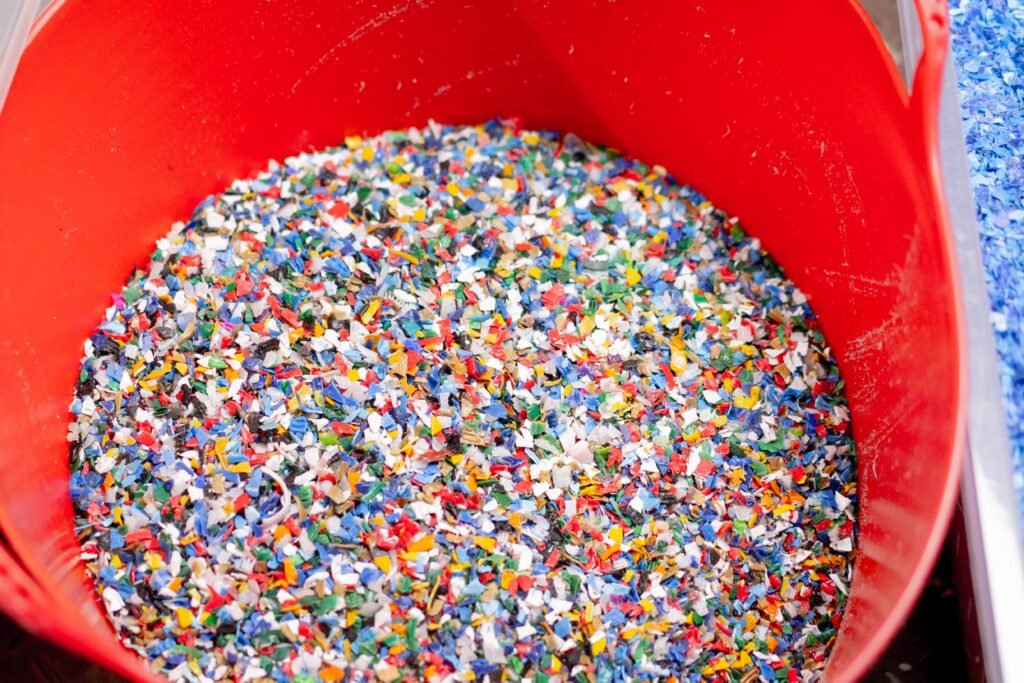
Fine fragments, for example those below approximately 2–3 mm, can create demanding sorting conditions because they provide limited detectable surface area and require precise ejection.
Dust, moisture, and surface contamination may also have a greater influence on small particles. When fine flakes accumulate in dense groups, individual recognition becomes more difficult, and air ejection may remove neighboring acceptable material.
Suitable high-resolution detection and carefully controlled feeding can help address these challenges.
Standard Washed PET Flakes
Washed PET flakes around 6–12 mm provide a useful example of moderately sized recycling material. Within a suitable equipment configuration, these dimensions may offer sufficient optical surface area for color recognition while allowing relatively consistent feeding and separation.
However, particle thickness, shape, transparency, and contamination remain important. A uniform batch of PET flakes can behave differently from another batch with the same nominal size but a greater proportion of thin, curled, or irregular fragments.
Large and Irregular Fragments
Larger plastic fragments, for example those above approximately 15–20 mm, generally provide more surface area for optical inspection, but their movement and separation can become less predictable.
Irregular pieces may rotate, bounce, or overlap smaller particles. Heavier fragments can also respond differently to compressed-air ejection. Depending on the equipment, larger particles may require adjustments to feeding conditions or separation settings.
Why Particle Size Distribution Matters
Average particle size alone does not describe how easily a material stream can be sorted. Consider two batches with an average flake size of approximately 10 mm. One contains relatively uniform particles, while the other combines fine fragments with oversized pieces.
The second batch may produce more overlap and inconsistent movement, even though both have similar average dimensions.
| Flake size category | Typical challenge | Sorting consideration |
| Fine flakes (e.g., below 2–3 mm) | Limited detection area and precise ejection | Sensor resolution and ejector selectivity |
| Medium flakes (e.g., around 6–12 mm) | Maintaining consistent separation | Feeding uniformity and optical contrast |
| Large fragments (e.g., above 15–20 mm) | Irregular movement and variable mass | Particle trajectory and air-ejection control |
| Mixed-size material | Overlap and inconsistent presentation | Screening and particle-size distribution |
These ranges are illustrative processing examples rather than universal industry limits or guaranteed operating ranges for specific sorting equipment.
How Plastic Flake Size Affects Color Sorting and NIR Detection
Different optical sorting technologies use different information to classify plastic particles. Their sensitivity to particle dimensions can therefore vary.
Visible-Light Color Sorting
Visible-light sorting systems use cameras and controlled illumination to identify differences in color, transparency, and appearance. Common applications include separating clear PET from blue or green PET, removing visibly discolored flakes, and identifying unwanted particles with distinguishable colors.
Particle size affects how much visual information reaches the camera. A larger colored fragment may produce a stronger image signal, while an extremely small particle may be difficult to distinguish when its color closely resembles the surrounding material.
However, contrast also matters. A small dark fragment against a suitable background may be easier to recognize than a larger transparent particle with only a slight color difference.
Transparent plastics introduce additional challenges because their appearance changes with thickness, lighting direction, and background conditions. The ability to identify subtle differences in transparent flakes therefore depends partly on the optical system’s illumination and image-processing design.
NIR Polymer Identification
Visible appearance alone cannot reliably identify every plastic polymer. For example, transparent PET and PVC flakes may look similar under conventional color inspection.
Near-infrared (NIR) sorting systems analyze characteristic spectral responses to distinguish certain polymer types. Depending on the sensor configuration and application, NIR technology can support the identification of PET, PP, PE, PVC, PS, and other plastics.
Small flakes may provide fewer usable spectral measurements, particularly when their dimensions approach the effective spatial sampling limits of the system.
NIR sensors and visible-light cameras may also have different spatial resolutions, measurement methods, and optical requirements. Their minimum effective particle sizes should therefore be assessed separately.
Material thickness, moisture, surface contamination, and pigmentation can further influence spectral recognition.
Combining Color and Polymer Identification
Some recycling applications require both color purification and polymer separation. A PET recycling facility, for example, may need to remove colored PET fragments and visually similar non-PET contaminants.
Visible-light sorting can identify suitable color differences, while polymer-sensitive detection can address certain contaminants that cannot be reliably distinguished by appearance alone.
Combining these technologies can improve the range of separation tasks performed, but successful sorting still depends on appropriate particle dimensions, material presentation, and ejection accuracy.
How to Optimize Plastic Flake Size for Better Sorting Results
Improving optical sorting performance often begins with better material preparation. Screening, washing, drying, and feeding control can help create more consistent conditions before plastic flakes reach the sorting machine.
Control Particle Size Distribution
Mechanical screening can separate excessive fines and oversized fragments from the main material stream. This reduces extreme size differences and helps maintain more predictable feeding behavior.
Oversized material may be redirected for additional size reduction, while fine particles may require separate handling depending on the recycling process. The objective is to create a particle-size distribution compatible with the equipment rather than force every flake into an identical shape.
Maintain Clean and Dry Material
Dust, labels, dirt, and moisture can interfere with optical recognition. Small particles are particularly sensitive because contamination may cover a significant portion of their detectable surface.
Residual moisture can also cause flakes to stick together, increasing overlap and reducing feeding consistency. Effective washing, drying, and dust management help maintain stable inspection conditions.
Understand the Relationship Between Size and Throughput
Particle size influences throughput because smaller flakes generally increase the number of individual particles processed at a given material mass.
For a simplified example, if otherwise identical particles are reduced to half their original length in all three dimensions, each particle has approximately one-eighth of the original volume. At the same total mass, the sorting system would therefore encounter roughly eight times as many particles.
Real plastic flakes have irregular shapes and thicknesses, so this calculation is illustrative rather than a direct prediction of machine capacity. Nevertheless, it demonstrates why fine material can create greater demands on detection, classification, and ejection.
When optical sorters operate with a near-monolayer material presentation, smaller or thinner flakes may reduce the mass carried per unit inspection area. Consequently, maintaining the same throughput in kg/h can require higher particle handling rates or different feeding conditions.
Increasing feed density beyond suitable conditions may cause overlap and reduce sorting effectiveness. This is why processing capacity should be evaluated using representative material under realistic operating conditions, rather than relying solely on advertised throughput or nominal flake size.
Balance Purity, Recovery, and Processing Capacity
A sorting machine should not be evaluated using throughput alone. Three performance indicators are particularly important:
Product purity: The proportion of desired material in the accepted output.
Material recovery: The proportion of desired input material retained in the accepted output.
Throughput: The quantity of material processed within a defined period.
Higher feed rates may increase production capacity, but excessive particle density can reduce sorting quality. Similarly, aggressive rejection settings may improve purity while increasing the loss of acceptable plastic.
The most effective operating conditions balance all three indicators according to the recycling facility’s requirements.
How to Choose a Plastic Flake Sorting Machine
Selecting optical sorting equipment requires more than comparing camera specifications or advertised processing capacity. Buyers should evaluate how each machine performs with their actual material, including its particle-size distribution, contamination characteristics, and required output quality.
Confirm the Effective Particle Size Range
Before purchasing equipment, identify the minimum, maximum, and typical dimensions of the plastic flakes being processed. Particle thickness, shape, and material composition should also be considered.
The sorting system must provide sufficient detection and separation capability for the relevant material range. A machine optimized for larger flakes may not deliver equivalent performance when processing fine fragments.
Match Sensor Technology to the Separation Task
Color sorting and polymer identification address different contamination problems.
Visible-light systems are appropriate for detecting suitable differences in appearance, while NIR-based systems can distinguish certain polymers with similar visible characteristics. For facilities processing mixed plastics, combined detection or multi-stage sorting may be useful.
The selection should follow the actual contamination profile rather than the number of sensors advertised.
Compare Equipment Using Representative Material Tests
Two machines with similar advertised capacities may produce different results when processing the same plastic flakes.
For example, a sorter tested with clean, uniform 10 mm PET flakes cannot be directly compared with another tested using mixed-size material containing dust and contamination. Meaningful equipment comparisons require similar feed conditions and clearly defined performance measurements.
| Test parameter | Purchasing significance |
| Particle size distribution | Confirms material suitability |
| Feed contamination level | Establishes sorting difficulty |
| Throughput (kg/h) | Measures practical processing capacity |
| Accepted-product purity (%) | Evaluates output quality |
| Target-material recovery (%) | Measures acceptable plastic retention |
| Acceptable material in rejects | Identifies unnecessary material losses |
A machine achieving higher purity may still be less economical if it rejects substantially more acceptable plastic. Likewise, higher throughput provides limited benefit if the accepted material fails to meet the required quality standard.
Representative sample testing allows buyers to evaluate these trade-offs under realistic processing conditions.
Consider the Entire Recycling Line
Optical sorting performance is influenced by upstream processes, including shredding, washing, screening, drying, and material handling.
A facility experiencing poor separation may benefit from improving particle preparation rather than immediately replacing its sorting equipment.
Evaluating the complete recycling process helps determine whether the main limitation involves particle dimensions, feeding conditions, sensor capability, or ejection performance.
Frequently Asked Questions About Plastic Flake Size
What is the ideal plastic flake size for optical sorting?
The most suitable size depends on the machine’s detection and separation capabilities. Washed PET flakes around 6–12 mm provide one processing example, but this range is not a universal optimum or equipment specification.
Can optical sorting machines detect flakes smaller than 3 mm?
Some systems can process fine particles, but reliable detection and separation depend on sensor resolution, particle presentation, and ejection precision. Actual capability should be confirmed through representative testing.
Does smaller flake size always reduce sorting accuracy?
No. Smaller flakes can increase detection and separation demands, but sorting performance also depends on optical contrast, sensor configuration, feeding conditions, and material characteristics.
Does flake size affect NIR polymer sorting?
Yes. Particle dimensions influence the amount of usable spectral information available for polymer identification. Small or thin flakes may require more demanding sensing conditions.
Should plastic flakes be screened before optical sorting?
Screening can improve material presentation when the feed contains excessive fines, oversized fragments, or a broad particle-size distribution. Its value depends on the recycling process and sorting equipment.
How does particle size affect sorting throughput?
Smaller flakes generally increase the number of particles processed per unit mass, placing greater demands on detection and ejection. When maintaining a near-monolayer feed, smaller or thinner flakes may also reduce achievable mass throughput (kg/h), depending on particle geometry and equipment configuration.
Conclusion: Match Plastic Flake Size with the Right Sorting Technology
Plastic flake size affects optical sorting through several connected factors, including detection resolution, spectral signal quality, particle movement, feeding density, and air-ejection precision.
Fine particles may require more demanding detection and separation conditions, while larger fragments can introduce different mechanical challenges. A broad particle-size distribution may further reduce processing consistency.
For recycling facilities, the objective is to match actual material characteristics with suitable sorting technology and operating conditions. Evaluating purity, recovery, and throughput together provides a more reliable basis for equipment selection.
At PolySorter, we help plastic recycling businesses evaluate optical sorting solutions based on their actual material characteristics and processing requirements. Share your plastic type, flake size distribution, contamination profile, target purity, and required throughput with our team to discuss a suitable sorting solution or arrange a representative sample test for your recycling line.