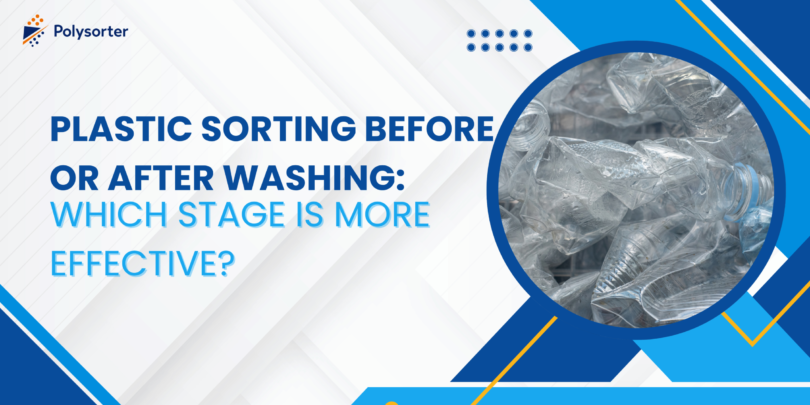
Mixed plastic waste may look like a single material stream, but it can contain PET bottles, HDPE containers, PP packaging, PVC fragments, PS products, ABS components, films, labels, and other materials. For recyclers, removing visible contamination is only part of the job. When the goal is to produce a cleaner, higher-value recycled fraction, plastics often need to be separated according to their polymer type.
So, how to separate mixed plastics by polymer type efficiently?
There is no single separation method that works equally well for every recycling stream. Density separation can divide certain plastics according to physical properties. Visible-light sorting can separate materials by color and appearance. When different polymers look almost identical, sensor-based material identification, particularly near-infrared (NIR) sorting, can provide another level of separation.
The right process therefore starts with the material itself: which polymers are present, what form they are in, how clean they are, and what purity the final recycled fraction needs to achieve.
Why Separate Mixed Plastics by Polymer Type?
Different polymers have different chemical structures, melting characteristics, densities, and processing behaviors. Mixing incompatible plastics can reduce the consistency and value of recycled material.
PET recycling provides a useful example. Clear PET and clear PVC fragments can appear very similar, yet even a relatively small amount of PVC contamination can create serious problems during PET recycling.
PET is typically processed at relatively high temperatures. PVC is less thermally stable under these conditions and can begin to degrade, potentially releasing hydrogen chloride (HCl). This contamination can contribute to discoloration, material degradation, and processing problems in the recycled PET stream.
This is why PET/PVC separation is not simply a matter of improving appearance. It can be an important purification step before downstream reprocessing.
The same principle applies to other mixed plastics. PP and PE may have similar colors and shapes, while ABS, PS, and other engineering plastics can also be difficult to distinguish through appearance alone.
The important question is:
Is the sorting problem based on color, visible contamination, or polymer identity?
If the problem is color, visible-light optical sorting may be appropriate. If visually similar materials must be distinguished by polymer type, material-sensitive detection becomes much more important.
How to Separate Mixed Plastics Using Different Technologies
A mixed-plastic recycling line normally uses several complementary processes rather than relying on one separation method.
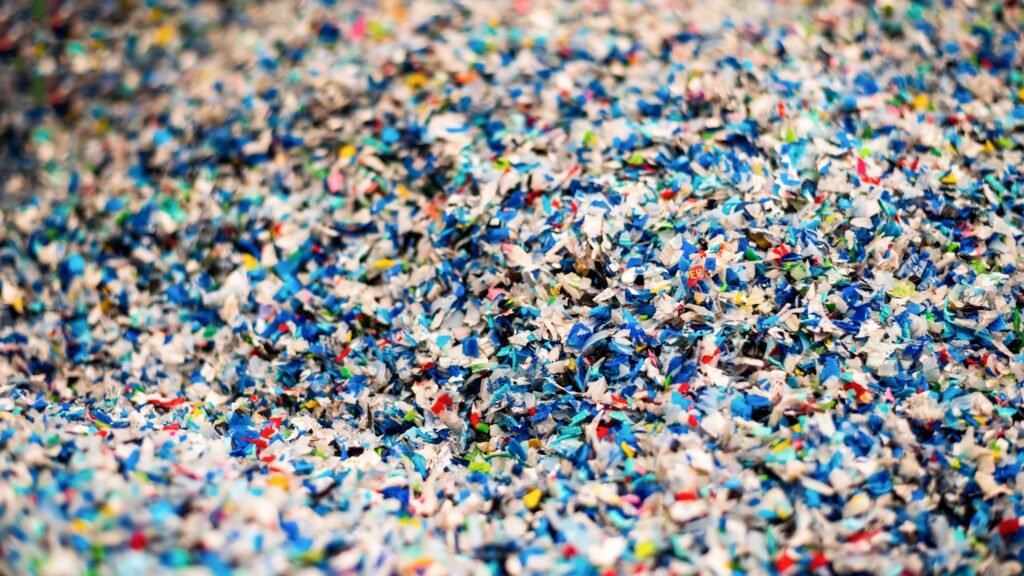
Mechanical preprocessing may include screening, shredding, washing, drying, and removing metals or other non-plastic contaminants. The exact sequence depends on whether the feed consists of whole containers, rigid pieces, flakes, films, or another material form.
After preparation, different separation technologies can perform different jobs.
Density Separation and Float-Sink Sorting
Density separation uses differences in physical density to divide plastics. Float-sink separation in water is one of the most common examples.
Many polyolefins, including PP and PE, typically have densities below approximately 1.0 g/cm³ and therefore tend to float in water. Denser plastics such as PET and PVC generally sink.
In a simplified mixed-plastic stream, the process may therefore look like:
Mixed Plastics → Float Fraction: PP + PE → Sink Fraction: PET + PVC and other denser materials
This makes float-sink separation useful for dividing broad groups of plastics. However, the same example also demonstrates an important limitation.
Because both PP and PE generally enter the floating fraction, ordinary water-based float-sink separation does not reliably distinguish PP from PE. Likewise, density separation alone does not necessarily provide the individual polymer fractions required for higher-purity recycling.
Additives, fillers, contamination, and modified material formulations can further affect density behavior.
Therefore, if a recycler needs to separate a mixed PP/PE fraction into individual polymer-rich streams, another identification technology may be required. NIR sorting is one option because it analyzes polymer characteristics rather than relying only on whether the plastic floats or sinks.
Visible-Light and Color Sorting
Optical color sorting analyzes visible characteristics such as:
- Color and shade
- Transparency
- Brightness
- Shape
- Surface appearance
- Visible defects
It is particularly useful when the polymer is already known but different visual fractions need to be separated. For example, a recycling plant may need to separate clear PET flakes from colored PET.
The limitation appears when two polymers look alike.
A clear PET flake and a clear PVC flake may have very similar visible characteristics. PP and PE materials can create the same problem. In these situations, a conventional color camera does not directly determine the polymer chemistry.
This is where NIR polymer identification becomes useful.
How NIR Separates Mixed Plastics by Polymer Type
Near-infrared sorting identifies plastics differently from ordinary color sorting.
Instead of relying only on visible appearance, an NIR system illuminates the material and analyzes its spectral response. Different polymer structures interact with near-infrared radiation differently, producing information that can be used for material classification.
Depending on the sensor configuration, material condition, and sorting task, NIR-based systems can be configured to distinguish a range of common polymers, including PET, PE, PP, PVC, PS, ABS, and selected engineering plastics. Some sorting applications can also combine polymer recognition with visible characteristics when both material type and appearance need to be considered.
A practical way to select the technology is to start with the actual separation objective:
| Sorting Goal | Main Challenge | Typical Technology |
| Clear PET vs. colored PET | Same polymer, different color | Visible-light sorting |
| PET vs. PVC | Similar appearance, different polymer | NIR polymer sorting |
| PET vs. PE/PP | Polymer contamination | NIR polymer sorting |
| PP-rich vs. PE-rich fractions | Similar density and appearance | NIR sorting, subject to material testing |
| Mixed polymers + mixed colors | Polymer and color differences | NIR + visible-light sorting |
| Carbon-black plastics | Weak conventional NIR response | Application-specific evaluation |
In a typical sensor-based process, mixed material is distributed across the feeding system so individual pieces can be inspected as clearly as possible. The detection system analyzes each passing object or flake. Classification software determines whether it belongs in the selected fraction, and the ejection system separates the targeted material from the main stream.
This process happens continuously at production speed.
However, the presence of an NIR sensor does not guarantee the same performance for every plastic stream. Particle size, material presentation, surface contamination, moisture, polymer composition, and the percentage of target material can all affect the result.
For this reason, representative material testing is particularly valuable when selecting equipment.
Building an Effective Mixed Plastic Polymer Separation Process
A polymer sorting machine performs best as part of a properly designed recycling process.
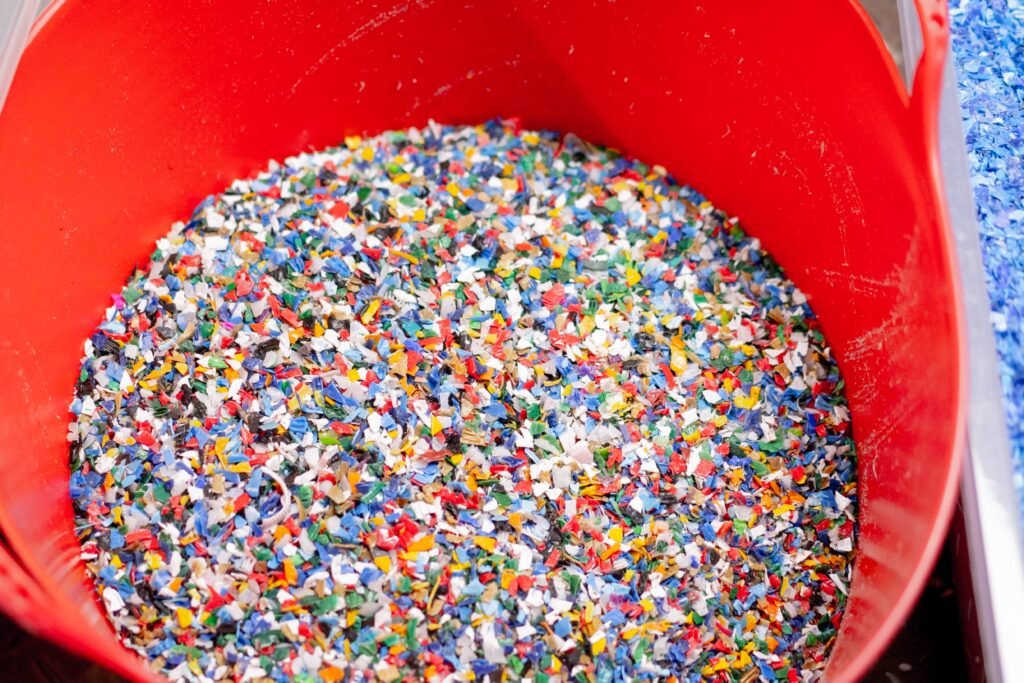
For sensor-based sorting, material presentation matters. Heavy overlap can make individual pieces more difficult to inspect. Excessive dust, moisture, labels, residues, and inconsistent particle sizes may also influence detection and separation performance.
A typical process may include:
Pre-sorting → Size Reduction → Washing → Drying → Material Preparation → Polymer Sorting → Color Purification → Final Quality Control
This sequence is not fixed.
Some recycling facilities remove selected polymers while bottles or rigid objects are still intact. Others shred and wash the material first, then use flake sorting for final polymer purification. The right position depends on the incoming waste and desired output.
For example, a recycler producing clear recycled PET may face two separate problems. First, non-PET polymers such as PVC or PE must be removed. Second, colored PET may need to be separated from clear PET.
These are not the same sorting task.
Polymer identification handles material differences, while visible-light sorting handles visual differences. When both matter, a recycling line may benefit from combining the two approaches.
One Sorting Pass Is Not Always Enough
Another common misconception is that mixed PET, PP, PE, PVC, and other plastics can always enter one machine and immediately leave as several high-purity fractions.
Industrial separation is often more complex.
A plant may first recover or purify one target polymer. The remaining material can then move to another sorting stage. Alternatively, the recovered fraction may pass through additional purification when higher quality is required.
A relatively simple process might look like:
Mixed Plastics → Target Polymer Recovery → Secondary Purification → Final Product
A more complex mixed stream might require:
Mixed Plastics → PET Separation → Remaining Mixed Stream → PP/PE Separation → Further Purification
The actual configuration depends on the feed composition and commercial objective. A plant producing a polymer-rich fraction may have different requirements from a facility preparing feedstock for more demanding downstream recycling applications.
For this reason, single-pass recovery, multi-pass purification, and multi-stage polymer separation should be evaluated according to the required output rather than treated as universally interchangeable solutions.
What About Black Plastics?
Black plastics require special consideration.
Many traditional black plastics contain carbon black pigment. Carbon black absorbs much of the near-infrared radiation used by conventional NIR systems. As a result, the sensor may receive insufficient reflected spectral information for reliable polymer classification.
This does not mean that every dark plastic is impossible to sort. Some materials use NIR-detectable pigments, while other sensing approaches may be considered for certain applications.
However, a large proportion of carbon-black material should be treated as a specific technical requirement rather than assumed to behave like ordinary light-colored plastics.
If black or very dark plastics form an important part of the feedstock, they should be included in representative sample testing before equipment configuration is finalized.
How to Choose a Plastic Sorting Machine for Mixed Plastics
When comparing plastic sorting machines, start with the waste stream rather than the machine specification sheet.
First, define the feed material. Is it made up of whole bottles, rigid pieces, washed flakes, or pellets? Is PET the dominant polymer, or is the feed genuinely mixed with PP, PE, PVC, PS, ABS, or other materials?
Next, define what the machine must actually accomplish.
A statement such as:
“We process mixed plastic flakes.”
provides limited information.
A more useful description would be:
“Our feed mainly contains PP and PE flakes with smaller quantities of ABS and PS, and our target is a PP-rich output.”
That immediately establishes the sorting objective.
For equipment selection, buyers should evaluate:
- Target polymer and unwanted polymers
- Material form and particle-size range
- Approximate feed composition
- Contamination level
- Presence of black or dark plastics
- Surface cleanliness and moisture
- Required throughput
- Target recovery and output purity
- Need for polymer identification, color sorting, or both
- Need for one sorting pass or multiple purification stages
Headline throughput and accuracy figures should also be treated carefully. Real-world sorting performance depends on feed composition, contamination level, material presentation, operating conditions, and required product quality.
A better procurement approach is to provide representative samples and define the desired accept and reject fractions. Material testing can then determine whether the proposed sensing configuration and sorting process match the actual recycling application.
FAQ: How to Separate Mixed Plastics by Polymer Type
Can mixed plastics be automatically separated by polymer type?
Yes. Sensor-based sorting can identify and separate many common polymers. Depending on the application and system configuration, this can include PET, PE, PP, PVC, PS, ABS, and other selected plastics. Actual performance should be evaluated according to the feed material and sorting target.
Can a color sorter separate PET, PP, and PE?
Not reliably based on polymer composition alone. Color sorting mainly analyzes visible characteristics such as color, transparency, and surface appearance. When visually similar materials need to be distinguished by polymer type, NIR or another suitable material-identification technology may be required.
Can NIR separate PP from PE?
NIR-based systems can distinguish spectral differences between PP and PE under suitable conditions. However, particle presentation, contamination, material form, sensor configuration, and required final purity all influence practical sorting performance. Representative testing is recommended for PP/PE separation projects.
Can float-sink separation separate PP from PE?
Not reliably in an ordinary water-based process. Both PP and PE generally have densities below that of water and tend to enter the floating fraction. Float-sink separation can therefore help separate PP/PE from denser plastics such as PET and PVC, but additional identification may be needed to separate PP from PE.
Should plastics be sorted before or after shredding?
Both approaches are used. Whole-object sorting can remove selected materials before size reduction, while flake sorting can provide additional purification after shredding, washing, and drying. The better position depends on the incoming material and required output.
Can NIR identify black plastics?
Conventional NIR can have difficulty identifying plastics containing carbon black because the pigment strongly absorbs near-infrared radiation. Dark-plastic applications should therefore be evaluated separately rather than assuming the same performance as conventional light-colored materials.
Choosing the Right Polymer Separation Strategy
Understanding how to separate mixed plastics by polymer type is ultimately about matching the technology to the material rather than searching for one universal sorting method.
Density and float-sink separation can divide broad material groups based on physical properties, but they cannot solve every polymer-separation problem. Visible-light sorting separates plastics according to color and appearance. NIR sorting adds polymer identification when visually similar or similarly behaving plastics need to be distinguished.
For more complex recycling streams, these methods can complement one another. The best starting point for equipment buyers is therefore a clear definition of the incoming material, target polymer, unwanted contaminants, required throughput, and expected output quality.
This makes it much easier to determine whether the project requires density separation, color sorting, NIR polymer identification, multiple sorting stages, or a combination of technologies.
PolySorter provides sensor-based sorting solutions for plastic recycling, including polymer identification, plastic flake purification, color sorting, and mixed-plastic separation. Contact PolySorter with information about your material, target fraction, and processing requirements, or provide representative samples for evaluation to determine a suitable sorting approach for your recycling process.