Not every mineral deposit is suitable for automated sorting. Some ores contain clear differences between valuable minerals and waste rock, making separation relatively straightforward. Others have complex mineral compositions that require more advanced detection technologies or additional processing.
Understanding what makes an ore suitable for sensor-based sorting is essential before investing in mineral sorting equipment. The right technology can help mining operations reject unwanted material, improve feed quality, and reduce unnecessary downstream processing. However, the results depend heavily on the characteristics of the ore itself.
Sensor-based sorting identifies individual mineral particles using measurable properties such as color, surface appearance, X-ray attenuation, or elemental composition. It then separates selected particles according to predefined sorting criteria.
While modern sorting systems offer increasingly sophisticated detection and classification capabilities, technology alone cannot guarantee effective separation. Mineral distribution, particle size, feed conditions, and economic requirements all influence the outcome.
This guide explains how to evaluate ore sortability, compare sensor technologies, and determine whether a mineral deposit is a promising candidate for automated sorting.
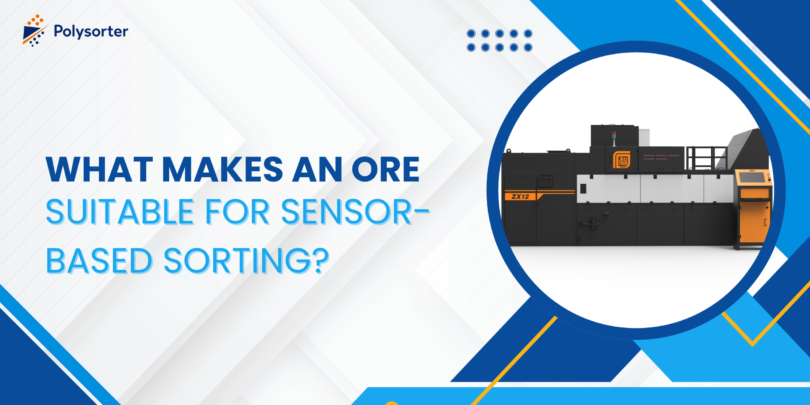
What Makes an Ore Suitable for Sensor-Based Sorting?
The most important requirement for successful ore sorting is a detectable difference between particles worth keeping and those that should be rejected.
However, not every physical difference provides useful separation information. The detected characteristics must also relate to mineral quality or economic value.
Mineral Heterogeneity and Grade Distribution
Mineral heterogeneity describes how mineral content varies within a deposit and between individual particles.
For sensor-based sorting, particle-level variation is especially important.
Consider two hypothetical deposits.
In the first deposit, valuable minerals are concentrated in certain rocks, while other rocks contain relatively little recoverable material. This creates an opportunity to remove low-value particles before further processing.
In the second deposit, valuable minerals are distributed almost uniformly throughout every rock. Rejecting individual particles could result in significant mineral losses.
The first deposit is generally more promising for coarse pre-concentration.
This explains why ore grade alone does not determine sorting suitability. Even relatively low-grade deposits may benefit from sorting when valuable and unwanted material occur in distinguishable particles.
Mineral Liberation and Detectable Differences
Traditional mineral processing often requires grinding ore until individual mineral grains become sufficiently liberated.
Sensor-based particle sorting works differently.
Complete mineral-grain liberation is not always necessary. Instead, valuable and unwanted material must be distributed among particles in a way that creates a useful classification signal.
A rock containing both valuable minerals and gangue may still be accepted when its measurable characteristics indicate sufficient economic value.
Potential detection characteristics include:
- Visible color and brightness differences
- Distinctive surface textures or patterns
- Differences in X-ray attenuation
- Elemental composition detectable by suitable sensors
The key requirement is a reliable relationship between sensor response and the intended separation target.
Ore Sortability Checklist
Before selecting equipment, buyers can use the following checklist to evaluate preliminary sorting potential.
| Evaluation Factor | Key Question | Favorable Indication |
| Mineral Distribution | Do individual particles contain different amounts of valuable minerals? | Clear particle-level variation |
| Detectable Contrast | Can sensors distinguish valuable particles from waste? | Consistent, measurable differences |
| Particle Size | Can the material be prepared within a practical sorting range? | Controllable size distribution |
| Feed Condition | Can particles be presented consistently? | Stable feeding with limited overlap |
| Recovery Potential | Can waste be rejected without excessive mineral losses? | Acceptable valuable-mineral recovery |
| Economic Value | Will sorting benefits exceed the additional costs? | Positive projected operating benefit |
A favorable preliminary assessment does not guarantee success. Representative sample testing remains necessary.
How Ore Characteristics Affect Sensor-Based Sorting Performance
Once a useful detection signal has been identified, the next question is whether the material can be processed consistently under industrial conditions.
Several physical characteristics influence the accuracy and efficiency of separation.
Particle Size and Size Distribution
Particle size affects sensor detection, material presentation, and rejection accuracy.
Larger rocks are easier to handle individually, but they may contain mixtures of valuable and waste minerals. Smaller particles may allow more selective separation, although they can create additional feeding and detection challenges.
Extremely fine particles may also require specialized handling systems and can reduce practical processing capacity.
A controlled particle-size distribution generally improves sorting consistency.
When large and small particles enter the same sorting zone, smaller particles may become hidden behind larger rocks. This can reduce detection reliability.
Therefore, crushing and screening are often important preparation stages.
The optimal particle-size range depends on the mineral characteristics, detection technology, and equipment configuration.
Surface Condition and Moisture Content
Surface contamination can interfere with optical recognition.
Dust, clay, and mineral coatings may conceal the natural appearance of ore particles. For example, a light-colored quartz particle covered with dark material may be incorrectly identified as an impurity.
Cleaning can improve detection when surface characteristics are important.
Moisture also affects material handling. Wet particles may stick together or adhere to conveying surfaces, making consistent separation more difficult.
However, wet material is not automatically unsuitable for sorting. Some equipment configurations are specifically designed for wet processing.
The decision between dry and wet sorting should consider particle size, material adhesion, feeding stability, and process requirements.
Feed Uniformity and Ore Variability
Sorting systems require stable material presentation to classify and separate individual particles effectively.
Excessive feed rates, overlapping particles, and inconsistent material trajectories can reduce performance.
Ore variability creates another challenge.
Mineral composition, oxidation, and impurity content may change between geological zones. As a result, sorting parameters that perform well on one sample may be less effective on another.
Representative testing should account for these variations before equipment selection.
Choosing the Right Sensor Technology for Different Ore Types
Determining whether an ore is suitable for sensor-based sorting also requires selecting a detection method that matches its measurable characteristics.
Different technologies recognize different material properties. Choosing the wrong sensor can limit separation performance, even when the mechanical equipment operates correctly.
Optical Sorting for Visible Mineral Differences
Optical sorting uses cameras and image-processing algorithms to identify differences in color, brightness, shape, or surface appearance.
It can be particularly useful for industrial minerals with visually distinct impurities.
For example, optical recognition may separate visibly discolored particles from a predominantly light-colored quartz feed.
Potential applications include quartz, feldspar, calcite, and other minerals where visible characteristics correlate with product quality.
However, optical sensors cannot reliably identify hidden mineral composition when the relevant differences are not visible at the surface.
X-Ray Transmission Sorting for Internal Contrast
X-ray transmission, commonly known as XRT, analyzes how X-rays are attenuated as they pass through individual particles.
The signal is influenced by material composition, density, and particle thickness.
XRT may be suitable for ores where valuable and unwanted rocks exhibit sufficiently different attenuation responses, even when their external appearance is similar.
Potential applications include selected tungsten, copper, iron, and manganese ores.
However, XRT does not directly measure mineral grade. Similar attenuation responses can make different materials difficult to distinguish.
X-Ray Fluorescence for Elemental Identification
X-ray fluorescence, or XRF, detects characteristic X-rays emitted by elements within the measurement region.
This allows suitable systems to classify materials according to detectable elemental signatures.
XRF may be useful when differences in elemental composition provide reliable separation information.
However, measurement depth, surface condition, particle geometry, and detection limits affect its performance.
Because XRF measurements are often surface-sensitive, the detected composition may not represent the entire rock.
Sensor Technology Comparison
| Technology | Detection Principle | Suitable Characteristics | Main Limitation |
| Optical Sorting | Visible color and surface features | Distinctive coloration or visual impurities | Cannot reliably detect hidden composition |
| XRT Sorting | X-ray attenuation differences | Contrasting internal material properties | Similar attenuation may limit separation |
| XRF Sorting | Elemental fluorescence | Detectable elemental differences | Surface sensitivity and measurement constraints |
| Multi-Sensor Sorting | Combined sensor information | Multiple complementary material characteristics | Greater system complexity |
How should buyers choose?
If valuable and unwanted particles have reliable visible differences, optical sorting is a logical starting point.
If their appearance is similar but X-ray attenuation differs, XRT deserves evaluation.
If elemental composition provides the strongest distinction, XRF may be appropriate.
When no available sensor can establish a useful relationship with mineral value, additional processing or another beneficiation method may be necessary.
AI-based recognition can improve classification of complex patterns, but it cannot recover information that the sensors do not detect.
The best technology is the one that provides reliable separation under realistic operating conditions, not necessarily the most sophisticated system.
Which Minerals Are Good Candidates for Sensor-Based Ore Sorting?
Many industrial minerals and metallic ores can potentially benefit from automated sorting. However, suitability depends on the characteristics of the individual deposit rather than the mineral name alone.
Industrial Minerals
Industrial minerals often require consistent product appearance, purity, and impurity control.
Quartz: Optical sorting may remove visibly discolored particles or contrasting impurities. Performance depends on whether these visual differences correlate with product quality.
Feldspar: Distinctive mineral coloration and impurities may create opportunities for optical separation.
Calcite and Limestone: Detectable differences between acceptable material and unwanted rock can support preliminary upgrading.
Fluorite: Optical or X-ray-based methods may be evaluated depending on mineral associations and detectable contrast.
For these applications, the objective may be improving product consistency rather than maximizing metal recovery.
Metallic Ores
Metallic ores can offer valuable pre-concentration opportunities when mineralized and barren particles respond differently to suitable sensors.
Potential applications include tungsten, copper, iron, manganese, and lead-zinc ores.
For example, mineralized rocks may produce different X-ray attenuation responses from surrounding gangue material.
However, complex mineral associations can complicate classification.
Two visually similar rocks may contain very different valuable-mineral concentrations. Conversely, rocks with different appearances may have comparable economic value.
Therefore, mineralogical analysis and sorting trials are essential.
Complex and Low-Grade Ores
Low-grade deposits may benefit from waste rejection before energy-intensive processing.
Nevertheless, low grade alone does not establish sorting potential.
When valuable minerals are finely disseminated throughout almost every particle, coarse separation may produce unacceptable losses.
Additional crushing, alternative sensors, or conventional beneficiation may offer better results.
The objective is not simply to reject the greatest possible quantity of material. It is to remove economically unnecessary mass while retaining an acceptable proportion of valuable minerals.
How to Test Ore Sortability Before Investing in Equipment
Before purchasing equipment, operators should evaluate whether an ore suitable for sensor-based sorting can achieve technically reliable and economically meaningful separation.
A structured testing process helps reduce investment uncertainty.
Step 1: Define the Sorting Objective
Start by identifying the desired outcome.
Common objectives include removing barren rock, improving feed grade, reducing visible impurities, or lowering downstream processing requirements.
Clear objectives establish meaningful testing criteria.
Step 2: Prepare Representative Samples
Collect samples that reflect expected production conditions.
Important information includes mineral composition, particle-size distribution, feed grade, moisture condition, and material variability.
Samples from different geological zones can help reveal changes in sorting performance.
Step 3: Conduct Detection and Sorting Trials
Initial tests should determine whether the selected sensor can reliably distinguish target materials.
Subsequent trials should evaluate actual separation performance.
Different feed rates, particle-size fractions, and sorting settings may be compared.
Repeatability is important because a single successful demonstration does not establish industrial reliability.
Step 4: Evaluate Mass Balance and Mineral Recovery
Sorting performance should be evaluated using several indicators together.
| Indicator | Meaning | Evaluation Purpose |
| Mass Rejection | Percentage of feed mass rejected | Measures waste removal |
| Valuable-Mineral Recovery | Valuable content retained in accepted material | Measures mineral preservation |
| Product Grade | Valuable content concentration in accepted material | Measures upgrading effectiveness |
| Throughput | Material processed per hour | Measures production capacity |
| Operating Consistency | Stability across changing conditions | Measures practical reliability |
Consider a hypothetical test in which 30% of the feed mass is rejected.
That result alone does not establish successful sorting.
If the rejected stream contains significant valuable mineral content, the economic losses may outweigh the benefits of waste removal.
For this reason, operators should analyze both accepted and rejected fractions and calculate a complete material balance.
A useful sorting process must achieve an acceptable relationship between waste rejection and valuable-mineral recovery.
Step 5: Assess Economic Feasibility
Technical separation must also make financial sense.
Potential benefits include reduced downstream processing tonnage, improved plant capacity, lower grinding requirements, and reduced consumption of processing resources.
These benefits should be compared with equipment investment, crushing, screening, conveying, energy, compressed air, maintenance, and operating costs.
A pilot-scale evaluation may be appropriate when laboratory results are promising but industrial performance remains uncertain.
Ultimately, the most suitable equipment is the system that delivers the required separation results at an economically justified operating cost.
Frequently Asked Questions About Sensor-Based Ore Sorting
1. What types of ore are most suitable for sensor-based sorting?
Ores containing detectable differences between valuable and unwanted particles are generally promising candidates. Suitability depends on mineral distribution, sensor response, particle size, and recovery requirements.
2. Can low-grade ores benefit from sensor-based sorting?
Yes. Low-grade ores may benefit when barren rocks can be rejected without excessive valuable-mineral losses. However, uniformly disseminated mineralization can make separation more difficult.
3. Does ore sorting require complete mineral liberation?
No. Complete mineral-grain liberation is not always necessary. However, the material must contain particle-level differences that allow economically meaningful separation.
4. Is optical sorting suitable for all metallic ores?
No. Optical sorting depends on visible characteristics. Metallic ores without reliable visual differences may require XRT, XRF, or another detection technology.
5. Can sensor-based sorting replace flotation?
Not necessarily. It often serves as a pre-concentration stage before conventional beneficiation. Whether it can replace another process depends on mineral characteristics and final product requirements.
6. How important is particle size in ore sorting?
Particle size affects detection, feeding, separation accuracy, and throughput. Controlled size fractions generally support more consistent results.
7. How can buyers evaluate ore sorting machine performance?
Buyers should examine mass rejection, valuable-mineral recovery, product grade, throughput, and consistency using representative samples rather than relying on advertised accuracy alone.
8. What information is needed before requesting an ore sorting solution?
Useful information includes ore type, mineral composition, particle size, moisture condition, processing capacity, feed grade, sorting objectives, and representative material samples.
Conclusion: Selecting the Right Ore Sorting Solution
Understanding what makes an ore suitable for automated separation is the foundation of successful equipment selection.
Mineral heterogeneity, detectable differences, particle size, material condition, and recovery requirements all influence sorting potential.
Some ores respond well to optical recognition, while others require X-ray-based detection or complementary technologies. However, no sorting method is universally effective.
Representative testing and economic evaluation remain essential before making an investment decision.
At PolySorter, we provide ore and mineral sorting solutions designed for different material characteristics and processing requirements. Explore our ore sorting equipment or contact our team to discuss your mineral samples, separation objectives, and suitable testing options.