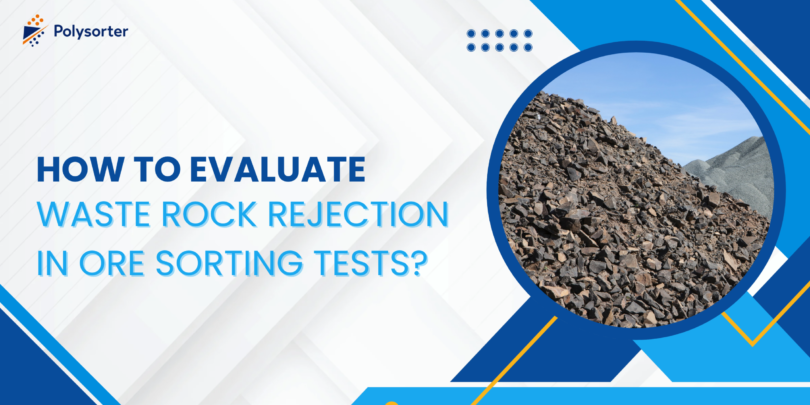
Waste rock rejection in ore sorting tests is a key measure of whether sensor-based sorting can improve mineral processing efficiency. By removing barren or low-value rock before downstream processing, mining operations may reduce unnecessary material handling, grinding requirements, and processing costs. However, rejecting more rock does not automatically mean better sorting performance.
A successful ore sorting test must balance waste removal with valuable mineral recovery. An aggressive sorting setting may reject a large proportion of the feed while also discarding mineral-bearing particles. A conservative setting may protect recovery but leave too much waste in the accepted material.
For mining companies comparing ore sorting equipment, understanding these trade-offs is essential. This guide explains how to calculate waste rejection, evaluate mineral recovery, interpret test results, and determine whether a sorting system is suitable for industrial operation.
Understanding Waste Rock Rejection in Ore Sorting Tests
Waste rock rejection is the process of separating barren or economically low-value rock from mineral-bearing material. In sensor-based ore sorting, particles are examined using measurable physical or chemical characteristics. The sorting system then directs them into accepted and rejected streams.
The objective is to remove material that contributes insufficient economic value while retaining particles containing recoverable minerals.
Waste Rock Rejection vs. Mass Rejection
These terms are related, but they are not identical.
Mass rejection describes the percentage of total feed mass directed into the reject stream.
Waste rejection efficiency measures the proportion of actual waste material correctly removed from the original feed.
A sorter may reject 40% of the feed, but this does not necessarily mean it has removed 40% of the waste. Some rejected particles may contain valuable minerals, while some barren particles may remain in the accepted stream.
Determining actual waste rejection efficiency requires a reliable method of identifying waste within the feed and reject streams.
Why Waste Rejection Matters
Removing low-value rock before energy-intensive processing can provide several operational advantages:
- Reduce material entering downstream crushing, grinding, or concentration stages.
- Increase the average grade of accepted material.
- Improve the utilization of existing processing equipment.
- Reduce downstream energy and material-handling requirements.
- Limit the quantity of low-value material requiring further treatment.
However, these benefits depend on ore characteristics and the location of the sorter within the processing circuit.
If valuable minerals are distributed relatively uniformly throughout individual rock particles, removing entire particles may cause unacceptable mineral losses.
Therefore, the first step in evaluating ore sorting potential is determining whether mineralized and barren particles have sufficiently different detectable characteristics.
Key Performance Indicators for Waste Rock Rejection
A reliable evaluation should measure more than the amount of rejected material. Four performance indicators provide a practical basis for comparing sorting results.
Mass Rejection Rate
Mass rejection measures the proportion of feed material removed during sorting.
Mass Rejection Rate (%) = (Rejected Mass ÷ Feed Mass) × 100
For example, if a test processes 1,000 kg of ore and rejects 350 kg:
350 ÷ 1,000 × 100 = 35%
The sorting system has rejected 35% of the original feed mass.
This result indicates how much material can potentially be removed from downstream processing. It does not establish the mineral value of the rejected stream.
Waste Rejection Efficiency
Waste rejection efficiency evaluates how effectively the sorter identifies and removes material classified as waste.
Waste Rejection Efficiency (%) = (Correctly Rejected Waste Mass ÷ Total Waste Mass in Feed) × 100
For example, suppose the feed contains 400 kg of material classified as waste. If 320 kg of that waste enters the reject stream, the waste rejection efficiency is 80%.
This calculation requires a defined waste classification criterion and supporting measurements.
In practical mining applications, classifying individual particles may require mineralogical analysis, chemical assays, or other suitable reference methods. Bulk stream weights alone are insufficient.
Valuable Mineral Recovery
Recovery measures how much of the valuable component remains in the accepted stream.
Recovery (%) = (Accepted Mass × Accepted Grade) ÷ (Feed Mass × Feed Grade) × 100
Consider the following hypothetical copper ore sorting test.
| Test Parameter | Result |
| Feed mass | 1,000 kg |
| Feed copper grade | 1.00% |
| Accepted mass | 650 kg |
| Accepted copper grade | 1.40% |
| Rejected mass | 350 kg |
| Rejected copper grade | Approximately 0.26% |
| Mass rejection | 35% |
| Copper recovery | 91% |
The original feed contains 10 kg of copper. After sorting, approximately 9.1 kg remains in the accepted stream.
This means the sorting-stage copper recovery is 91%, while approximately 9% of the copper reports to the reject stream.
The example is illustrative and does not represent actual equipment test results.
Whether this performance is economically attractive depends on the value of the lost copper, avoided processing costs, and subsequent mineral recovery.
Grade Improvement and Mass Balance
Grade improvement measures the increase in valuable mineral concentration after sorting.
Grade Upgrade Ratio = Accepted Grade ÷ Feed Grade
In the previous example:
1.40 ÷ 1.00 = 1.40
The accepted material has a copper grade 1.4 times the original feed grade.
However, a higher accepted grade does not necessarily mean greater total metal production. Recovery must be evaluated alongside grade improvement.
Test reports should also include a mass balance check.
The measured feed mass should be compared with the combined accepted and rejected masses. Similarly, the valuable component estimated in the feed should be reconciled with the amounts measured in both output streams.
Differences may arise from sampling, weighing, moisture variation, or laboratory assay errors.
A reliable test report should disclose material discrepancies and explain how they affect the interpretation of recovery and rejection results.
How to Conduct Reliable Ore Sorting Tests
The reliability of waste rock rejection in ore sorting tests depends heavily on sample preparation, testing conditions, and the methods used to verify results.
Even advanced sorting equipment can produce misleading conclusions when the tested material does not represent the actual ore deposit.
Step 1: Prepare Representative Ore Samples
Testing should begin with samples that reflect expected production conditions.
Important characteristics include ore grade, mineral composition, particle size distribution, moisture content, and the proportion of different rock types.
Where a deposit contains several geological zones, samples from each relevant zone should be evaluated.
Testing only a small quantity of visually distinctive ore may demonstrate technical feasibility, but it cannot establish performance across an entire mining operation.
Representative sampling and appropriate sample preparation are therefore essential.
Step 2: Evaluate Different Particle Sizes
Particle size affects both sensor detection and mechanical separation.
Very fine particles may be difficult to present individually. Oversized particles may exceed equipment handling limits, while broad size distributions can create inconsistent feeding conditions.
Testing separate particle size fractions helps determine where useful separation is achievable.
The suitable size range depends on mineral characteristics, equipment design, and the required processing capacity.
Some applications involve fine mineral particles, while others require sorting larger crushed rocks before further size reduction.
Step 3: Select the Appropriate Sensor Technology
Different sorting technologies detect different material properties.
Optical ore sorting uses cameras and controlled illumination to identify visible differences in color, brightness, shape, and surface appearance. It is suitable when target and unwanted particles have distinguishable visual characteristics.
X-ray Transmission (XRT) sorting measures differences in X-ray attenuation through particles. These differences depend on factors including material composition and particle thickness. XRT can be useful when mineralized and barren particles produce sufficiently different transmission signals.
X-ray Fluorescence (XRF) sorting detects characteristic fluorescent X-rays associated with certain elements. Its effectiveness depends on elemental composition, detection conditions, and the accessible measurement region.
These technologies are not interchangeable.
XRT does not directly measure ore grade, and optical sorting cannot reliably identify mineral differences that are invisible to its sensing system.
The most suitable technology should be determined through representative material testing rather than general equipment specifications alone.
Step 4: Compare Different Sorting Thresholds
Sorting systems can often be adjusted to prioritize either waste removal or valuable mineral retention.
A conservative setting may achieve higher recovery but lower mass rejection. An aggressive setting may remove more material while increasing mineral losses.
Testing multiple thresholds makes it possible to examine the relationship between mass rejection and recovery.
A useful approach is to plot mass rejection against valuable mineral recovery for each operating setting.
This reveals the trade-off between removing waste and retaining valuable material.
The preferred operating point should be selected according to the mine’s economic and processing objectives, not simply the highest rejection percentage.
Step 5: Repeat Tests Under Realistic Conditions
Laboratory trials can establish whether a material is technically sortable. However, production performance also depends on feed rate, particle presentation, mechanical separation, and operating stability.
Repeated tests help determine whether results are consistent.
Where practical, testing should include different ore samples, feed rates, and sorting settings.
Promising laboratory results should be followed by appropriate pilot-scale or production-oriented validation before major equipment investment decisions are made.
Factors That Influence Waste Rock Rejection Results
Even when sorting machines use similar sensing principles, their performance may differ significantly depending on the material and operating conditions.
Understanding these factors helps buyers interpret test reports more accurately.
Mineral Distribution Within Rock Particles
Particle-level mineral distribution is one of the most important factors affecting sorting potential.
If valuable minerals are concentrated in certain rocks while others contain mostly barren material, sensor-based sorting may provide effective pre-concentration.
However, when valuable and unwanted minerals occur together within the same particles, rejecting entire rocks becomes more difficult.
This limitation is especially relevant to finely disseminated ores.
A sensor may correctly identify a particle’s characteristics without being able to separate the valuable minerals contained within it.
Surface Conditions and Moisture
Dust, mud, and surface coatings can hide useful visual characteristics.
This can reduce the effectiveness of optical sorting when separation depends on visible differences.
Moisture may also influence feeding behavior. Fine particles can stick together or adhere to conveying surfaces, making consistent separation more difficult.
Some sorting configurations support wet material, while others require dry or appropriately prepared feed.
Testing conditions should reflect the actual material entering the planned sorting system.
Feed Rate and Particle Presentation
Increasing throughput can affect sorting performance.
When particles overlap, sensors may have difficulty identifying individual objects. Overlapping or closely spaced particles can also interfere with accurate ejection.
Uneven distribution across a conveyor or chute may create similar problems.
For this reason, sorting performance should be evaluated at feed rates relevant to the intended installation.
A machine that performs well at low throughput may not maintain identical results under full production loading.
Separation Accuracy and Ore Variability
Correct sensor classification does not always guarantee correct physical separation.
Particle trajectory, ejection timing, air pressure, and interactions between neighboring particles may cause material to enter the wrong stream.
Ore variability adds another challenge.
Changes in mineral composition, particle characteristics, or feed quality may require adjustments to sorting settings.
A reliable evaluation should therefore consider both detection performance and actual separation results across representative operating conditions.
How to Choose an Ore Sorting Machine Based on Test Results
For equipment buyers, the purpose of testing is to determine whether a sorting system can provide reliable technical and economic benefits.
Comparing machines based only on advertised sorting accuracy or maximum throughput can lead to misleading conclusions.
A stronger evaluation focuses on verified results obtained under comparable conditions.
Compare Machines at Similar Recovery Levels
Suppose two sorting systems achieve different mass rejection rates.
The machine rejecting more material may initially appear more effective. However, this comparison is incomplete unless valuable mineral recovery is also considered.
A better approach is to compare rejection rates at the same recovery target.
For example, if both machines retain 95% of the valuable metal, the system rejecting more low-value material may offer a greater reduction in downstream processing load.
This comparison should also account for feed characteristics, particle size, throughput, and operating costs.
Match Sorting Technology to Ore Characteristics
Equipment selection should begin with the properties of the ore rather than the advertised capabilities of a particular machine.
| Evaluation Factor | Optical Sorting | XRT Sorting |
| Main detection principle | Visible surface characteristics | X-ray attenuation |
| Suitable material characteristics | Distinguishable color, shape, or surface appearance | Sufficient transmission contrast |
| Main limitation | Hidden or visually similar mineral characteristics | Insufficient attenuation contrast or ambiguous particle responses |
| Important test conditions | Surface cleanliness, illumination, particle presentation | Particle thickness, composition, presentation |
| Selection basis | Verified optical separation performance | Verified XRT separation performance |
Neither technology is universally superior.
Optical sorting may be effective when valuable and unwanted particles have clear surface differences. XRT may offer advantages when relevant material differences are detectable through X-ray transmission.
The final decision should follow actual ore testing.
Evaluate Industrial Processing Requirements
A successful laboratory result must also be compatible with the intended production line.
Buyers should consider:
- Required throughput and expected feed variability.
- Particle size range and preparation requirements.
- Compressed air and electricity consumption.
- Maintenance accessibility and operating stability.
- Integration with existing crushers, screens, and conveyors.
- Availability of technical support and process adjustments.
The equipment should be capable of maintaining acceptable separation performance at the required operating capacity.
Assess the Economic Value of Waste Rejection
Higher rejection does not always produce better financial results.
The economic benefit depends on avoided downstream processing costs, the value of minerals lost in rejects, and the additional costs of sorting.
A practical evaluation should compare the expected savings from removing low-value material against equipment investment, operating expenses, and potential revenue losses.
The most economical operating point may differ from the setting that produces the highest rejection rate.
Request a Complete Sorting Test Report
Before making a purchasing decision, buyers should request a test report containing feed characteristics, sample preparation methods, sorting conditions, accepted and rejected masses, laboratory assays, recovery calculations, and mass balance results.
Where available, results from multiple sorting thresholds and throughput conditions should also be included.
This information helps identify whether performance differences reflect genuine equipment capability or variations in test conditions.
A dependable supplier should explain both the advantages and limitations demonstrated by the results.
Frequently Asked Questions About Waste Rock Rejection
What is a good waste rock rejection rate in ore sorting?
There is no universal target. An acceptable rejection rate depends on ore characteristics, valuable mineral recovery, processing costs, and project economics. A moderate rejection rate with high recovery may be more beneficial than aggressive rejection that causes significant mineral losses.
How do you calculate waste rock rejection efficiency?
Waste rejection efficiency is calculated by dividing the rejected waste mass by the total waste mass in the original feed, then multiplying by 100. This requires a reliable reference method for identifying waste material.
Does higher mass rejection mean better ore sorting performance?
Not necessarily. Higher mass rejection can also increase valuable mineral losses. Sorting performance should be evaluated using recovery, accepted grade, reject grade, and economic considerations.
Can optical sorting and XRT sorting achieve the same results?
Not always. Optical sorting detects visible characteristics, while XRT sorting measures differences in X-ray attenuation. Their effectiveness depends on the physical and compositional characteristics of the ore. Representative testing is necessary to determine the better option.
Can laboratory ore sorting results predict industrial performance?
Laboratory results help establish sorting potential, but they do not guarantee production performance. Industrial operation introduces additional variables, including throughput, particle presentation, ore variability, and mechanical separation. Further validation is recommended before large-scale installation.
Conclusion
Evaluating waste rock rejection in ore sorting tests requires more than measuring the percentage of material removed. A meaningful assessment combines mass rejection, waste rejection efficiency, valuable mineral recovery, grade improvement, and reliable test conditions.
For mining companies comparing equipment suppliers, these measurements provide a stronger basis for selecting suitable sorting technology and estimating potential processing benefits.
PolySorter provides sensor-based ore sorting solutions for different mineral processing applications, including optical and XRT sorting configurations. To evaluate the sorting potential of your material, explore our solutions at PolySorter or contact our team to discuss your ore characteristics, processing requirements, and testing objectives.