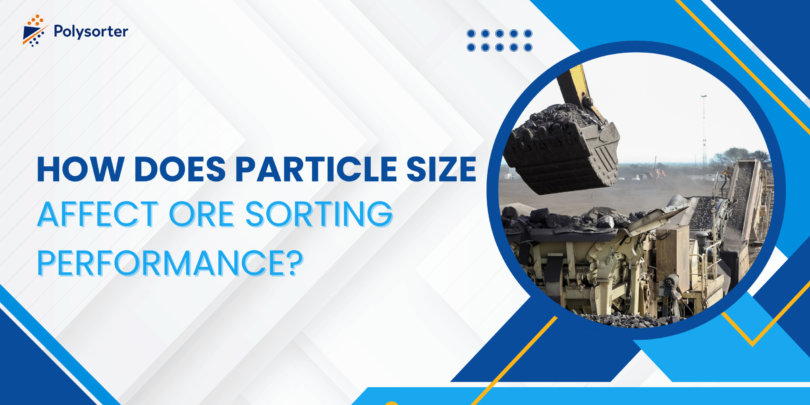
Particle size is a critical factor in mineral processing, directly influencing how accurately ore particles can be identified, separated, and recovered. Whether a mining operation uses optical sorting or X-ray transmission (XRT) technology, particle dimensions affect detection accuracy, processing capacity, and separation efficiency.
However, smaller particles do not always produce better results. Crushing can expose valuable minerals and improve liberation, but excessive size reduction may create challenges in feeding, sensor recognition, and particle rejection. Larger particles are often easier to handle individually, yet they may contain valuable minerals mixed with unwanted gangue.
Understanding how particle size affects ore sorting performance helps mining operators make informed decisions about crushing, screening, equipment selection, and process optimization. The goal is to identify a practical particle size range that balances mineral recovery, waste rejection, throughput, and operating costs.
This guide explains how particle size influences sorting results, compares different feed size ranges, and provides practical recommendations for choosing suitable ore sorting equipment.
Why Particle Size Matters in Ore Sorting
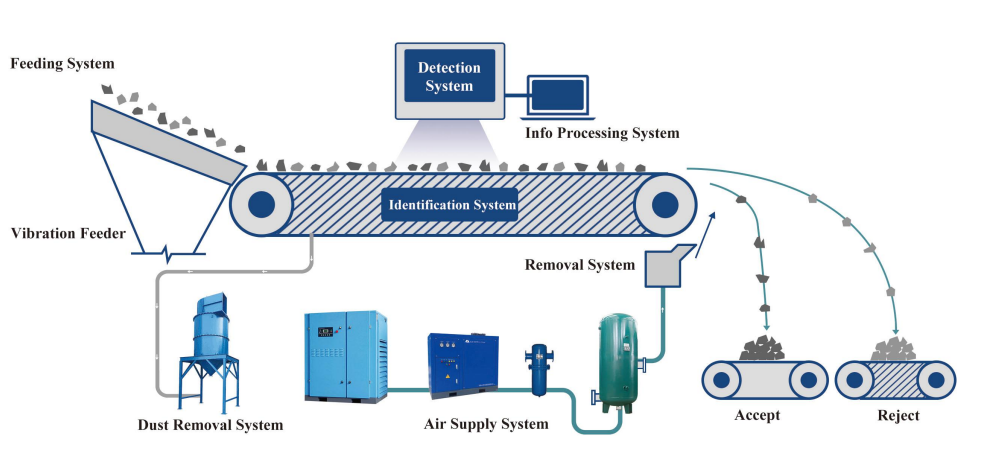
Sensor-based ore sorting separates particles according to detectable physical characteristics. Optical systems examine surface color, brightness, shape, and texture, while XRT systems analyze differences in X-ray attenuation through individual particles.
Regardless of the technology, successful sorting requires reliable detection, accurate classification, and controlled physical separation. Particle size affects all three stages.
Particle Size and Mineral Liberation
Mineral liberation describes how completely valuable minerals are separated from surrounding waste material.
In many ore deposits, valuable minerals occur together with gangue inside individual rock fragments. Crushing reduces particle dimensions and may expose mineral boundaries, allowing more selective separation.
However, sensor-based sorting does not always require complete mineral liberation.
Coarse ore sorting frequently processes composite particles containing both valuable and unwanted minerals. Instead of identifying fully liberated mineral grains, the system distinguishes particles using detectable characteristics associated with their composition or economic value.
For example, a mining operation may reject low-value rock before sending accepted material to grinding and concentration equipment. This can reduce the amount of material entering energy-intensive downstream processes.
The key is determining whether valuable and low-value particles can be distinguished reliably at the selected feed size.
Balancing Mineral Liberation and Excessive Crushing
Reducing particle size can improve liberation, but crushing beyond the necessary level may increase operating costs and complicate sorting.
Smaller particles are more numerous at the same feed mass. They place greater demands on detection systems, material presentation, and rejection precision. Excessive crushing can also generate additional dust and eliminate opportunities for early coarse waste rejection.
A suitable particle size therefore balances improved mineral liberation against the practical limitations of the sorting process.
When valuable and unwanted rocks can already be distinguished at a coarse size, additional crushing may offer little benefit. When separation remains poor, further size reduction may improve the result.
The appropriate balance should be established through ore characterization and representative sorting tests.
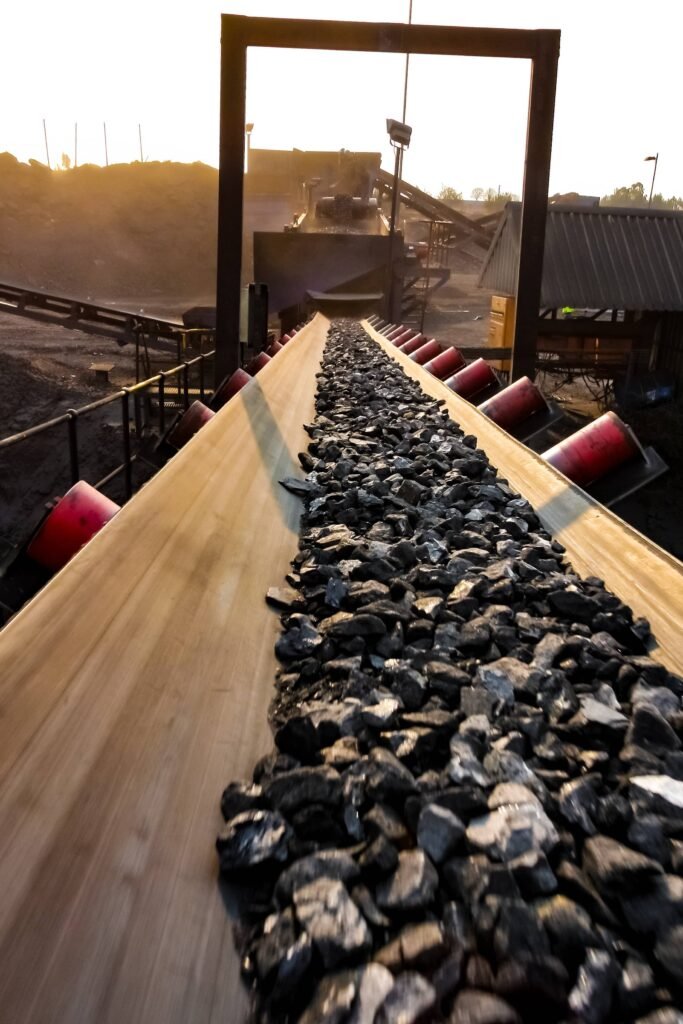
How Particle Size Affects Ore Sorting Accuracy and Efficiency
Particle dimensions influence the information available to sensors, material movement through the equipment, and the precision required for separation.
These effects become especially important when processing plants handle high feed rates or widely varying particle sizes.
Optical Detection and Sensor Resolution
Optical ore sorting machines use cameras and controlled illumination to identify visible differences between particles.
Larger particles generally provide more surface information for imaging systems. Differences in color, texture, and mineral appearance may therefore be easier to recognize.
As particles become smaller, fewer image pixels may represent each object. Subtle visual differences become harder to distinguish, particularly when dust, surface coatings, or overlapping particles interfere with detection.
High-resolution imaging, suitable illumination, and stable feeding can improve recognition, but every system has practical operating limits.
Optical sorting primarily evaluates visible characteristics. It cannot reliably identify internal mineral composition when those characteristics are not reflected in the observed surface.
XRT Detection and Practical Particle Size Limits
XRT sorting analyzes how X-rays are attenuated as they pass through ore particles.
The measured attenuation depends on material composition, effective atomic characteristics, particle thickness, and X-ray energy. This allows suitable XRT systems to distinguish certain materials that appear visually similar.
However, particle size strongly influences detection reliability.
Conventional industrial XRT systems often face greater technical and economic challenges when processing particles below approximately 8–10 mm. At smaller sizes, limited attenuation contrast, detector resolution, and increased particle counts can complicate accurate separation.
This is not a universal minimum size. Specialized fine-particle XRT systems may operate below this range when their detection and material-handling systems are designed accordingly.
Particle thickness also matters. Thin particles may produce weaker attenuation signals, while irregular shapes introduce additional variation.
For these reasons, XRT suitability should be established through representative material testing rather than particle size alone.
Aerodynamics, Ejection Precision, and Throughput
After identifying an unwanted particle, the sorting system must direct it into the appropriate discharge stream.
Fine particles are particularly sensitive to aerodynamic drag and induced air currents during free fall. These forces can alter particle trajectories and make precise rejection more difficult.
Smaller particles may also travel close together, increasing the risk that an air pulse removes valuable material alongside unwanted particles.
Larger particles generally have greater momentum. Depending on the equipment design, they may require stronger pneumatic impulses or alternative mechanical separation mechanisms.
The appropriate rejection method depends on particle mass, velocity, material characteristics, and equipment geometry.
Particle size also influences processing capacity. At the same mass flow rate, smaller particles create a larger number of individual objects requiring detection and classification.
For similarly shaped particles of equal density, halving the characteristic diameter reduces the approximate volume of each particle to one-eighth. This simplified relationship illustrates why fine-particle sorting can place greater demands on detection and separation systems.
Actual throughput also depends on particle shape, density, size distribution, and equipment configuration.
Ore Sorting Performance Across Different Particle Sizes
Different feed sizes require different detection and material-handling arrangements.
Fine mineral powders, crushed aggregates, and large rocks cannot always be processed efficiently using the same equipment.
The following table illustrates common application categories and their main technical challenges.
| Particle Size | Typical Sorting Approach | Main Challenges |
| Approximately 0.125–1.2 mm | Specialized optical powder sorting | Dust, particle visibility, uniform feeding |
| Approximately 1–10 mm | Fine-particle optical sorting | Sensor resolution, particle overlap, ejection precision |
| Approximately 10–50 mm | Optical sorting or suitable XRT systems | Mineral contrast, feed distribution, recovery |
| Approximately 50–100 mm | Coarse optical sorting or XRT | Composite particles, material handling |
| Approximately 100–200 mm | Large-particle sensor-based sorting | Particle mass, throughput, mineral distribution |
These are illustrative application ranges, not universal equipment limits. Actual compatibility depends on material characteristics, sensor technology, and machine configuration.
Fine Mineral Powder Sorting
Fine-particle sorting is particularly relevant to industrial minerals such as quartz, calcite, dolomite, and barite.
These applications often involve removing visibly different impurities to improve product consistency.
Specialized optical powder sorters use controlled feeding, high-resolution imaging, and precise rejection systems to process small particles.
However, dust, irregular feeding, and particle adhesion can interfere with detection. Maintaining a controlled particle size distribution is especially important for stable performance.
Small and Medium-Sized Ore Sorting
Small and medium-sized particles can provide a practical balance between detectable mineral characteristics and manageable material flow.
Optical sorting is suitable when valuable and unwanted particles exhibit recognizable surface differences.
For example, certain quartz, feldspar, and fluorite applications may benefit from identifying discoloration or visible impurities.
XRT may be more appropriate when internal attenuation differences provide stronger separation information than surface appearance.
Neither technology should be selected solely according to particle size. Two ores with similar dimensions may require different systems because their mineral composition and separation objectives differ.
Coarse Ore and Large Rock Sorting
Coarse sorting is commonly used for pre-concentration and early waste rejection.
Removing low-value rocks before additional crushing or grinding can reduce downstream processing requirements.
Larger particles may support higher mass throughput because fewer individual objects need to be processed per tonne.
However, coarse particles frequently contain multiple mineral phases. A rock containing valuable mineral inclusions may be difficult to classify if those inclusions do not produce a sufficiently distinctive sensor signal.
Successful coarse sorting therefore depends on ore texture, mineral distribution, and the relationship between detectable characteristics and economic value.
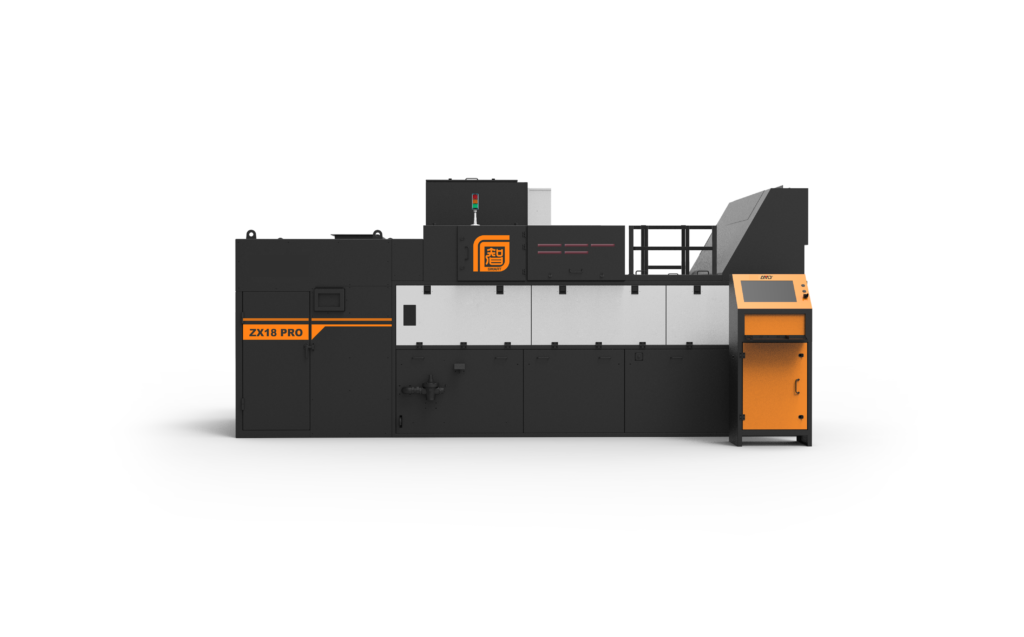
How to Optimize Particle Size for Better Ore Sorting Performance
Improving sorting efficiency often begins with feed preparation.
Crushing, screening, feeding, and moisture control determine whether the equipment receives material within its effective operating range.
Use Crushing and Screening Strategically
The first step is to examine the particle size distribution produced by the crushing circuit.
Rather than crushing every rock to the smallest possible dimension, operators should evaluate whether coarse material can be sorted before additional size reduction.
Screening can divide material into narrower size fractions, improving feeding consistency and allowing different sorting stages to operate under suitable conditions.
For many particle-based sorting applications, maintaining a relatively narrow feed size ratio, such as 2:1 or 3:1, can help improve material presentation and separation consistency.
The feed size ratio is commonly expressed as:
Size Ratio = Maximum Particle Size / Minimum Particle Size
For example, a 10–20 mm fraction has a 2:1 size ratio, while a 20–60 mm fraction has a 3:1 ratio.
A narrower distribution can reduce differences in particle movement, minimize overlap, and support more consistent rejection timing.
However, these ratios are practical guidelines rather than universal requirements. The optimal distribution depends on the equipment, mineral characteristics, and separation method.
Particle shape, density, and the proportion of fines should also be considered because two feeds with identical size ratios may behave differently.
Maintain Stable Feeding Conditions
Consistent material presentation is essential for reliable detection.
When particles overlap or accumulate, sensors may receive incomplete information about individual objects. Excessive loading can also reduce rejection precision.
Operators should evaluate feed rate, particle spacing, vibration settings, and conveyor speed together.
The objective is to maintain a suitable balance between throughput and separation accuracy rather than maximizing feed volume alone.
Control Moisture, Dust, and Surface Conditions
Moisture and contamination can influence material handling and optical recognition.
Wet fine particles may stick together or adhere to feeding surfaces. Dust and surface coatings can obscure visible mineral characteristics, reducing color-based detection accuracy.
Washing may improve recognition when contamination hides useful surface differences, but it is not necessary for every application.
Some sorting systems are designed for dry materials, while others can process wet feed within specified operating conditions.
Feed preparation should reflect the actual ore characteristics and equipment requirements.
Verify Performance Through Material Testing
Particle size optimization should be supported by representative sorting tests.
A practical testing program compares different feed fractions while measuring product grade, valuable mineral recovery, waste rejection, mass yield, and processing capacity.
Misplacement should also be evaluated, including valuable material lost to rejects and unwanted material remaining in the accepted stream.
The most suitable particle size is not necessarily the one achieving the highest impurity rejection.
Instead, operators should identify the conditions that provide an economically acceptable balance between recovery, product quality, throughput, and processing costs.
How to Choose an Ore Sorting Machine Based on Particle Size
Selecting suitable equipment requires more than matching feed dimensions to a manufacturer’s stated operating range.
Buyers should consider mineral characteristics, separation objectives, expected throughput, and recovery requirements.
Compare Optical Sorting and XRT Technology
Optical sorting is generally worth evaluating when valuable and unwanted materials show detectable differences in surface color, brightness, or texture.
XRT may be suitable when internal X-ray attenuation characteristics provide stronger separation information than external appearance.
For example, visually similar ore particles may contain different internal mineral compositions. An appropriately configured XRT system may detect useful attenuation differences that conventional color recognition cannot distinguish.
However, XRT does not directly measure mineral grade, and useful attenuation contrast cannot be assumed for every ore.
The choice should be supported by material testing under realistic operating conditions.
Evaluate Feed Conditions and Actual Capacity
A machine’s nominal throughput does not guarantee identical performance across every particle size.
Fine materials may require lower feed rates to maintain adequate particle spacing, while coarse materials require suitable feeding and discharge arrangements.
Buyers should evaluate equipment using samples that represent expected production conditions.
| Buyer Consideration | What to Evaluate |
| Feed Size Distribution | Minimum, maximum, and dominant particle sizes |
| Mineral Characteristics | Visible contrast or X-ray attenuation differences |
| Required Capacity | Target throughput under actual operating conditions |
| Separation Objective | Waste rejection, pre-concentration, or purification |
| Recovery Requirements | Acceptable valuable mineral losses |
| Material Conditions | Moisture, dust, particle shape, and surface coatings |
Consider the Complete Processing Line
A sorting machine operates as part of a larger mineral processing system.
Feeders, crushers, screens, conveyors, compressed air systems, and product discharge arrangements can all influence separation performance.
For operations handling several particle size fractions, multiple sorting stages may be more effective than attempting to process every fraction through one machine.
The most suitable configuration is the one that delivers the required separation results while maintaining practical operating costs.
Frequently Asked Questions About Particle Size in Ore Sorting
What is the ideal particle size for ore sorting?
There is no universal ideal particle size. The appropriate range depends on mineral liberation, sensor technology, material characteristics, and separation objectives. Representative testing helps determine suitable operating conditions.
Is a 2:1 or 3:1 feed size ratio necessary?
Not always. Narrow size ratios can improve feeding consistency and separation control, but they are not mandatory for every sorting system. The acceptable range depends on equipment design and material behavior.
Can XRT ore sorting machines process particles smaller than 10 mm?
Some specialized XRT systems can process particles below 10 mm. However, conventional industrial systems may face greater detection and economic challenges at smaller sizes. Actual capability should be confirmed through equipment specifications and material testing.
Why do fine particles create sorting difficulties?
Fine particles are more sensitive to airflow disturbances and may overlap during feeding. Their small dimensions can also limit sensor information and increase the precision required for individual rejection.
Should ore be crushed before sensor-based sorting?
Crushing is often necessary to produce suitable feed dimensions and expose useful mineral characteristics. However, excessive crushing can increase costs and reduce opportunities for coarse waste rejection.
Conclusion: Finding the Right Particle Size for Efficient Ore Sorting
Particle size affects detection accuracy, rejection precision, processing capacity, mineral recovery, and operating costs.
Fine particles may improve mineral liberation but require more specialized detection and handling systems. Larger particles can support early waste rejection and higher mass throughput, although composite mineral structures may limit separation selectivity.
The most effective approach is to match particle size with mineral characteristics, sensor technology, and processing objectives rather than optimizing any single factor in isolation.
At PolySorter, we provide optical and sensor-based ore sorting solutions for different mineral processing requirements. Whether your operation involves fine industrial minerals, crushed ore, or coarse rock pre-concentration, our team can help evaluate suitable sorting technologies and processing configurations. Contact PolySorter to discuss your ore characteristics, particle size distribution, and separation goals.