In a plastic recycling line, sorting and washing solve different problems, but where the plastic sorting machine is installed can significantly affect its role in the process. This raises an important question for recyclers planning a new line or upgrading an existing one: Is plastic sorting before or after washing more effective?
There is no universal answer. Sorting before washing is generally better suited to feedstock concentration and early contaminant removal, while sorting after washing is better suited to final material purification. For recycling plants with demanding output requirements, the two stages may also work together rather than compete with each other.
The right choice depends on the incoming material, contamination profile, particle size, sorting objective, sensor technology, and required output quality. That is why choosing a plastic sorting machine should start with the process—not simply with machine capacity or a list of specifications.
Plastic Sorting Before Washing: Removing Contamination Earlier
Plastic waste entering a recycling facility is rarely uniform. A post-consumer stream may contain target plastics mixed with other polymers, unwanted colors, labels, films, metals, paper, dirt, and other foreign materials.
Plastic sorting before washing acts primarily as a pre-sorting or feedstock concentration stage.
Consider a PET bottle recycling line. Before bottles are shredded and washed, sorting can be used to concentrate the target PET stream while rejecting non-target containers, unwanted colors, and other detectable materials. Depending on the line configuration, several separation technologies may work together at this stage.
Typical pre-wash sorting targets can include:
- non-target plastic containers;
- unwanted polymer types;
- bottles of unwanted colors;
- obvious foreign materials;
- selected non-plastic contaminants detectable by the installed system.
Removing these materials early can prevent unnecessary contamination from continuing through shredding, washing, drying, and other downstream processes. Instead of processing everything first and rejecting unwanted material later, the recycling line concentrates the useful fraction earlier.
However, pre-wash sorting also has challenges.
Incoming bottles and rigid plastics may still carry labels, dirt, residues, and moisture. Objects may overlap or present inconsistently on the conveyor. These factors can affect the conditions under which sensors inspect the material.
This does not mean dirty plastic must always be washed before sensor-based sorting.
For example, NIR technology can be used for bottle-level polymer identification before washing. However, heavy surface contamination, labels, moisture, overlapping objects, and inconsistent presentation may influence detection conditions. The suitability of pre-wash sorting therefore needs to be evaluated against the actual feedstock and separation target.
Plastic Sorting After Washing: Fine Purification of Plastic Flakes
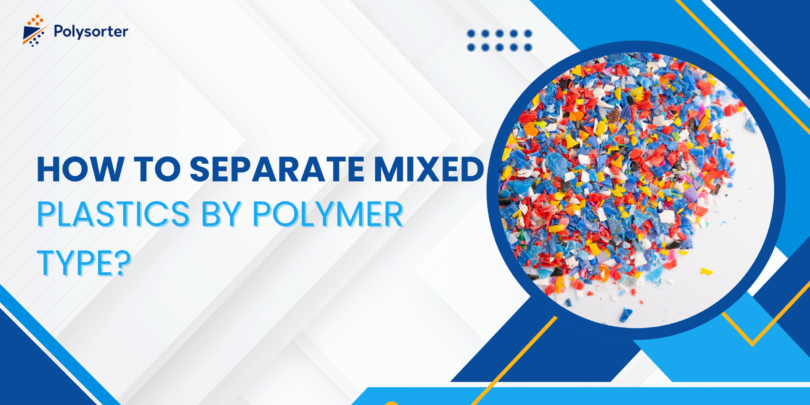
After pre-processing, plastic is often shredded into smaller pieces before entering washing, separation, and drying stages. The material presented to a downstream sorter is therefore very different from the original waste stream.
This is where plastic sorting after washing becomes especially important.
At this stage, the goal is usually no longer to remove large quantities of obvious waste. Instead, sorting focuses on fine purification of the recovered plastic stream.
Typical post-wash sorting targets may include:
- residual PVC or other foreign polymers in PET;
- remaining PP or PE contamination;
- off-color PET flakes;
- opaque or discolored flakes;
- other detectable foreign polymer pieces.
Cleaned and properly prepared flakes can provide more controlled conditions for downstream optical inspection. However, the correct sensing technology still depends on what needs to be separated.
A visible-light or color sorting system can identify differences in color, transparency, and visible appearance. For example, it can help separate clear PET flakes from blue, green, yellow, opaque, or otherwise discolored flakes.
Polymer contamination requires a different approach.
Two flakes can appear visually similar while being made from different polymers. When separation depends on polymer identity rather than appearance, near-infrared (NIR) sorting can analyze characteristic spectral responses to distinguish detectable materials such as PET, PE, PP, PVC, PS, ABS, and other polymers, depending on the application and system configuration.
Some applications therefore require color sorting, some require polymer identification, and others benefit from a combination of sensing technologies.
This distinction is critical when selecting a plastic sorting machine. Removing green PET from clear PET is not the same sorting problem as removing PVC from a PET flake stream.
Plastic Sorting Before or After Washing: A Practical Comparison
So, which stage is more effective?
It depends on the purpose of sorting. Before-wash and after-wash sorting should not be viewed as interchangeable steps.
| Factor | Sorting Before Washing | Sorting After Washing |
| Typical feed material | Bottles, rigid plastics, mixed plastic streams | Washed flakes or regrind |
| Main purpose | Pre-sorting and bulk contaminant removal | Fine purification |
| Best suited for | Feedstock concentration | Final material purification |
| Material condition | May contain dirt, labels and residues | Cleaner and generally more uniform |
| Typical targets | Non-target plastics, unwanted colors and foreign materials | Wrong polymers, off-colors and residual contaminants |
| Material presentation | Larger objects commonly presented on conveyor systems | Smaller flakes commonly handled by chute or gravity-fed systems |
| Position in recycling line | Upstream | Downstream |
| Main process benefit | Removes unnecessary contamination earlier | Refines final recyclate quality |
These are typical configurations rather than fixed rules. Actual recycling lines differ in feedstock, contamination, equipment layout, throughput, and final quality requirements.
It is also important to understand that washing does not replace sorting, and sorting does not replace washing.
Washing mainly deals with removable surface contamination such as dirt, residues, adhesives, and similar contaminants. Sensor-based sorting addresses detectable material differences that washing cannot simply eliminate.
A PVC flake does not become PET because it has been washed. Likewise, a green PET flake remains green after surface dirt has been removed.
The two processes therefore perform different but complementary jobs.
Why Multi-Stage Plastic Sorting Can Be More Effective
For many recycling plants, the better question is not simply before or after washing? Instead, it is:
What contaminants should be removed at each stage?
A multi-stage plastic recycling process may broadly follow this sequence:
Incoming material → Material preparation → Pre-sorting → Size reduction → Washing → Drying → Flake sorting → Quality control → Further processing
The exact configuration varies from plant to plant.
In this type of process, upstream sorting concentrates the target material and removes unwanted fractions before they travel farther through the recycling line. Washing and mechanical processing then change the physical condition of the material. Downstream sorting focuses on contaminants that remain in the cleaned flake stream.
Put simply, the two sorting stages have different priorities.
In a multi-stage line, the upstream sorter primarily helps prevent unnecessary contamination from entering downstream processing, while the downstream sorter focuses on protecting final recyclate quality.
This approach can be particularly useful when processing variable post-consumer feedstock or producing recycled material with tighter quality requirements.
However, that does not mean every recycling facility needs sorting machines both before and after washing.
A plant processing relatively consistent material may achieve its target with a simpler sorting arrangement. A line handling highly variable mixed waste may require more separation stages. Similarly, a producer making material for demanding downstream applications may need more intensive purification than a recycler producing a general-purpose recovered fraction.
The correct configuration should therefore be determined by the contamination problem and final product requirement—not simply by adding more sorting equipment.
How to Choose the Right Plastic Sorting Stage
Before choosing where to install a plastic sorting machine, recyclers can begin with five practical questions:
- What material enters the sorter?
- What contaminants need to be removed?
- Is separation based on color, polymer type, or both?
- What output quality is required downstream?
- At which stage can the unwanted material be removed most effectively?
The first question determines the basic material-handling requirements. Whole bottles, rigid plastics, shredded material, flakes, and regrind behave differently during feeding and sorting.
Next, define the contamination problem clearly. A vague requirement such as “improve plastic purity” is not enough to select the right technology. A recycler should identify whether the problem is PVC contamination, mixed polymers, off-color flakes, opaque material, or another detectable defect.
Sensor selection should follow that objective.
Visible optical sorting is suitable when the detectable difference is primarily based on color or appearance. NIR-based sorting becomes relevant when separation depends on polymer identity. Where both polymer and color contamination must be controlled, a combination of sensing capabilities may be appropriate.
The required output quality is equally important. Producing a general recovered plastic fraction and preparing highly purified flakes for demanding downstream processing are different objectives.
Finally, consider the complete recycling process.
Feed preparation, conveying, shredding, washing, drying, material distribution, sorting, recovery passes, and quality control interact with one another. A capable sorter cannot compensate for every upstream process problem.
For this reason, equipment selection should ideally include representative material testing. Actual sorting results can vary with material composition, contamination level, particle size, moisture, throughput, feed consistency, and the required final purity.
FAQ About Plastic Sorting Before or After Washing
Should plastic be sorted before washing?
In many recycling lines, yes. Sorting before washing can concentrate the target material and remove unwanted fractions before they enter further processing. Whether this stage is necessary depends on the incoming feedstock and the overall recycling process.
Is plastic sorting more accurate after washing?
Not automatically. Washing can improve the condition of flakes for downstream inspection by removing surface contamination, but sorting performance still depends on sensor technology, material presentation, contaminant characteristics, throughput, feed consistency, and equipment configuration.
Can NIR sort dirty plastic before washing?
Yes, NIR sorting can be used before washing for suitable applications, including polymer separation at the bottle level. However, labels, heavy surface contamination, moisture, overlapping objects, and material presentation may influence detection conditions. Representative material testing is therefore important.
Why sort plastic flakes after washing?
Post-wash flake sorting can target remaining foreign polymers, off-color pieces, opaque flakes, and other detectable contaminants. It is particularly useful when the recycling process requires tighter control over final recyclate quality.
Do PET recycling lines need sorting both before and after washing?
Not necessarily. Some lines can meet their targets with fewer sorting stages. Others combine upstream bottle sorting with downstream flake purification because the incoming material is variable or the finished recyclate has stricter quality requirements.
Where should a plastic sorting machine be installed?
The best position depends on the feed material, contaminant profile, material size, washing process, throughput, and required output quality. The sorting stage should be selected according to where the target contamination can be identified and removed effectively.
Conclusion: Before or After Washing Depends on the Sorting Objective
When comparing plastic sorting before or after washing, neither stage is universally more effective.
Sorting before washing mainly supports feedstock concentration and early contaminant removal. Sorting after washing focuses on fine purification of cleaned plastic flakes. For more demanding recycling applications, both stages can form part of a coordinated process in which each sorter performs a different job.
The most important question is therefore not simply where to place the machine. It is what material needs to be separated, from what contaminant, and at which point in the process that separation can be performed effectively.
When planning a new recycling line or upgrading an existing one, PolySorter can evaluate your material type, feed condition, contaminant profile, particle size, throughput requirement, and target output quality. Based on representative material testing, we can help determine whether sorting is better positioned before washing, after washing, or at multiple stages of the recycling process.