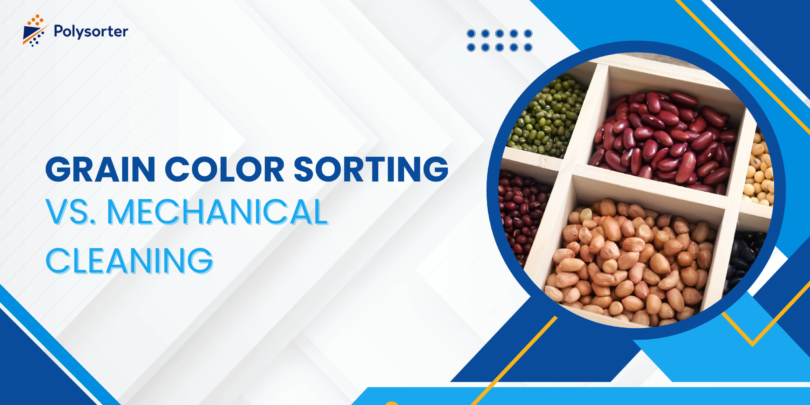
Grain Color Sorting vs. Mechanical Cleaning is an important consideration for grain processors looking to improve product quality, remove impurities, and invest in suitable processing equipment. Although both technologies contribute to cleaner grain, they operate on different principles and solve different quality problems.
Mechanical cleaning separates materials according to physical characteristics such as size, density, and aerodynamic behavior. Optical grain sorting uses cameras, controlled lighting, and image-processing technology to identify grains with detectable differences in color or appearance.
For wheat mills, corn processors, bean suppliers, and grain exporters, understanding these differences is essential. Choosing the wrong equipment may leave certain impurities in the finished product or increase operating costs without delivering meaningful quality improvements.
In many processing facilities, the best solution is not choosing one technology over the other. Instead, mechanical cleaning and optical sorting work together at different stages of production.
This guide explains how both systems operate, compares their capabilities, and helps buyers determine which equipment best suits their grain processing requirements.
How Mechanical Grain Cleaning and Optical Color Sorting Work
Understanding the operating principles of both technologies helps processors identify which equipment can address their specific quality challenges.
Mechanical Grain Cleaning: Separating by Physical Properties
Mechanical grain cleaning uses differences in physical characteristics to separate acceptable grain from unwanted materials.
Several types of equipment are commonly used:
- Vibrating screens: Separate oversized and undersized particles according to their dimensions.
- Air separators: Remove lightweight impurities such as dust, husks, and chaff through controlled airflow.
- Destoners: Separate stones and other dense materials using vibration, airflow, and density differences.
- Gravity separators: Separate materials according to differences in specific weight.
- Indented cylinder separators: Classify grains according to length differences.
For example, a wheat processing facility may use vibrating screens to remove large debris, followed by aspiration to eliminate dust and lightweight impurities.
Additional equipment can then remove stones or certain low-density kernels.
These methods are especially effective when unwanted materials differ sufficiently from acceptable grain in size, weight, density, or shape.
However, mechanical separation becomes less reliable when defective grains have physical properties similar to healthy kernels.
Optical Grain Sorting: Separating by Detectable Appearance
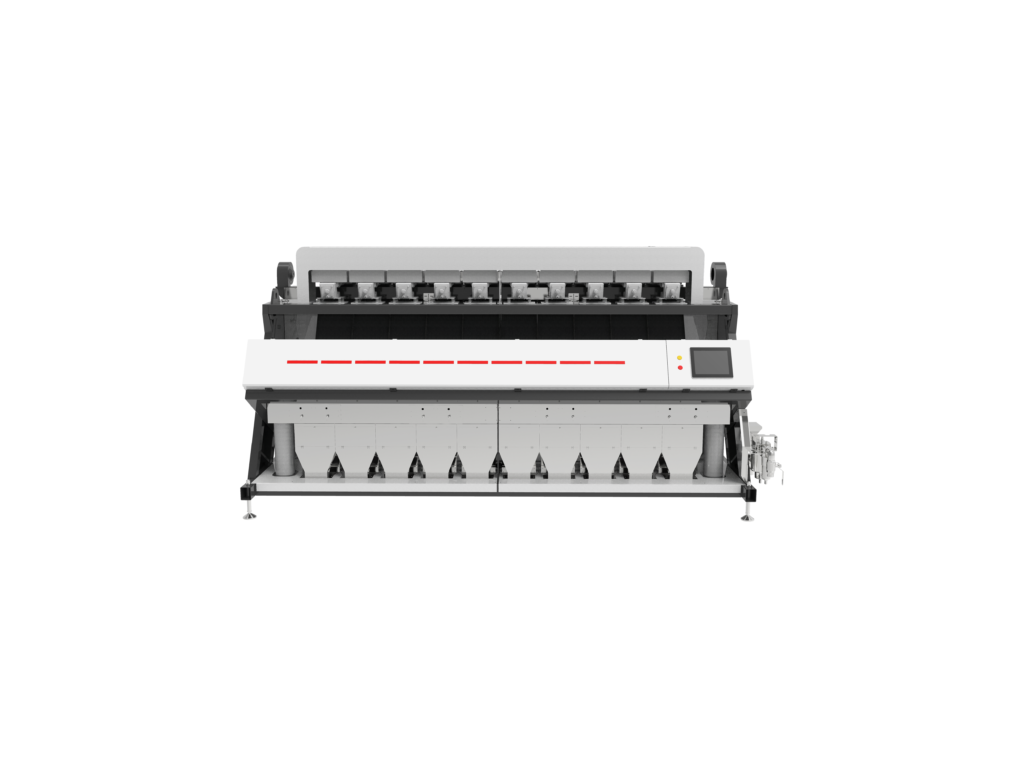
An optical grain sorter inspects individual grains using cameras and specialized lighting systems.
The sorting process generally follows four steps:
- Feeding: Grains are distributed into a controlled, consistent material flow.
- Inspection: Cameras capture visual information as particles pass through the detection area.
- Recognition: Image-processing software analyzes the captured information against configured sorting criteria.
- Rejection: Precisely timed compressed-air jets separate identified defective particles from acceptable grain.
Modern optical sorting machines may incorporate AI-assisted recognition to identify discolored kernels, surface abnormalities, and certain foreign materials.
Depending on the sensor configuration, some systems can also evaluate additional optical or shape characteristics.
For example, a darkened wheat kernel may have nearly the same size and density as an acceptable kernel. Mechanical equipment might not distinguish them, while a color sorter can potentially identify their visible differences.
However, optical sorting capabilities depend on the installed cameras, sensors, algorithms, and material presentation conditions. Not every machine offers the same detection functions.
Grain Color Sorting vs. Mechanical Cleaning: Key Differences
The fundamental distinction between these technologies lies in the characteristics used to identify unwanted materials.
Mechanical systems primarily rely on physical separation, while optical systems analyze detectable visual or spectral differences.
Comparison of Grain Cleaning Technologies
| Comparison Factor | Mechanical Cleaning | Optical Grain Color Sorting |
| Separation principle | Size, density, weight, and airflow behavior | Detectable color, appearance, and supported optical characteristics |
| Typical equipment | Screens, aspirators, destoners, gravity separators | Camera-based optical sorting machines |
| Primary function | Bulk impurity removal and physical grading | Precision removal of optically distinguishable defects |
| Dust and chaff removal | Effective with suitable equipment | Not designed for primary dust removal |
| Stone removal | Effective with appropriate destoners | Limited to optically distinguishable stones |
| Discolored kernels | Limited when physical properties are similar | Effective when color differences are detectable |
| Foreign seeds | Separates seeds with different physical properties | Separates seeds with recognizable optical differences |
| Processing position | Early and intermediate cleaning stages | Usually after appropriate pre-cleaning |
| Operating requirements | Mechanical maintenance and physical adjustments | Optical cleaning, calibration, and compressed air |
| Main limitation | Cannot reliably detect appearance-only defects | Cannot reliably detect defects without distinguishable optical features |
Differences in Defect Removal
Mechanical cleaning is particularly effective for removing large quantities of physical impurities.
For instance, screening can eliminate straw fragments and oversized particles, while destoning equipment separates dense contaminants.
Optical sorting becomes valuable when defects remain after these processes.
Common targets include discolored kernels, stained beans, visibly damaged grains, and foreign seeds with detectable color differences.
Nevertheless, a grain color sorter cannot identify every internal defect or invisible contaminant.
For example, some fungal infections or mycotoxin contamination may occur without obvious surface abnormalities. Visible-light sorting does not directly measure mycotoxin concentrations.
Differences in Processing Capacity and Efficiency
Mechanical cleaning systems commonly handle substantial volumes of incoming grain, particularly during preliminary cleaning.
Optical sorting performance depends on additional factors, including feed uniformity, grain dimensions, defect concentration, and required separation accuracy.
Increasing throughput beyond the machine’s suitable operating range may reduce sorting performance or increase the rejection of acceptable grain.
Therefore, buyers should compare equipment using actual finished-product output at the required quality level, rather than relying exclusively on advertised processing capacity.
A machine with higher nominal throughput is not necessarily the better investment if it produces excessive good-grain loss or inconsistent results.

Grain Color Sorting Applications in Different Grain Processing Lines
Different agricultural materials present different cleaning challenges. Selecting suitable equipment requires understanding the impurities commonly found in each grain category.
Wheat Processing
Wheat may contain dust, straw fragments, stones, foreign seeds, and damaged kernels.
Mechanical cleaning is essential for removing many of these materials before milling.
However, some discolored or visibly abnormal wheat kernels may retain dimensions and densities similar to acceptable grain.
Optical sorting provides an additional separation stage when these defects can be identified through detectable surface differences.
For wheat affected by Fusarium, optical sorting may remove some visibly abnormal kernels. However, it does not directly measure deoxynivalenol (DON) or guarantee that the remaining grain meets mycotoxin limits.
Laboratory testing remains necessary for verifying relevant safety requirements.
Corn Processing
Corn processing facilities frequently encounter broken kernels, foreign materials, discolored grain, and storage-related defects.
Mechanical equipment can remove oversized debris, lightweight impurities, and some broken or poorly developed kernels.
An optical sorter can further identify darkened, stained, or otherwise visibly abnormal corn.
This additional inspection may help processors improve product appearance and reduce selected defective fractions.
However, optical sorting cannot guarantee the complete removal of aflatoxins. Some contaminated kernels may appear normal, while some visibly defective kernels may not contain elevated toxin concentrations.
Beans, Lentils, and Pulses
Visual appearance is often an important grading factor for beans and pulses.
Processors may need to separate stained beans, discolored seeds, foreign materials, or kernels with noticeable surface defects.
Mechanical screening and gravity separation help establish consistent physical quality.
Optical sorting then addresses appearance-related differences that mechanical equipment may overlook.
For example, two beans may have nearly identical size and weight but different surface colors. A color sorter can potentially separate them when the difference is sufficiently recognizable.
When Mechanical Cleaning May Be Sufficient
Not every grain processing facility requires optical sorting.
If the principal impurities consist of dust, stones, straw, and materials with clear physical differences, properly configured mechanical cleaning may achieve the required finished-product specifications.
Optical sorting becomes more relevant when appearance-related defects remain after mechanical cleaning or when tighter visual grading requirements justify additional inspection.
The decision should be based on actual material conditions and customer requirements rather than the complexity of the technology.
Why Combining Mechanical Cleaning and Optical Sorting Often Works Best
In commercial grain processing, mechanical cleaning and optical sorting usually perform complementary functions.
A well-designed processing line can use mechanical systems for bulk impurity removal and optical equipment for more selective defect rejection.
Recommended Grain Cleaning Process
A typical grain cleaning line may follow this sequence:
Raw Grain Reception → Screening → Aspiration → Destoning → Gravity Separation (When Required) → Optical Color Sorting → Final Quality Inspection
The precise arrangement depends on the grain variety, impurity characteristics, processing objectives, and plant layout.
During preliminary cleaning, screens and air separators remove large debris and lightweight impurities.
Destoners and gravity separators then address materials with distinguishable density characteristics.
After these stages, the grain is generally more uniform and contains fewer bulk contaminants.
This creates more favorable conditions for optical inspection.
Benefits of Pre-Cleaning Before Color Sorting
Appropriate mechanical pre-cleaning can improve the performance of downstream optical equipment in several ways.
Stable material feeding: Removing excessive debris and unsuitable particles helps maintain a more consistent flow through the sorting system.
Improved optical inspection: Lower dust levels and more uniform material presentation help cameras capture usable information.
Reduced unnecessary rejection: Better-prepared grain allows the sorter to focus on the targeted visual defects rather than excessive mixed impurities.
More efficient equipment utilization: Mechanical equipment handles bulk cleaning tasks, leaving optical sorting to perform precision separation.
These benefits depend on appropriate equipment configuration, consistent material feeding, and regular maintenance.
Adding a color sorter does not automatically improve an inefficient processing line. The complete system must be designed around the actual material and production requirements.
How to Choose the Right Grain Cleaning Equipment
For buyers comparing sorting technologies, the most important consideration is whether the equipment can solve their specific quality problems at an acceptable operating cost.
A systematic evaluation helps avoid unnecessary investment while ensuring that important defects are not overlooked.
Identify Your Main Cleaning Requirements
Start by examining representative samples of incoming grain and material that has already passed through mechanical cleaning.
Determine whether the remaining impurities differ primarily in physical properties or optical appearance.
The following comparison provides a practical starting point.
Grain Cleaning Equipment Selection Guide
| Processing Requirement | Recommended Approach |
| Removing dust, husks, and lightweight debris | Mechanical cleaning |
| Removing stones and dense foreign materials | Mechanical destoning |
| Separating oversized or undersized kernels | Mechanical screening |
| Removing visibly discolored grains | Optical color sorting |
| Separating similar-sized grains with different colors | Optical color sorting |
| Removing both physical impurities and visible defects | Combined mechanical and optical cleaning |
These recommendations should be validated using actual samples because separation performance depends on the characteristics of the material being processed.
Evaluate Sorting Performance with Real Grain Samples
Before purchasing an optical grain sorter, buyers should request material testing under conditions representative of their production process.
Four indicators are especially important:
| Performance Indicator | What Buyers Should Evaluate |
| Defect removal rate | How effectively the equipment removes targeted impurities |
| Good grain loss | How much acceptable grain enters the reject stream |
| Actual throughput | Processing capacity while maintaining the required quality |
| Finished-product quality | Whether the accepted material meets customer specifications |
These indicators should be evaluated together.
High defect removal does not necessarily indicate good performance if excessive acceptable grain is rejected.
Similarly, high throughput provides limited value if finished-product quality becomes inconsistent.
The objective is to achieve an appropriate balance between sorting accuracy, usable output, and product recovery.
Compare Total Operating Costs
Mechanical cleaning equipment and optical sorting machines have different maintenance and operating requirements.
Mechanical systems may require screen replacement, bearing inspection, airflow adjustment, and routine servicing.
Optical sorters additionally require clean optical components, stable electrical conditions, suitable compressed air, and periodic calibration.
Buyers should consider:
- Initial equipment investment
- Electricity and compressed-air consumption
- Maintenance and replacement parts
- Operator training requirements
- Installation and integration costs
- Good-grain recovery and reject losses
- Expected finished-product value
A color sorter may provide economic benefits through improved product consistency, reduced manual inspection, or better recovery of saleable grain.
However, these benefits should be confirmed through representative material trials and realistic operating-cost calculations.
Consider Long-Term Processing Requirements
Equipment should support future production plans as well as current capacity.
Facilities handling several grain varieties may benefit from sorting systems that allow different material settings and adaptable operating configurations.
Buyers should also evaluate maintenance accessibility, technical support, operator usability, and compatibility with existing production equipment.
Ultimately, the right grain sorting system is one that consistently meets the required product specifications under actual working conditions.
Frequently Asked Questions
1. What is the main difference between grain color sorting and mechanical cleaning?
Mechanical cleaning separates materials according to physical properties such as size, density, and airflow behavior. Optical sorting identifies particles using detectable differences in color, appearance, or other supported optical characteristics.
2. Can a grain color sorter replace mechanical cleaning equipment?
Generally, no. Mechanical cleaning handles bulk physical impurities, while optical sorting focuses on recognizable defects. Combining both technologies usually provides more comprehensive cleaning.
3. Which technology is better for removing discolored grains?
Optical color sorting is generally more suitable when discolored kernels have physical properties similar to acceptable grain but show detectable surface differences.
4. Is optical sorting necessary for every grain processing plant?
No. Its value depends on the remaining defects, finished-product specifications, and economic requirements. Some facilities can meet their quality targets through mechanical cleaning alone.
5. Where should a grain color sorter be installed?
It is commonly installed after appropriate mechanical pre-cleaning. The exact position depends on the material, processing sequence, and required finished-product quality.
6. Can optical sorting completely remove mycotoxins from grain?
No. Optical sorting may remove some visibly affected kernels but cannot directly measure mycotoxin concentrations or guarantee their complete elimination. Laboratory verification remains necessary.
7. How can buyers determine whether optical sorting is worth the investment?
Evaluate representative grain samples and compare defect removal, good-grain loss, actual throughput, product quality, and total operating costs.
Conclusion: Choosing the Right Grain Cleaning Technology
Grain Color Sorting vs. Mechanical Cleaning should not be viewed as a competition between traditional and advanced equipment. Mechanical cleaning efficiently removes impurities based on physical characteristics, while optical sorting provides additional precision for detecting and removing selected visible defects.
For many commercial processing facilities, combining both technologies offers a practical approach to improving grain quality while maintaining efficient production. The final investment decision should depend on actual material testing, required product specifications, and operating economics.
PolySorter offers optical grain sorting solutions for processors seeking reliable defect separation and more consistent finished-product quality. Explore our grain sorting equipment at PolySorter or contact our team to discuss your material characteristics and sorting requirements.