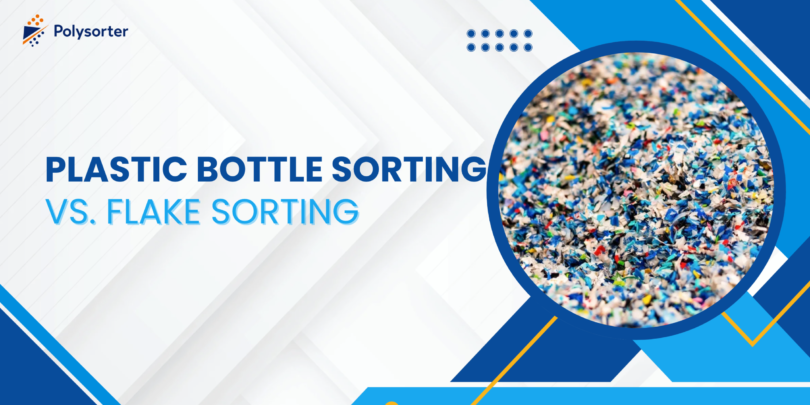
Plastic bottle sorting vs. flake sorting is an important consideration for recycling facilities looking to improve material purity, reduce contamination, and increase the value of recovered plastics. Although both technologies use automated separation systems, they operate at different stages of the recycling process and solve different problems.
Bottle sorting separates whole plastic containers before shredding, while flake sorting removes unwanted particles from crushed plastics, typically after washing and drying. The distinction affects equipment selection, operating costs, and the quality of recycled material.
For recycling plant operators, choosing the right technology is not simply about purchasing the most advanced machine. It requires understanding the incoming material, identifying contamination risks, and determining the purity required for the final product.
This guide explains how both technologies work, their key differences, and when recycling facilities should invest in one or both sorting stages.
What Is Plastic Bottle Sorting and How Does It Work?
Plastic bottle sorting is an upstream separation process that identifies and removes unwanted plastic containers before they enter shredding and washing operations.
Post-consumer bottle streams often contain PET beverage bottles, HDPE containers, PP packaging, PVC bottles, and containers of different colors. Without effective separation, these materials can become mixed during size reduction, making downstream purification more difficult.
How Plastic Bottle Sorting Machines Work
Industrial bottle sorting machines commonly use conveyor-based feeding systems, optical sensors, and automated ejection mechanisms.
The process generally involves four steps:
- Material feeding: Bottles are released from compressed bales and distributed across a conveyor for inspection.
- Material detection: Sensors examine individual containers to identify visible characteristics or polymer composition.
- Intelligent classification: The control system determines which bottles meet the sorting requirements.
- Automated separation: Air ejectors or other mechanisms direct targeted containers into different material streams.
Visible-light cameras identify differences in bottle color, shape, and surface appearance. For example, they can distinguish clear PET bottles from green or blue bottles when the visual characteristics are sufficiently different.
Near-infrared (NIR) sensors provide another level of identification by analyzing the spectral response of plastic materials. Suitable NIR systems can distinguish PET from other polymers, including HDPE, PP, and PVC, under appropriate detection conditions.
AI-assisted image recognition may further support classification of irregular containers and complex packaging.
However, labels, full-body sleeves, overlapping bottles, dirt, and certain dark pigments can interfere with detection. Full-body labels may obscure the underlying polymer, making accurate material identification more challenging.
To reduce these limitations, some recycling facilities use mechanical de-labeling equipment before optical bottle sorting. Removing labels can expose more of the bottle surface and improve sensor visibility. However, the placement of de-labeling equipment depends on the recycling line configuration, feedstock characteristics, and sorting requirements.
Why Bottle Sorting Matters
The main advantage of bottle sorting is removing unwanted materials before they enter energy-intensive downstream processes.
For example, separating non-PET containers before shredding reduces the amount of unwanted plastic processed by a PET washing line.
This can help facilities reduce unnecessary processing, improve feedstock consistency, and recover different plastic fractions.
Nevertheless, bottle sorting cannot eliminate every contaminant. Caps, labels, multilayer packaging components, and small foreign materials may remain attached to accepted bottles.
Additional washing, mechanical separation, and downstream purification are often necessary.

What Is Plastic Flake Sorting and Why Is It Important?
Plastic flake sorting is a downstream purification process that separates crushed plastic fragments according to detectable color differences, polymer composition, or other material characteristics.
After shredding and washing, recycled plastic flakes may appear clean but still contain unwanted materials.
For example, a clear PET flake stream may include colored PET, PVC fragments, PE or PP particles, and residual label material. Even small quantities of certain contaminants can affect downstream processing and finished-product quality.
How Plastic Flake Sorting Machines Work
Unlike bottle sorting systems, which typically handle larger containers on conveyors, many industrial flake sorters use gravity-fed or chute-based configurations.
Prepared flakes are distributed through the feeding system and inspected as they pass through the detection area.
Depending on the machine configuration, the sorting system may use different sensor technologies.
Visible-Light Color Sorting
High-resolution cameras detect differences in color, brightness, and visible appearance.
This technology is suitable for separating clear PET flakes from blue, green, brown, or visibly discolored particles.
However, color sorting alone cannot reliably distinguish different polymers when they have similar appearances.
Near-Infrared Polymer Sorting
NIR sensors analyze material-specific spectral characteristics to identify different plastic polymers.
For example, suitable NIR sorting equipment can detect PVC or polyolefin fragments mixed with PET, even when the particles have similar visible colors.
Detection performance depends on particle size, surface condition, sensor configuration, and material presentation. Some dark plastics and complex materials may be difficult to identify using conventional NIR technology.
Combined Color and Polymer Sorting
Some flake sorting systems integrate visible-light and NIR detection to address both color contamination and polymer contamination.
After identification, precisely timed air ejectors remove targeted particles from the material stream.
Why Flake Sorting Improves Recycled Material Quality
Flake sorting targets contamination that remains after earlier processing stages.
For example, washing can remove dirt and residues, while density separation can remove certain polymers with different floating characteristics.
In conventional PET recycling lines, float-sink separation typically removes much of the PP and PE contamination, as these polymers generally float in water while PET sinks.
However, density separation cannot reliably remove every foreign polymer. PVC, for example, generally sinks along with PET, making separation by water density alone difficult.
Optical flake sorting provides an additional purification stage to remove remaining detectable contaminants, including PVC fragments and unwanted colored PET.
Its effectiveness should be evaluated through measurable improvements in material purity and recovery rather than assuming that every contaminant can be removed.
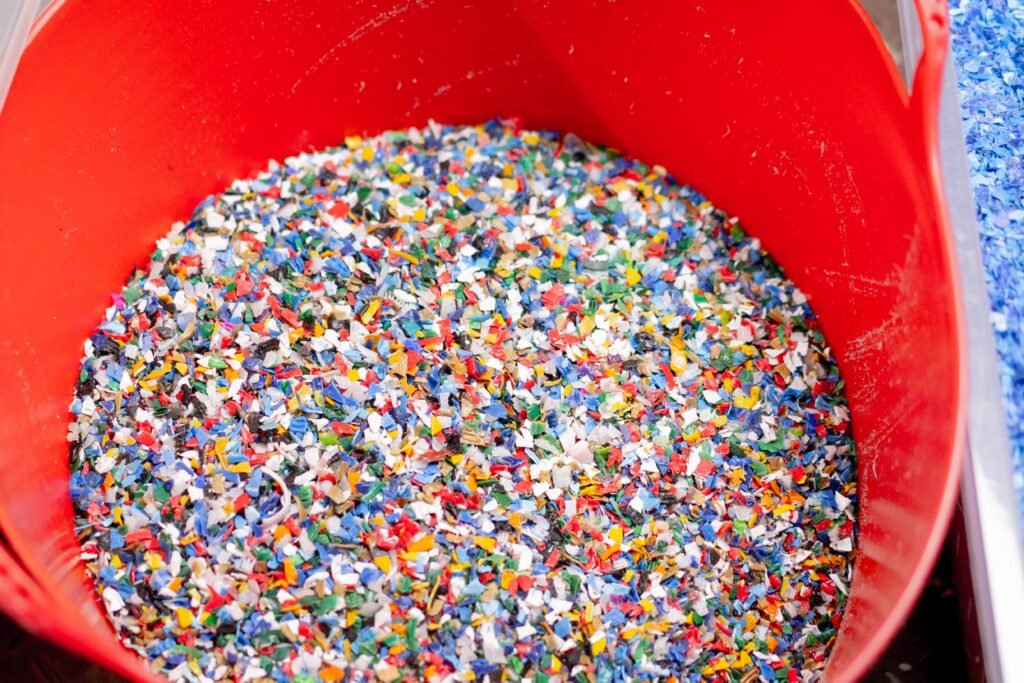
Plastic Bottle Sorting vs. Flake Sorting: Key Technical Differences
The primary difference between plastic bottle sorting and flake sorting is the physical form of the material being inspected.
Whole bottles provide relatively large surfaces for identification, while plastic flakes are smaller, move differently, and require more precise feeding and detection arrangements.
These characteristics influence equipment design, sensor selection, and achievable sorting performance.
Bottle Sorting vs. Flake Sorting Comparison Table
| Comparison Factor | Bottle Sorting | Flake Sorting |
| Material form | Whole or largely intact containers | Crushed plastic fragments |
| Process position | Before shredding | Commonly after washing and drying |
| Main objective | Bulk material separation | Residual contamination removal |
| Feeding system | Conveyor-based | Commonly gravity-fed or chute-based |
| Sorting targets | Polymer type, bottle color, container category | Polymer type, flake color, residual impurities |
| Sensor options | Visible-light, NIR, AI-assisted vision | Visible-light, NIR, combined detection |
| Feedstock requirements | Separated, inspectable containers | Controlled particle size and feed condition |
| Main challenges | Labels, overlap, deformation, dirt | Small particles, moisture, dust, overlap |
| Economic benefit | Reduces unwanted downstream processing | Improves usable recyclate quality |
| Key performance indicators | Separation efficiency and bottle recovery | Final purity and valuable flake recovery |
| Typical application | Mixed bottle recycling | PET flake purification and plastic regrind processing |
Visible-Light Sorting vs. NIR Polymer Identification
Understanding the distinction between color recognition and polymer identification is essential when comparing plastic sorting machines.
Visible-light cameras classify materials according to detectable differences in appearance. They can separate different colors of the same polymer but cannot reliably identify chemical composition from color alone.
For example, transparent PET and transparent PVC may look similar under visible light despite having different material properties.
NIR sensors analyze spectral characteristics associated with polymer composition. This allows suitable equipment to distinguish many plastics that appear visually similar.
However, NIR detection is not universal. Surface contamination, multilayer structures, small particle dimensions, and certain pigments can reduce identification reliability.
Therefore, a color sorter should not automatically be considered a polymer sorter. Equipment selection must reflect the actual separation task.
Sorting Accuracy, Purity, and Recovery
Neither bottle sorting nor flake sorting is inherently more accurate in every application.
Bottle sorting can efficiently reject identifiable unwanted containers, while flake sorting can target smaller residual contaminants.
Performance depends on the feed material, sensor capabilities, particle presentation, operating speed, and rejection settings.
Importantly, high product purity does not necessarily mean high material recovery.
Aggressive rejection settings may remove more contaminants but also discard acceptable plastic.
Recycling facilities should evaluate purity and recovery together to understand the true effectiveness of a sorting system.
Should Recycling Plants Choose Bottle Sorting, Flake Sorting, or Both?
The right sorting stage depends on the incoming material and the quality requirements of the finished recycled plastic.
In many recycling operations, bottle sorting and flake sorting are complementary technologies rather than direct alternatives.
When Bottle Sorting Is the Better Choice
Bottle sorting is generally the first priority when a facility receives mixed whole containers.
For example, a PET recycling plant processing post-consumer beverage bottles may need to separate HDPE, PP, PVC, and unwanted colored containers before shredding.
Removing these materials upstream reduces unnecessary processing and helps maintain more consistent feedstock quality.
Bottle sorting is especially valuable when contamination levels are high or the facility wants to recover several marketable polymer fractions.
When Flake Sorting Is the Better Choice
Flake sorting is often more suitable for facilities processing already shredded or washed plastics.
A recycling company purchasing washed PET flakes from external suppliers, for example, may need to remove remaining colored particles or foreign polymers.
Because the material is already crushed, whole-bottle sorting equipment would not address this requirement.
Flake sorting may also be appropriate when existing washing and mechanical separation systems cannot consistently achieve the required output specification.
When Both Sorting Stages Are Needed
Facilities processing mixed post-consumer bottles into high-purity recycled flakes may benefit from using both stages.
A typical PET recycling process can follow this sequence:
Bale Opening → Bottle Sorting → Shredding → Washing and Density Separation → Drying → Flake Sorting → Final Quality Control
Bottle sorting removes identifiable unwanted containers before size reduction.
Washing and mechanical separation remove dirt, residues, labels, and certain foreign materials. In PET recycling, float-sink separation is particularly useful for removing lighter PP and PE components.
Flake sorting then targets remaining detectable color and polymer contamination.
Depending on the recycling line design, additional steps such as mechanical de-labeling, metal removal, and pre-washing may be incorporated before or after bottle sorting. The exact process sequence should be adapted to the incoming material and required output quality.
This multi-stage approach distributes separation tasks across the recycling line instead of relying on one machine to remove every impurity.
However, facilities receiving consistently clean, pre-sorted materials may not require both systems.
The final configuration should be based on representative material testing and defined quality targets.
How to Choose the Right Plastic Sorting Machine for Your Recycling Plant
Once the required sorting stage has been identified, the next step is evaluating equipment performance and long-term operating value.
Purchasing decisions should be based on actual material conditions rather than nominal machine specifications alone.
Define Material and Output Requirements
Before comparing suppliers, document the incoming polymer types, contamination levels, material size, and expected processing capacity.
Then establish measurable finished-material requirements.
These may include acceptable foreign-polymer contamination, color consistency, target purity, and minimum recovery.
Different applications require different levels of purification, so the sorting configuration should match the intended downstream use.
Evaluate Real Processing Capacity
Machine throughput should be evaluated under realistic operating conditions.
A sorter processing clean, uniform material may perform differently when handling mixed colors, irregular particles, or heavily contaminated feedstock.
Ask suppliers to demonstrate capacity using representative material at the required purity and recovery targets.
Compare Total Cost of Ownership
The initial purchase price represents only part of the investment.
Total cost of ownership should also consider electricity, compressed air, maintenance, cleaning, labor, spare parts, and installation requirements.
Bottle sorting may create economic value by reducing unnecessary downstream processing.
Flake sorting may create value by improving the quality and marketability of recovered material.
The better investment depends on which contamination problems create the greatest financial losses.
Verify Performance Through Material Testing
Before making a final purchase decision, request sorting trials using representative production samples.
A meaningful test should measure processing capacity, accepted-material purity, valuable-material recovery, and contaminant rejection.
Operating requirements and maintenance accessibility should also be reviewed.
These results provide a stronger basis for comparing suppliers and estimating operational benefits than isolated accuracy claims.
Frequently Asked Questions About Bottle and Flake Sorting
1. What is the main difference between bottle sorting and flake sorting?
Bottle sorting separates whole plastic containers before shredding, while flake sorting separates smaller plastic fragments, commonly after washing and drying. Bottle sorting primarily improves incoming feedstock quality, whereas flake sorting focuses on removing residual contaminants.
2. Is flake sorting more accurate than bottle sorting?
Not necessarily. Both technologies can achieve effective separation when matched to suitable materials and operating conditions. Performance depends on sensor capabilities, contamination levels, feeding consistency, and the required balance between purity and recovery.
3. Can one machine sort both plastic bottles and flakes?
Most industrial sorting systems are designed for specific material sizes and feeding conditions. Whole bottles and small flakes generally require different handling and ejection configurations. Any claimed dual-purpose capability should be verified through material testing.
4. Does a PET recycling plant need both sorting stages?
Not always. Plants processing mixed post-consumer bottles may benefit from both stages, while facilities receiving clean, pre-shredded material may only require flake purification. The decision depends on contamination levels and finished-material specifications.
5. Can bottle sorting remove all PVC contamination from PET?
No. Bottle sorting can reject detectable PVC containers, but small fragments or contamination associated with accepted bottles may remain. Additional downstream separation may be required to meet the desired PET purity.
6. Can flake sorting separate PET from PP and PE?
Yes. Suitable NIR-based flake sorting systems can identify and separate PET from PP and PE under appropriate conditions. However, in conventional PET recycling lines, most PP and PE contaminants are typically removed through float-sink separation during washing. Flake sorting is therefore more commonly used to remove remaining contaminants, such as PVC, unwanted colored PET, and other detectable impurities.
7. Which sorting stage provides a better return on investment?
The better investment depends on the recycling operation. Bottle sorting can reduce unnecessary downstream processing, while flake sorting can improve finished-material quality. Reliable ROI estimates require actual throughput, purity, recovery, operating-cost, and material-value data.
Conclusion: Choosing the Right Sorting Strategy for Plastic Recycling
Understanding the differences between bottle sorting and flake sorting helps recycling facilities select equipment that matches their production requirements.
Bottle sorting focuses on removing unwanted containers before shredding, reducing unnecessary processing and improving feedstock consistency.
Flake sorting targets smaller residual contaminants, helping improve the purity and consistency of recycled plastic.
Neither technology is universally superior. The right solution depends on incoming materials, existing processing equipment, required output quality, and investment priorities.
For some facilities, one sorting stage is sufficient. For others, combining upstream bottle separation with downstream flake purification provides a more complete recycling strategy.
Looking for the right plastic sorting solution? Contact PolySorter to discuss your material characteristics, contamination challenges, processing capacity, and target output quality. Our team can help evaluate whether bottle sorting, flake sorting, or a combined sorting configuration is the best fit for your recycling operation.