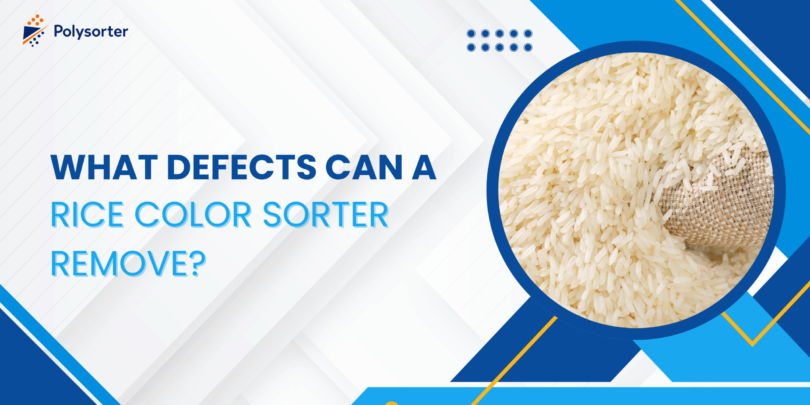
Rice may appear uniform after milling and polishing, but commercial batches often contain much more variation than expected. Yellow kernels, chalky grains, black spots, immature rice, broken kernels, surface damage, and residual foreign materials can all affect the appearance and market grade of the finished product.
A rice color sorter is designed to identify these unwanted materials by analyzing visible differences between acceptable rice and the target defects. Modern optical sorting systems can evaluate characteristics such as color, brightness, shape, size, transparency, and surface patterns. Once a defective kernel is recognized, the machine tracks its position and uses a precisely timed air jet to separate it from the accepted product stream.
However, not every rice defect is equally easy to detect. A dark kernel against white rice creates strong visual contrast, while slight chalkiness or a small damaged area may be much harder to distinguish. Sorting performance also depends on the rice variety, defect severity, feeding conditions, machine settings, and required final quality.
For buyers, therefore, the important question is not simply whether a machine can “sort defective rice.” It is what defects a rice color sorter can remove reliably under your actual processing conditions.
What Color Defects Can a Rice Color Sorter Remove?
Color abnormalities are among the most common targets in optical rice sorting. Because these defects usually create visible differences from acceptable kernels, they are also relatively easy to evaluate during a sample sorting test.
Yellow and Dark Yellow Rice
Yellow rice is a common concern in white rice processing. Affected kernels may range from slightly cream-colored grains to clearly dark yellow rice.
When the discoloration is obvious, optical identification is relatively straightforward. The challenge increases when a yellow kernel differs only slightly from acceptable rice.
In this situation, the sorting system needs enough sensitivity to recognize subtle color differences without rejecting excessive amounts of good rice. This balance between defect removal and good-rice recovery is important when evaluating machine performance.
Black, Brown, and Discolored Kernels
Black grains, dark spots, brown discoloration, and other abnormal color patterns can also be identified when they differ sufficiently from the target rice.
Some defects affect the entire kernel, while others appear only as a small spot or patch. Localized defects require more detailed image analysis because most of the grain may still look normal.
Differently Colored Rice
Not every rejected grain is technically defective.
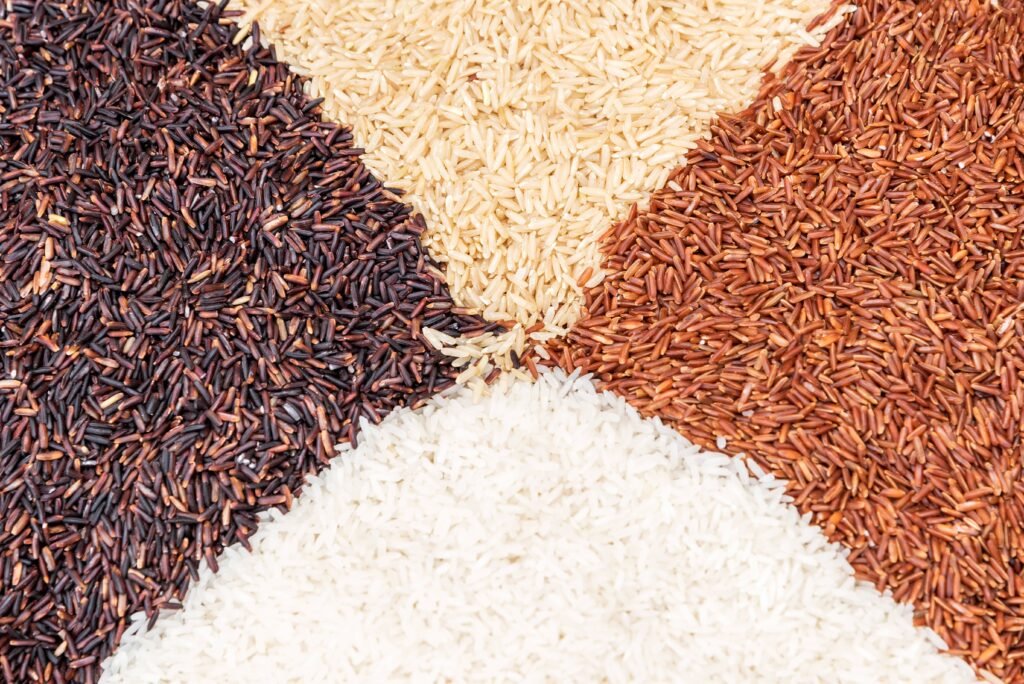
For example, a differently colored rice variety mixed into a uniform white rice batch may still be perfectly edible. However, if it does not meet the appearance requirements of the finished product, it can be classified as a reject.
This illustrates an important principle of optical sorting: the machine separates material according to the quality standard established by the processor. Different sorting programs can therefore be used for different rice varieties, grades, and customer requirements.
Can a Rice Color Sorter Remove Chalky, Immature, and Broken Rice?
Some rice defects are not defined primarily by color. Differences in transparency, shape, size, and surface appearance can also provide useful information for optical classification.
Chalky Rice
Chalky rice contains opaque white areas that differ from the more translucent appearance of normal kernels.
The amount of chalkiness can vary considerably. Some grains may be almost completely chalky, while others contain only a small opaque area. Strongly chalky grains generally provide a clearer optical difference, whereas partially chalky kernels require more precise classification.
For processors producing premium or export-grade rice, controlling excessive chalkiness can help improve the visual uniformity of the finished product.
Immature and Abnormal Kernels
Immature kernels may differ in color, size, transparency, shape, or overall appearance.
When these characteristics create a recognizable difference, an optical rice sorting machine can classify them according to the selected acceptance standard. However, immature kernels that closely resemble normal rice may be more difficult to distinguish.
This is one reason sorting results should always be evaluated with the buyer’s actual raw material rather than assuming identical performance across every rice variety.
Broken Rice
Broken rice requires a different approach because it is not necessarily waste.
In some processing lines, broken kernels are removed from premium whole-grain rice. In others, they are collected as a separate commercial grade.
Where broken kernels can be distinguished through visible size and shape differences, optical sorting can support this separation. The appropriate sorting strategy therefore depends on whether the processor wants to reject, recover, or separately grade broken rice.
A useful way to understand the main sorting targets is:
| Rice Defect | Typical Detectable Feature | Relative Sorting Difficulty |
| Yellow rice | Yellow or cream discoloration | Low–Medium |
| Black/dark kernels | Strong dark discoloration | Low |
| Chalky rice | Opaque or cloudy white areas | Medium |
| Immature kernels | Abnormal color, size or transparency | Medium |
| Broken rice | Different length or shape | Low–Medium |
| Insect-damaged rice | Holes, dark spots or irregular surfaces | Medium–High |
| Mold-damaged rice | Visible spots or discoloration | Medium–High |
| Foreign materials | Different color, shape or appearance | Material-dependent |
These difficulty levels are only general guidance. Actual results depend on how clearly the target defect differs from acceptable rice under the installed optical system.
Can a Rice Color Sorter Detect Mold, Insect Damage, and Surface Defects?
Surface-related defects are more complicated because their appearance can vary significantly from one kernel to another.
Visibly Mold-Damaged Rice
Mold-related deterioration may create dark spots, discoloration, abnormal surface patterns, or other visible changes.
When these abnormalities are optically distinguishable, affected kernels can potentially be identified and rejected. The system may evaluate several visible characteristics together rather than relying only on a simple light-versus-dark comparison.
However, this capability has an important limit.
A rice color sorter identifies observable characteristics of the kernel. It does not directly measure invisible chemical contamination, nor should optical sorting be treated as proof that a batch is free from mycotoxins.
For food-safety applications, optical sorting should therefore work alongside appropriate testing and broader quality-control procedures.
Insect-Damaged Rice
Insect damage can create small holes, dark marks, broken edges, irregular shapes, or surface abnormalities.
If these features are sufficiently visible, image-based recognition can classify affected kernels. Large or strongly discolored damage is generally easier to identify than very small defects that closely resemble the natural surface of rice.
Other Surface Defects
Storage deterioration, mechanical damage, heat-related discoloration, and processing damage may also change the visible appearance of a grain.
Modern recognition systems can use combinations of color, shape, edge characteristics, brightness, and surface patterns to differentiate these kernels.
The key requirement is that there must be a detectable difference.
If an unacceptable grain and an acceptable grain appear almost identical to the installed sensor, software cannot reliably classify them simply because the operator knows that one is defective. The sensor must first be able to capture a meaningful difference.
What Foreign Materials Can a Rice Color Sorter Remove?
A rice processing line may still contain residual foreign materials after cleaning, destoning, husking, milling, polishing, and grading.
Depending on their appearance and the sensor configuration, optical sorting can provide an additional quality-control stage for materials such as:
- Paddy or husk fragments
- Straw and plant material
- Weed seeds
- Small wood fragments
- Visually distinguishable stones or gravel
- Other particles with contrasting colors or shapes
However, a rice color sorter should not be viewed as a replacement for conventional cleaning and destoning equipment.
Bulk impurities are better removed during earlier mechanical cleaning stages. Optical sorting is most valuable as a precision separation step, targeting remaining impurities and defective grains that have passed through upstream equipment.
Sensor capability also matters.
A conventional visible-light system works best when the unwanted material has a recognizable visual difference from the accepted rice. If two materials look extremely similar under visible light, conventional color recognition may have difficulty separating them.
Additional sensor technologies can be useful when a specific application requires information beyond normal visible appearance. The correct sensor configuration should therefore be selected according to the actual contaminant rather than assuming that every foreign material can be removed by the same optical setup.
For buyers, this changes the question from:
“Can this machine remove foreign materials?”
to:
“Can this sensor configuration distinguish my specific foreign material from my rice?”
That question is much more useful when comparing rice sorting machines.
How to Evaluate Rice Color Sorter Defect Removal Before Buying
A supplier may provide a long list of detectable defects, but this does not show how the machine will perform with your actual rice. Representative sample testing is a more practical way to evaluate sorting performance.
Use samples from normal production and make sure they contain the defects you actually want to remove, such as yellow rice, chalky grains, black spots, immature kernels, or broken rice.
During the test, focus on three results:
Accepted-product quality. Check how many target defects remain after sorting.
Good-rice loss. Examine the reject stream to see whether too much acceptable rice is being removed together with defective kernels.
Practical throughput. Confirm that the required sorting quality can be maintained at a capacity suitable for your production line.
These factors should be evaluated together. Increasing sorting sensitivity may remove more borderline defects, but it can also increase good-rice loss. Similarly, a machine that performs well at a very low test capacity may not deliver the same result at normal production throughput.
For this reason, the best rice color sorter is not simply the one that produces the cleanest sample. It should achieve the required finished-rice quality while maintaining practical throughput and acceptable product recovery.
When comparing suppliers, use similar rice samples and the same acceptance standard for each test. Comparing the accepted material, reject stream, throughput, and recovery rate will give you a much clearer basis for choosing the right machine.
FAQ About Rice Color Sorter Defect Removal
What defects can a rice color sorter remove?
A rice color sorter can typically target yellow rice, dark or discolored kernels, chalky rice, immature grains, broken rice, black spots, and other visually distinguishable abnormalities. Depending on the application and sensor configuration, it can also separate selected foreign materials.
Can a rice color sorter remove chalky rice?
Yes. Chalky areas have different opacity and visual characteristics from normal translucent kernels. However, partially chalky grains can be more difficult to classify than strongly chalky rice.
Can a rice color sorter remove moldy rice?
It can reject mold-damaged kernels when the damage creates detectable discoloration, spots, or other visible abnormalities. Optical sorting does not directly detect invisible toxins, so it should not replace appropriate food-safety testing.
Can a rice color sorter separate broken rice?
Yes, when broken kernels can be classified according to visible differences in size and shape. Whether they are rejected or recovered as a separate grade depends on the processing objective.
Can a rice color sorter remove stones?
Some residual stones can be removed when their visible characteristics differ sufficiently from the rice and can be recognized by the installed sensors. However, optical sorting should not replace the main destoning stage of a rice processing line.
Can a rice color sorter remove foreign materials?
Yes, certain foreign materials such as husk fragments, plant material, seeds, wood fragments, and visually distinct particles can be targeted. Performance depends on whether the installed sensor system can reliably distinguish the foreign material from acceptable rice.
Can one sorting setting remove every rice defect?
Usually not optimally. Yellow rice, chalkiness, broken kernels, dark spots, and subtle surface defects have different characteristics. Sorting parameters should be adjusted according to the incoming material and required finished-product standard.
Choosing a Rice Color Sorter Around Your Actual Defects
So, what defects can a rice color sorter remove?
Yellow rice, dark and discolored kernels, chalky grains, immature rice, broken kernels, visible insect damage, surface abnormalities, and selected foreign materials can all be suitable sorting targets when they produce characteristics that the installed optical system can distinguish.
But the most important purchasing decision is not finding the machine with the longest defect list.
A sorter must match your actual raw material, defect profile, required finished-product quality, processing capacity, and acceptable recovery rate. A defect that is easy to remove from one rice variety may be much more difficult to distinguish in another.
That is why representative sample testing should play an important role in equipment selection.If you are evaluating a rice sorting solution, PolySorter can assess your rice variety, representative raw-material samples, major defects, required capacity, and finished-product target to help determine a suitable sorting configuration.