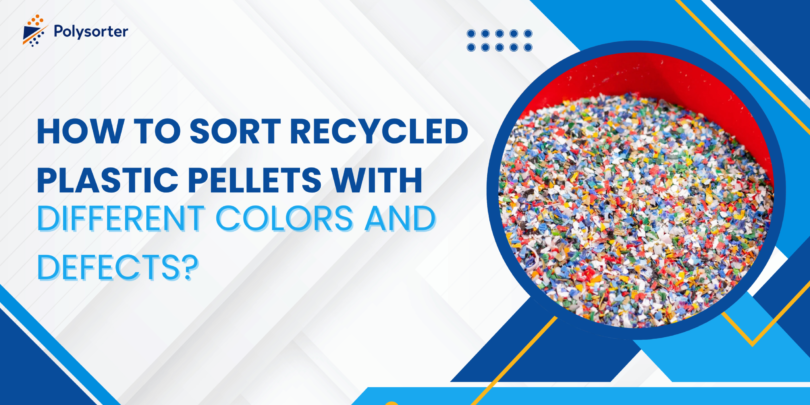
Recycled plastic pellets are widely used in packaging, injection molding, extrusion, and other plastic manufacturing applications. However, maintaining consistent pellet quality can be challenging. Even after washing, melting, filtration, and pelletizing, recycled granules may contain unwanted colors, black spots, yellowed particles, or other visible defects.
These imperfections can affect the appearance of finished plastic products, reduce batch consistency, and increase quality-control costs. For manufacturers supplying natural, transparent, white, or colored recycled pellets, even a small proportion of visibly defective granules may be unacceptable.
Recycled plastic pellet sorting provides an automated way to identify and separate granules based on their optical characteristics. Using camera-based inspection and precise rejection systems, a plastic pellet color sorter can remove targeted defective particles while retaining acceptable material.
But different defects require different inspection methods. A machine that easily separates black pellets from white granules may not perform equally well when detecting tiny dark inclusions inside transparent pellets.
This guide explains how to identify common pellet defects, how optical sorting technology works, and how to choose a suitable sorting machine for your recycling operation.
Understanding Different Colors and Defects in Recycled Plastic Pellets
Before selecting sorting equipment, manufacturers need to understand which defects are present and how they affect the finished material.
Not all pellet defects have the same origin, and not all can be detected through conventional optical inspection.
Mixed-Color Plastic Pellets
Color contamination is one of the most common problems in recycled pellet production.
For example, a batch of natural recycled pellets may contain occasional blue, green, brown, or black granules. These unwanted particles can originate from insufficient separation of incoming plastic waste, residual pigments, or contamination between production batches.
Although the affected pellets may retain usable mechanical properties, their appearance can make them unsuitable for applications requiring consistent coloration.
Optical color sorting is particularly useful when unwanted pellets have a distinguishable color difference from acceptable material.
Black Spots and Dark Inclusions
Black spots can develop from degraded polymer residues, carbonized material, contaminated feedstock, or insufficient melt filtration.
Some defects appear as completely dark pellets. Others are small black inclusions inside otherwise acceptable granules.
This distinction is important because detecting an entirely black pellet is generally easier than identifying a tiny dark spot within a transparent or translucent particle.
The visibility of small inclusions depends on their size, position, optical contrast, and the inspection system.
Yellowing, Opacity, and Other Visible Defects
Recycled pellets may also develop yellow or brown discoloration during processing. In transparent applications, opaque particles or visible inclusions can create additional quality problems.
The following table summarizes common defects and their sorting considerations.
| Defect type | Typical appearance | Optical sorting approach |
| Mixed-color pellets | Unexpected colored granules | Color recognition and separation |
| Black spots | Dark specks or inclusions | High-resolution optical inspection |
| Yellowed pellets | Yellow or brown discoloration | Color and shade detection |
| Opaque pellets | Reduced transparency | Suitable lighting and contrast detection |
| Visible foreign particles | Particles with distinguishable appearance | Optical impurity recognition |
| Irregular pellets | Oversized, deformed, or clustered granules | Mechanical screening or supported shape inspection |
An important limitation is that visual appearance does not necessarily reveal polymer composition. Conventional color sorting cannot reliably distinguish visually identical PET, PP, and PE pellets.
Similarly, internal contamination without a detectable optical difference may require other quality-control methods.
Understanding these limitations helps manufacturers establish realistic sorting requirements before purchasing equipment.

How a Plastic Pellet Color Sorting Machine Works
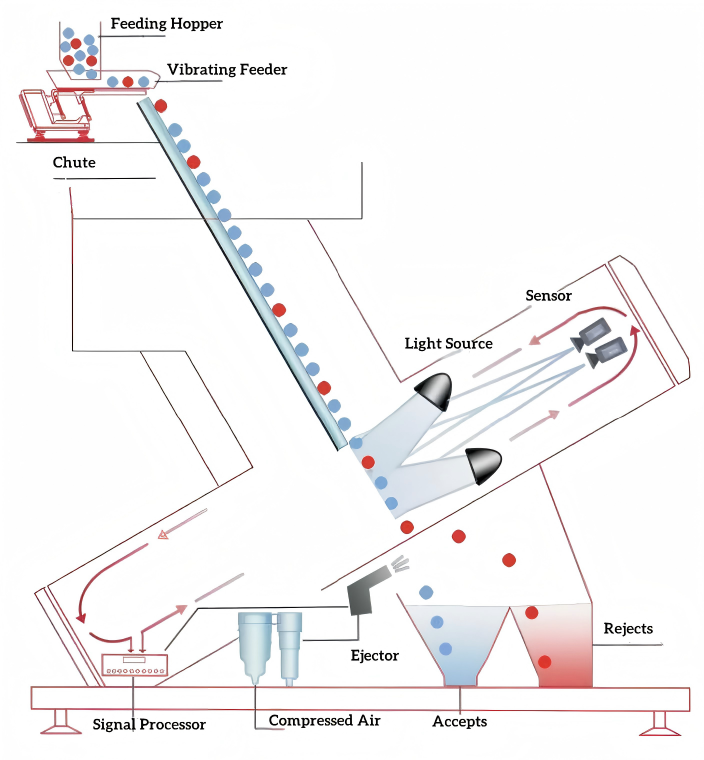
A plastic pellet color sorting machine combines controlled material feeding, optical inspection, image processing, and automatic rejection.
Its purpose is to inspect individual granules and separate particles that do not meet predefined appearance standards.
Feeding and Material Distribution
Plastic pellets enter the machine through a controlled feeding system.
The equipment distributes the granules to create a stable material flow through the inspection area. Proper distribution helps prevent overlapping particles and allows the optical system to observe more of each pellet.
Clean, dry, free-flowing pellets generally provide more stable inspection conditions.
Excessive dust, moisture, or inconsistent feeding can reduce detection reliability and increase unnecessary rejection.
Optical Detection and Defect Recognition
As pellets pass through the inspection zone, cameras capture information about their appearance.
Depending on the optical configuration, the system may evaluate color, brightness, transparency, visible inclusions, and specific surface characteristics.
Different pellet types may require different illumination arrangements.
For example, transparent pellets containing dark inclusions may benefit from lighting designed to reveal internal contrast. White or colored pellets may require settings that distinguish unwanted shades from acceptable variations.
The captured information is processed according to predefined sorting criteria.
Operators can adjust detection thresholds to identify unwanted particles while avoiding excessive rejection of acceptable pellets.
Automatic Pellet Separation
When the inspection system identifies a defective pellet, the sorting controller calculates its position and activates the appropriate rejection mechanism.
In pneumatic sorting systems, precisely timed compressed-air pulses divert unwanted granules into a separate outlet.
Acceptable pellets continue into the finished-product stream.
This process enables continuous inspection and separation without requiring operators to manually examine individual particles.
However, sorting effectiveness depends on more than camera resolution. Lighting, material presentation, image processing, rejection timing, and operating conditions all influence the final result.
How to Sort Recycled Plastic Pellets Step by Step
Effective recycled plastic pellet sorting begins with defining the required product quality and selecting appropriate inspection settings.
The following procedure can help recycling facilities establish a reliable sorting process.
Step 1: Prepare the Plastic Pellets
Before optical sorting, pellets should be sufficiently clean, dry, and free from excessive dust.
Where necessary, mechanical screening can remove fines, oversized particles, and clumps.
A consistent material flow allows the optical system to inspect pellets more effectively.
Manufacturers should also identify whether their material consists of transparent, translucent, white, or colored granules because these characteristics influence the inspection requirements.
Step 2: Identify the Defects That Must Be Removed
Different pellet applications require different sorting strategies.
| Pellet type | Common unwanted defects | Main sorting priority |
| Transparent pellets | Black spots, yellowing, colored or opaque granules | Transparency and visible inclusion detection |
| White pellets | Black particles, dark spots, colored granules | Strong color contrast |
| Colored pellets | Incorrect colors or inconsistent shades | Color classification and shade thresholds |
| Translucent pellets | Dark inclusions, discoloration, opaque particles | Suitable illumination and defect contrast |
| Mixed-color pellets | Unwanted color fractions | Target color selection and separation |
For transparent recycled pellets, manufacturers may prioritize removing black inclusions and yellowed particles.
For white pellets, the primary objective may be separating dark or colored granules.
For colored pellets, the challenge may involve distinguishing unacceptable shades from normal color variation.
A suitable sorting program should reflect these differences instead of applying the same settings to every material.
Step 3: Configure the Sorting Parameters
Once the target defects are identified, operators can adjust the machine’s inspection settings.
These may include color thresholds, defect sensitivity, material feeding rate, and rejection parameters.
Increasing sensitivity may improve the detection of subtle defects. However, overly strict settings can also cause acceptable pellets to enter the reject stream.
The objective is not simply to remove as many particles as possible. It is to achieve the required finished-product quality while maintaining reasonable material recovery.
Step 4: Conduct Representative Sorting Tests
Sorting trials are essential before finalizing operating settings.
Manufacturers should test pellets that represent actual production conditions, including normal variations in color, size, defect concentration, and material characteristics.
A practical test should evaluate:
- Incoming defect concentration
- Remaining defects in accepted pellets
- Acceptable material lost in the reject stream
- Stable throughput under the selected settings
- Consistency across repeated trials
For example, a facility processing transparent pellets may first establish a baseline for visible black spots.
After sorting, samples from the accepted and rejected streams can be examined to determine whether the required quality has been achieved and whether excessive good material was rejected.
If necessary, the sorting parameters can be adjusted and the test repeated.
Step 5: Monitor and Optimize Production
Once the sorting process is operating, regular sampling helps maintain consistent results.
Changes in raw material sources, pellet appearance, or contamination levels may require updated sorting settings.
Some facilities may also evaluate a second sorting pass or separate recovery treatment for rejected material.
However, additional passes should be justified by actual improvements in quality and recovery rather than assumed to be necessary.
How to Choose the Right Plastic Pellet Sorting Machine
Choosing suitable equipment requires more than comparing machine prices or advertised processing capacities.
A plastic pellet sorting machine should be evaluated according to the material it will process, the defects it must detect, and the quality requirements of the finished product.
Select Equipment Designed for Plastic Pellets
Plastic pellets are generally smaller and more uniform than shredded flakes or whole plastic bottles.
A sorting machine designed for larger recycling materials may not provide the feeding control or optical inspection needed for small granules.
Buyers should confirm that the equipment is suitable for their pellet dimensions, appearance, and production requirements.
For transparent pellets, the ability to detect small visible inclusions may be particularly important.
For mixed-color granules, accurate color recognition and stable rejection may be the main priorities.
Evaluate Optical Detection Capabilities
Camera resolution is important, but it should not be considered independently.
The complete inspection system determines whether a particular defect can be detected.
Buyers should examine the equipment’s lighting configuration, optical sensitivity, material presentation, and ability to inspect the target pellet type.
A supplier should also explain which defects are detectable and which may fall outside the equipment’s capabilities.
For example, a machine capable of removing completely black pellets may not necessarily detect extremely small inclusions inside otherwise transparent granules.
Actual sample testing provides a more meaningful assessment than general performance claims.
Compare Sorting Quality, Recovery, and Throughput
Three factors deserve particular attention when comparing equipment:
Sorting quality: How effectively does the machine reduce unwanted particles in the accepted material?
Material recovery: How much acceptable material remains in the finished-product stream rather than being unnecessarily rejected?
Processing capacity: How much material can the equipment process while maintaining the required sorting quality?
These factors are closely connected.
Increasing the feed rate may affect inspection conditions, while more aggressive rejection settings may improve visual purity at the expense of material recovery.
Therefore, buyers should evaluate all three under comparable test conditions.
Review Operating and Maintenance Requirements
Long-term operating costs also influence equipment selection.
Important considerations include compressed-air consumption, electricity requirements, cleaning accessibility, spare parts, maintenance procedures, and operator training.
Facilities handling different pellet colors should also evaluate how easily sorting programs can be adjusted or changed between production batches.
Equipment that performs well during a short demonstration should also be capable of maintaining stable results during normal production.
Request a Material Sorting Test Before Purchasing
A representative sample test is one of the most useful steps in the purchasing process.
Before testing, buyers should provide information about the pellet material, size range, target defects, expected throughput, and acceptable output quality.
The test should establish measurable acceptance criteria rather than relying solely on visual impressions.
For example, a buyer can compare incoming and outgoing defect concentrations while recording acceptable material losses and processing conditions.
This makes it easier to determine whether the proposed machine can meet production requirements.
PolySorter can help evaluate pellet sorting applications based on material characteristics, visible defects, and required output quality.
Improving Recycled Plastic Pellet Quality with Optical Sorting
Optical pellet sorting is most effective when used as part of a broader quality-control process.
Upstream preparation can reduce contamination before extrusion, while final pellet inspection helps remove identifiable visible defects that remain after production.
Combine Upstream Cleaning with Final Pellet Inspection
Washing, drying, polymer separation, and melt filtration address different quality problems.
For example, washing removes surface contamination, while suitable filtration systems help reduce certain solid contaminants during extrusion.
Optical pellet sorting provides an additional inspection stage after pelletizing.
It can identify unwanted off-color granules, black spots, and other visible defects that were not eliminated earlier.
However, optical sorting does not replace polymer identification or laboratory testing when chemical composition and material properties must be verified.
Maintain Stable Production Conditions
Some pellet defects originate during extrusion.
Excessive processing temperatures, prolonged material residence times, or accumulated degraded residues may contribute to discoloration and black spots.
Controlling these conditions helps reduce the number of defective pellets entering the sorting system.
This is generally more efficient than relying exclusively on downstream rejection to correct preventable processing problems.
Use Sorting Data to Improve Quality Control
Regularly reviewing sorting results can help manufacturers identify changes in material quality.
For example, an increase in rejected black-spotted pellets may indicate changes in incoming material or processing conditions.
Tracking rejection rates, accepted-product quality, and material recovery can support better production decisions.
Over time, combining stable upstream processing with effective optical inspection can help manufacturers produce more visually consistent recycled granules.
Frequently Asked Questions About Plastic Pellet Sorting
What types of defects can a plastic pellet color sorter detect?
A suitable plastic pellet color sorter can detect identifiable visible defects, including unwanted colors, black spots, yellowing, opaque particles, and certain visible impurities. Detection performance depends on defect size, optical contrast, pellet characteristics, and machine configuration.
Can transparent and colored recycled plastic pellets be separated automatically?
Yes. Optical sorting machines can separate transparent and visibly colored pellets when the differences are detectable under the configured inspection conditions. Actual performance should be verified through material testing.
Can a plastic pellet sorting machine remove very small black spots?
Some optical systems can detect small visible inclusions, but there is no universal minimum detectable defect size. Performance depends on sensor resolution, lighting, pellet transparency, defect location, and operating conditions. Buyers should test their specific material before purchasing.
Can one machine sort PET, PP, and PE pellets?
A plastic pellet color sorter can inspect visible differences in pellets made from PET, PP, and PE. However, conventional RGB cameras cannot reliably distinguish polymers with similar colors and appearances.
For polymer identification, Near-Infrared (NIR) or suitable hyperspectral sorting technology may be used, depending on the material characteristics and equipment configuration. Buyers should verify the system’s polymer recognition capabilities through representative sample testing.
How can I test a plastic pellet sorting machine before purchasing?
Provide representative pellet samples containing the defects you need to remove. Establish measurable quality requirements, then compare incoming contamination, accepted-product quality, material recovery, and stable throughput during the test.
What is the difference between plastic flake sorting and pellet sorting?
Plastic flake sorting generally occurs before extrusion and helps remove unwanted colors or, with appropriate sensors, certain polymer contaminants. Pellet sorting takes place after pelletizing and focuses on detecting and removing identifiable visible defects from finished granules.
Conclusion: Choosing an Effective Recycled Plastic Pellet Sorting Solution
Sorting recycled plastic pellets with different colors and defects requires a clear understanding of the material, the defects that must be removed, and the inspection technology available.
A suitable optical pellet sorter can help manufacturers separate off-color granules, remove identifiable visible impurities, and improve the appearance consistency of finished recycled materials.
However, successful recycled plastic pellet sorting depends on appropriate feeding conditions, reliable optical detection, carefully adjusted sorting parameters, and representative material testing.
For buyers evaluating different machines, the most important consideration is whether the equipment can achieve the required output quality and material recovery under realistic production conditions.
Looking for a reliable plastic pellet sorting solution? Contact PolySorter to discuss your pellet materials, common defects, production capacity, and quality requirements. Our team can help assess your application and recommend a suitable optical sorting solution.