Reducing good grain loss during optical sorting is essential for grain processors seeking higher recovery rates, consistent product quality, and better operating efficiency. Although grain color sorters are designed to remove defective kernels and foreign materials, some acceptable grains may also enter the reject stream. Over time, this unnecessary rejection reduces the amount of marketable product and increases processing costs.
For grain cleaning plants, flour mills, and agricultural processing facilities, effective sorting involves more than removing visible impurities. The objective is to achieve the required finished-product quality while retaining as much acceptable grain as possible.
Modern grain color sorters combine optical recognition, image-processing algorithms, controlled feeding, and precisely timed air ejectors. However, their performance depends on how these systems work together and how well the equipment is maintained.
Understanding the causes of unnecessary rejection, the operating parameters that influence it, and the methods used to measure grain recovery can help processors make better equipment and production decisions.
What Causes Good Grain Loss During Optical Sorting?
Good grain loss occurs when acceptable grains are removed from the production stream instead of being retained in the finished product. The two main mechanisms are false rejection and collateral rejection, although feeding conditions and equipment maintenance can influence both.
False Rejection and Natural Grain Variation
False rejection occurs when an optical sorting system incorrectly classifies acceptable grain as defective.
Agricultural products naturally vary in color, shape, size, and surface appearance. Healthy wheat kernels, for example, may display different shades because of variety, growing conditions, or maturity.
If the detection threshold is too restrictive, these natural differences may trigger unnecessary rejection. The problem becomes more noticeable when processing mixed varieties or grain with substantial visual variation.
Poor optical visibility can also contribute to classification errors. Dust accumulation on inspection windows or contamination of the background can reduce image clarity and interfere with consistent recognition.
Collateral Rejection During Air Ejection
Not every acceptable grain entering the reject stream has been incorrectly identified.
Sometimes, the sorter correctly detects a defective kernel, but the resulting air pulse also removes nearby acceptable grains. This is known as collateral rejection.
The likelihood depends on grain spacing, ejector response, nozzle characteristics, and material movement.
When grains travel too closely together, a single ejection event may affect several particles.
In practical equipment evaluation, collateral rejection can be examined through the composition of the reject stream, including the relationship between removed defects and acceptable grains.
Uneven Feeding and Excessive Throughput
Optical sorting requires grains to pass through the inspection area with sufficient separation for reliable detection and ejection.
Excessive feeding rates can cause particles to overlap or cluster together. This may interfere with image analysis and increase the likelihood of acceptable grains being removed alongside defects.
Therefore, maximum machine capacity does not always represent the optimal operating capacity.
The appropriate throughput depends on grain characteristics, incoming defect concentration, equipment configuration, and the required finished-product quality.

How to Reduce Good Grain Loss Through Sorting Parameters and Maintenance
Optimizing the primary sorting process is often the most practical way to reduce unnecessary rejection.
Rather than immediately adding recovery equipment, processors should first examine detection settings, optical cleanliness, and ejector performance.
Adjust Detection Sensitivity Carefully
Sorting sensitivity determines how strictly the machine identifies differences between acceptable and unacceptable materials.
Higher sensitivity can improve the detection of subtle defects. However, excessively strict settings may classify naturally varied but acceptable grains as unwanted material.
For example, a wheat processor may need to remove severely discolored or visibly damaged kernels while retaining healthy grains with minor color differences.
Operators should adjust detection thresholds gradually and examine both accepted and rejected material after each change.
Reducing sensitivity may lower false rejection, but it can also allow additional defects into the finished product. Recovery improvements must therefore be evaluated alongside finished-product quality.
Keep Optical Windows and Backgrounds Clean
Optical recognition depends on stable illumination and clear images.
In grain processing environments, dust from wheat, corn, and other agricultural materials may accumulate on optical windows and surrounding components.
When contamination interferes with the optical path, image contrast and recognition consistency can deteriorate. This may contribute to classification errors or unstable sorting performance.
Routine maintenance should include inspecting and cleaning optical windows, checking background surfaces, and confirming that illumination remains stable.
Where available, automatic window-cleaning mechanisms and dust-extraction systems can help maintain suitable inspection conditions.
However, cleaning requirements and available automation depend on the equipment configuration.
Maintain Clean, Dry Compressed Air and Accurate Ejection
Compressed-air quality directly affects the reliability of pneumatic sorting components.
Moisture, oil aerosols, and particulate contamination may interfere with solenoid valves, air passages, and ejector nozzles. Over time, contamination can contribute to inconsistent valve operation, blocked nozzles, or increased maintenance requirements.
Air preparation systems should provide suitable filtration and drying according to the machine’s specifications and operating environment.
Depending on the installation, this may involve refrigerated or desiccant air dryers, particulate filters, and oil-removal filtration.
Operators should also maintain stable air pressure and verify that ejectors respond at the correct time.
Reducing pressure without proper testing is not necessarily beneficial because insufficient force may allow defective grains to remain in the accepted stream.
Low grain loss depends on the coordination of optical recognition, material presentation, and precise ejection—not on detection technology alone.
Improve Grain Recovery Through Feeding and Material Preparation
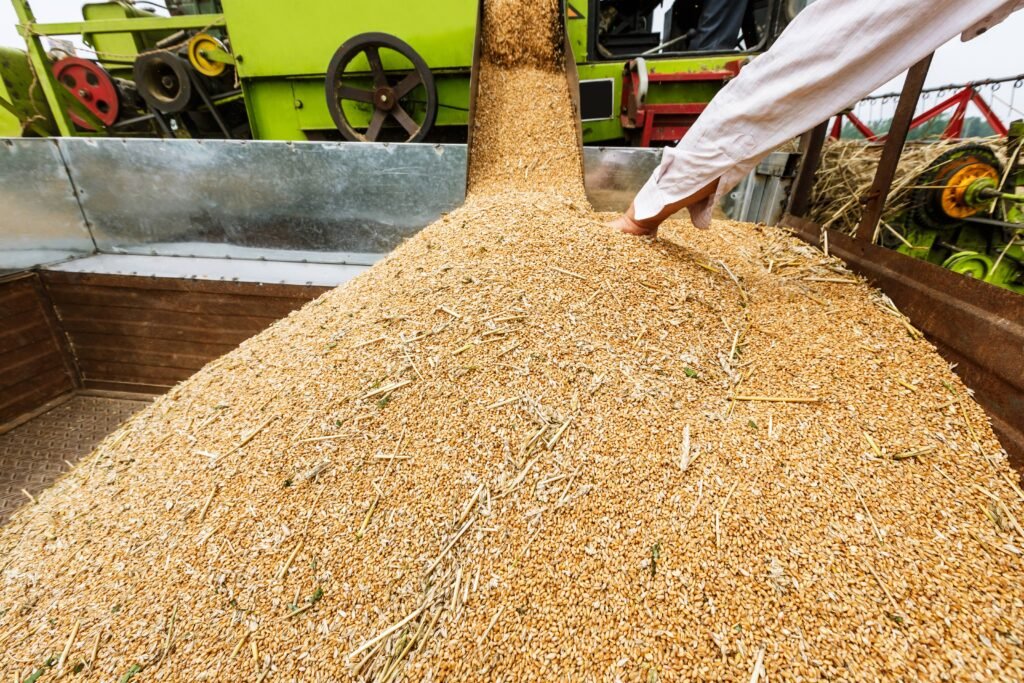
Even a properly calibrated grain sorter may experience unnecessary rejection when incoming material is poorly prepared.
Stable feeding and suitable pre-cleaning help create better conditions for reliable inspection.
Maintain Uniform Material Distribution
Grains should enter the inspection area in a controlled, consistent flow.
When material distribution is uneven, some sections of the machine may become overloaded while others remain underutilized.
This increases particle overlap and makes targeted ejection more difficult.
Feeding systems should be adjusted according to grain size, flow characteristics, and the intended processing capacity.
Regular inspection of vibratory feeders, channels, and material-contact surfaces can prevent buildup that disrupts material movement.
Different grain varieties may require different feeding settings, even when processed on the same machine.
Improve Pre-Cleaning Before Optical Sorting
Pre-cleaning can improve optical sorting conditions by removing materials that do not require advanced optical identification.
Depending on the application, screening, aspiration, and mechanical separation may remove oversized debris, dust, lightweight impurities, and other unwanted materials.
Reducing these contaminants before optical sorting helps improve material presentation and prevents unnecessary loading of the inspection system.
However, mechanical pre-cleaning cannot replace optical sorting when defective and acceptable grains have similar physical dimensions.
The two processes serve different purposes and can complement each other within a grain processing line.
Consider Secondary Sorting Only When Necessary
Some facilities use an additional sorting pass to recover acceptable grains from the initial reject stream.
This approach may be useful when rejected material contains a substantial proportion of recoverable grain.
However, secondary sorting introduces additional handling, operating costs, and process complexity.
Before implementing another sorting stage, processors should determine whether excessive rejection can be reduced through better detection settings, stable feeding, optical cleaning, or ejector calibration.
Optimizing the primary sorting process should generally come first.
How to Measure Good Grain Loss, Recovery Rate, and Carryover Ratio
Reducing grain loss requires measurable results rather than relying only on the appearance of the finished product.
Three useful indicators are the good grain loss rate, good grain recovery rate, and reject-to-good ratio. Each describes a different aspect of sorting performance.
Good Grain Loss Rate
The good grain loss rate measures the proportion of acceptable incoming grain that ends up in the reject stream.
Good Grain Loss Rate (%) = (Acceptable Grain in Reject Stream ÷ Acceptable Grain in Feed) × 100
For example, consider a sorting trial with:
- Total incoming material: 1,000 kg
- Acceptable grain in feed: 950 kg
- Defective grain and impurities: 50 kg
- Acceptable grain in reject stream: 19 kg
The calculation is:
19 ÷ 950 × 100 = 2.0%
This means that 2% of the acceptable incoming grain was rejected.
The total reject weight should not be confused with good grain loss because the reject stream also contains intentionally removed defects and impurities.
Good Grain Recovery Rate
The recovery rate measures how much acceptable incoming grain remains in the accepted output.
Good Grain Recovery Rate (%) = (Acceptable Grain in Accepted Stream ÷ Acceptable Grain in Feed) × 100
Using the same example, assuming the only outlets are the accepted and rejected streams:
Acceptable grain recovered = 950 − 19 = 931 kg
931 ÷ 950 × 100 = 98.0%
This means that 98% of the acceptable incoming grain was retained.
Recovery rate and loss rate are complementary under this two-stream material balance, but neither independently describes finished-product purity.
Carryover Ratio or Reject-to-Good Ratio
Another useful indicator is the relationship between defective material and acceptable grain in the reject stream.
This may be described as a carryover ratio, reject-to-good ratio, or bad-to-good ratio. However, terminology and ratio direction can vary between suppliers and processing facilities.
For clarity, this article defines the ratio as:
Reject-to-Good Ratio = Defective Material in Reject Stream : Acceptable Grain in Reject Stream
For example:
- 1:1 means 1 kg of defective material is rejected alongside 1 kg of acceptable grain.
- 3:1 means 3 kg of defective material is rejected alongside 1 kg of acceptable grain.
- 10:1 means 10 kg of defective material is rejected alongside 1 kg of acceptable grain.
Under this definition, a higher ratio indicates less acceptable grain in the reject stream relative to the amount of defective material removed.
However, a higher ratio does not automatically prove better overall sorting performance. The machine may also be removing fewer defects.
Therefore, reject composition should always be evaluated alongside finished-product purity, defect removal performance, and good grain recovery.
Compare Performance Before and After Optimization
The following example illustrates how improved operating conditions can affect material recovery.
| Performance Indicator | Before Optimization | After Optimization |
| Total incoming material | 1,000 kg | 1,000 kg |
| Acceptable grain in feed | 950 kg | 950 kg |
| Acceptable grain in reject | 38 kg | 19 kg |
| Good grain loss rate | 4.0% | 2.0% |
| Good grain recovery rate | 96.0% | 98.0% |
| Acceptable grain recovered | 912 kg | 931 kg |
Illustrative calculation only. Actual performance depends on material characteristics, equipment settings, and operating conditions.
In this example, optimization recovers an additional 19 kg of acceptable grain from the same incoming batch.
However, these figures alone do not establish that finished-product purity remains unchanged. A complete comparison must also measure the defective material remaining in the accepted output.
The most suitable operating point balances finished-product purity, good grain recovery, and processing throughput rather than maximizing one indicator independently.
How to Choose a Grain Color Sorter with Lower Grain Loss
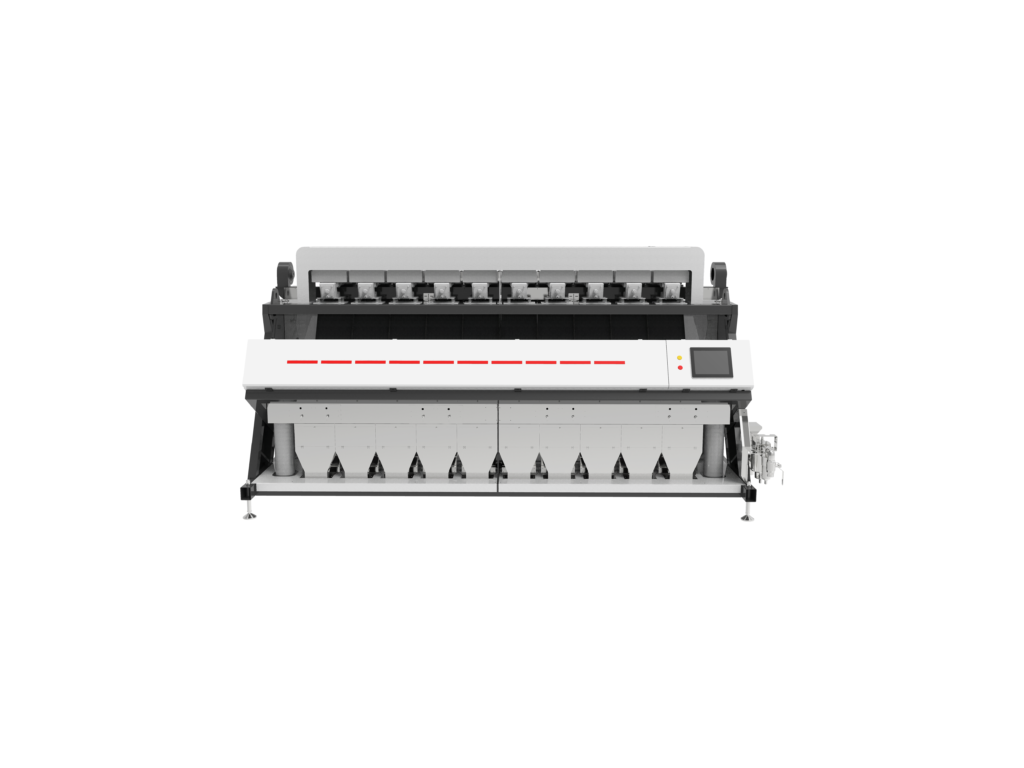
For equipment buyers, grain recovery should be considered alongside sorting accuracy, processing capacity, reliability, and operating costs.
A machine that produces visually clean grain but rejects excessive amounts of acceptable material may not deliver the best economic result.
Evaluate Recognition and Ejection Performance
The first consideration is whether the equipment can reliably identify the defects present in the buyer’s material.
Visible-light optical sorting can identify many defects involving color, shape, or surface appearance. However, some internal defects and contaminants cannot be reliably identified through visible appearance alone.
Specialized sensing or additional inspection methods may be required for particular applications.
Buyers should also evaluate how accurately identified defects are physically removed.
Even reliable recognition may result in unnecessary grain loss if ejector timing or material spacing is unsuitable.
Compare Machines Through Representative Material Tests
Actual material testing is one of the most useful ways to evaluate grain sorting equipment.
A meaningful comparison should use equivalent operating conditions and clearly defined acceptance standards.
| Evaluation Factor | What Buyers Should Check |
| Raw material | Same batch or verified equivalent samples |
| Finished-product standard | Consistent acceptance criteria |
| Sorting accuracy | Defects remaining in accepted output |
| Good grain recovery | Acceptable grain entering the reject stream |
| Reject-to-good ratio | Defective-to-acceptable material ratio in reject |
| Processing capacity | Performance at realistic operating throughput |
| Ejection precision | Unnecessary removal of nearby acceptable grains |
| Operating stability | Consistency during sustained operation |
| Maintenance | Ease of cleaning, air filtration, and routine servicing |
Testing should include normal variations in grain appearance, defect concentration, and material flow.
A short demonstration under ideal conditions may not reflect performance during continuous industrial operation.
Consider Total Operating Value
The purchase price of a grain color sorter is only one part of its long-term cost.
Material recovery, compressed-air consumption, electricity usage, maintenance, and production stability all influence operating economics.
For example, two machines may achieve similar finished-product purity while rejecting different amounts of acceptable grain.
The machine with better recovery may generate greater long-term value, provided that its capacity, reliability, and operating requirements are also suitable.
Buyers should therefore request trial results showing finished-product quality, grain recovery, and reject composition rather than relying on a single sorting accuracy figure.
FAQ About Good Grain Loss During Optical Sorting
1. Why does a grain color sorter reject good grains?
Acceptable grains may be rejected because of strict detection thresholds, natural color variation, contaminated optical windows, overlapping material, inaccurate ejection timing, or collateral rejection.
2. Can reducing sorting sensitivity improve grain recovery?
Yes, but only when the adjusted settings continue to meet finished-product quality requirements. Lower sensitivity may reduce false rejection while allowing additional defective grains to pass.
3. How does compressed-air quality affect grain sorting?
Moisture, oil, and particles in compressed air can affect pneumatic components and ejector reliability. Suitable drying, filtration, and routine maintenance help maintain consistent operation.
4. What is a good carryover ratio for grain sorting?
There is no universal target. Ratio definitions and acceptable values depend on material characteristics, defect concentration, product standards, and equipment configuration. Buyers should compare results using the same calculation method.
5. How can buyers compare the recovery performance of different grain sorters?
Use representative material samples, equivalent quality requirements, and realistic processing rates. Measure good grain loss, recovery rate, reject composition, and finished-product purity under comparable conditions.
Conclusion
Reducing good grain loss during optical sorting requires a balanced approach to recognition accuracy, detection sensitivity, feeding stability, optical cleanliness, and ejection control. Excessive rejection is not always caused by inadequate equipment. In many cases, unsuitable settings or inconsistent operating conditions contribute to unnecessary material loss.
For grain processors, the most effective strategy is to identify the causes of rejection, measure actual recovery performance, and optimize the primary sorting process before investing in additional recovery equipment.
When purchasing a grain color sorter, evaluating finished-product purity, good grain recovery, reject composition, and realistic throughput together provides a more reliable basis for equipment selection.
PolySorter provides optical grain sorting solutions for agricultural processing applications. If you want to improve sorting efficiency, reduce unnecessary grain rejection, or evaluate equipment for your processing line, visit PolySorter to explore our grain sorting solutions and contact our team to discuss material testing and equipment selection.