Choosing the right ore sorting technology can make a significant difference in mineral recovery, waste rejection, and processing costs. However, with several sensor-based sorting technologies available, determining which system best suits a particular ore deposit is not always straightforward.
XRT vs. Optical Ore Sorting is an important comparison for mining companies planning to improve ore quality or remove waste rock before downstream processing. Both technologies identify and separate individual particles, but they rely on different physical properties to make sorting decisions.
Optical ore sorting uses cameras and image-processing algorithms to identify visible differences in color, brightness, texture, and shape. X-ray transmission (XRT) sorting measures how X-rays are attenuated as they pass through particles, providing information that may not be visible on the surface.
In this comparison, optical sorting primarily refers to camera-based systems operating in the visible spectrum. Other technologies, such as near-infrared and hyperspectral sorting, use different spectral information and are not directly interchangeable with conventional color sorting.
Understanding how these technologies work, where they perform best, and how to evaluate their results will help mining operators select equipment based on actual processing requirements rather than marketing claims.
How Do XRT and Optical Ore Sorting Machines Work?
Both technologies belong to the broader category of sensor-based ore sorting. They inspect individual particles moving through a controlled detection area and use automated separation mechanisms to direct material into different streams.
However, their detection principles are fundamentally different.
How Optical Ore Sorting Works
An optical ore sorting machine uses high-resolution cameras, controlled lighting, and image-processing software to examine the visible characteristics of each particle.
The system can identify differences in color, brightness, surface texture, shape, and visible mineral features. As particles move through the detection area, software compares their characteristics with established sorting criteria.
The machine then activates a separation mechanism, often using precisely controlled compressed-air ejectors.
Optical sorting is particularly effective when valuable minerals and waste material have consistent visual differences.
For example, quartz containing dark or colored impurities may be separated from cleaner quartz when the differences are sufficiently visible. Similar principles can apply to calcium carbonate, feldspar, dolomite, and other industrial minerals.
Modern systems can also use artificial intelligence and deep-learning algorithms to recognize more complex visual patterns. However, these technologies do not eliminate the fundamental limitations of surface-based detection.
If valuable and unwanted particles look nearly identical, optical cameras may struggle to distinguish them reliably.
How XRT Ore Sorting Works
XRT sorting uses a different detection method.
An X-ray source directs radiation through moving ore particles. Detectors on the opposite side measure the transmitted X-ray intensity.
The amount of attenuation depends on several factors, including material density, effective atomic composition, particle thickness, and X-ray energy.
As a result, particles with similar external appearances may produce different X-ray responses.
Some industrial systems use dual-energy XRT technology. By comparing attenuation measurements at different X-ray energies, these systems can improve material discrimination and reduce certain effects associated with particle thickness.
However, XRT does not directly measure the complete chemical composition or precise mineral grade of each particle. Its effectiveness depends on whether differences in X-ray attenuation correlate reliably with the target separation.
XRT should also not be confused with X-ray fluorescence (XRF). XRT measures transmitted X-ray attenuation, while XRF detects characteristic fluorescent X-rays to obtain elemental information.
For mining operations, XRT is especially relevant when valuable and barren particles show measurable attenuation differences despite having similar surface characteristics.
XRT vs. Optical Ore Sorting: Key Differences
The main difference between these technologies is the information used to identify valuable material.
Optical systems evaluate what cameras can observe on the particle surface. XRT systems examine how radiation passes through the particle.
This affects material suitability, feed preparation, equipment complexity, and potential applications.
| Comparison | Optical Ore Sorting | XRT Ore Sorting |
| Detection principle | Visible-light imaging | X-ray transmission |
| Main characteristics | Color, brightness, texture, shape | X-ray attenuation influenced by composition, density, and thickness |
| Surface dependence | High | Relatively low |
| Internal mineral contrast | Limited unless reflected at the surface | May detect internal attenuation differences |
| Surface contamination | Can interfere with recognition | Generally less sensitive to visible surface contamination |
| Typical applications | Industrial mineral purification and visually distinguishable ore separation | Ore pre-concentration and waste-rock rejection |
| Equipment considerations | Lighting, cameras, feeding, and ejection systems | X-ray source, detectors, shielding, feeding, and ejection systems |
| Main selection factor | Consistent visual contrast | Consistent X-ray attenuation contrast |
Why Surface Appearance Matters
Consider a mineral processing operation where clean quartz particles are mixed with visibly discolored material.
If the unwanted particles can be identified by color or texture, optical sorting may provide an effective separation method without requiring X-ray detection.
Now consider an ore deposit where mineralized rocks and barren rocks have nearly identical surface appearances.
A visible-light camera may not provide sufficient information to classify them. However, if the two particle groups have distinguishable X-ray attenuation characteristics, XRT may offer a practical alternative.
Neither example proves that one technology is universally superior. Instead, it demonstrates why material characteristics should determine sensor selection.
Equipment Design: Chute-Type vs. Belt-Type Sorting
Beyond sensor technology, the material handling system also influences sorting performance.
Optical ore sorters may use chute-type (free-fall) or belt-type configurations.
Chute-type systems allow particles to pass through the detection area under gravity. Their relatively compact structure makes them suitable for certain dry, free-flowing mineral materials, particularly when consistent feeding and particle presentation can be maintained.
Belt-type systems transport particles through the detection area on a conveyor. This provides controlled particle movement and can accommodate different material characteristics, including larger ore fragments.
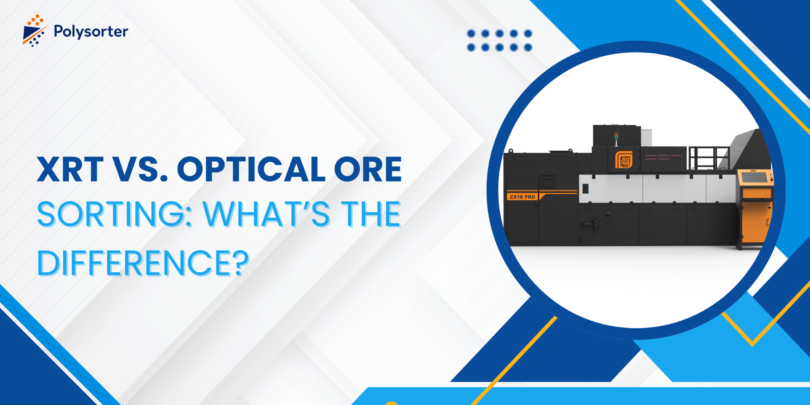
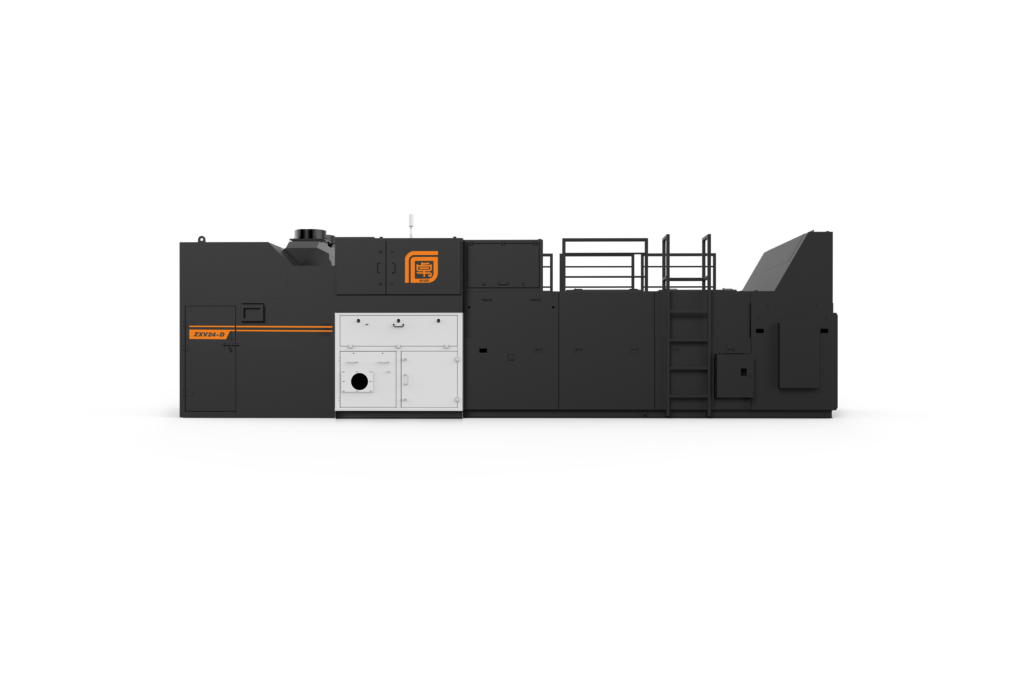
Industrial XRT ore sorting machines commonly use belt-type conveyors. Stable conveyor speed and controlled particle positioning help maintain consistent X-ray scanning conditions and accurate separation.
However, equipment configuration should not be selected independently of material properties. Particle size, moisture, throughput, wear resistance, and separation requirements all influence the final mechanical design.
Equipment Complexity and Operating Requirements
The two technologies also differ in their supporting equipment.
Optical sorters require stable illumination, clean optical components, controlled feeding, and accurate particle tracking.
XRT systems require an X-ray source, suitable detectors, radiation shielding, safety interlocks, and appropriate monitoring and maintenance procedures.
Both technologies may use compressed air for particle ejection, depending on the machine design.
XRT equipment can involve additional safety, maintenance, and regulatory requirements associated with industrial X-ray systems. However, actual operating costs depend on machine configuration, capacity, site conditions, and maintenance arrangements.
Therefore, buyers should compare complete operating requirements rather than assuming one technology always has lower costs.
When Should You Choose Optical Ore Sorting?
Optical sorting is often a strong candidate when mineral quality or waste characteristics can be recognized through visible differences.
This makes it particularly relevant for industrial mineral processing, where product appearance and impurity removal can directly influence commercial value.
Optical Sorting for Industrial Minerals
Common applications worth evaluating include quartz, silica, calcium carbonate, feldspar, dolomite, and similar mineral materials.
For example, a quartz processing facility may need to remove visibly stained particles, dark inclusions, or foreign material before producing higher-quality mineral products.
If these defects create consistent optical differences, a camera-based sorting system may distinguish acceptable and unacceptable particles.
Optical sorting can also support quality classification when the desired product is defined partly by visible characteristics.
However, appearance should not be confused with chemical purity. A visually clean mineral particle may still contain impurities that are not detectable through conventional imaging.
When chemical composition is the primary concern, optical sorting results should be verified through appropriate laboratory analysis.
Feed Preparation and Particle Size
Optical sorting performance depends heavily on how material is presented to the sensors.
Important conditions include consistent feeding, appropriate particle-size classification, sufficient separation between particles, and adequate visibility of the target features.
Dust, mud, surface coatings, and excessive particle overlap can reduce recognition reliability.
Washing or drying may improve results in some applications, but the required preparation depends on the material and equipment configuration.
Particle size also affects equipment selection.
Fine mineral powders, medium-sized particles, and large rocks require different feeding and separation arrangements. A machine designed for fine particles should not automatically be assumed suitable for large ore fragments.
For buyers, the most important question is whether the optical system can consistently identify the target material at the required production capacity.
If visual differences are clear and stable, optical sorting may provide a practical solution without the additional complexity of X-ray detection.
When Is XRT Ore Sorting the Better Choice?
XRT is particularly valuable when the useful separation characteristic is related to X-ray attenuation rather than visible appearance.
This often makes it a candidate for mineral pre-concentration, especially where barren material can be rejected before energy-intensive downstream processing.
XRT for Ore Pre-Concentration
In conventional mineral processing, large quantities of material may pass through crushing, grinding, and concentration stages.
However, not every particle entering these processes contains sufficient valuable mineral content to justify further treatment.
If low-value particles can be identified reliably, sensor-based sorting may remove part of the waste stream before fine grinding.
Potential benefits include reduced downstream mass flow, lower processing requirements, and improved feed quality.
These benefits are conditional. Their magnitude depends on the amount of rejectable waste, valuable-mineral recovery, sorting performance, and the economics of the overall processing circuit.
XRT sorting may be evaluated for tungsten, manganese, copper, iron, lead-zinc, lithium, phosphate, bauxite, and other mineral applications.
Nevertheless, mineral names alone do not establish suitability.
Two deposits containing the same valuable mineral may have different gangue compositions, mineral associations, and particle characteristics. One may provide strong X-ray contrast, while another may require a different sensor or processing strategy.
XRT Sorting for Spodumene and Lithium Ore
Spodumene-bearing lithium ore is an important application to evaluate for sensor-based pre-concentration.
In hard-rock lithium processing, valuable spodumene may occur alongside quartz, feldspar, and other gangue minerals. Removing low-value material before grinding and concentration can potentially reduce the amount of material entering downstream processing.
Where sufficient X-ray attenuation contrast exists, XRT sorting may help separate selected mineralized particles from lower-value waste.
However, spodumene and common silicate gangue do not always provide strong XRT discrimination. Their mineral composition, particle associations, and attenuation characteristics can make separation challenging.
For this reason, XRT should not automatically be considered the best technology for every spodumene deposit.
Representative material testing is essential to determine whether XRT provides reliable separation. Depending on the ore characteristics, optical, near-infrared, or other sensor technologies may also deserve evaluation.
Limitations of XRT Ore Sorting
Although XRT can reveal differences that optical cameras cannot, it has important limitations.
First, the target material must produce a sufficiently distinguishable X-ray response. If valuable and waste particles have similar attenuation characteristics, separation may be unreliable.
Second, particle thickness and size distribution affect X-ray measurements. Suitable size classification and calibration are therefore important.
Third, mineral liberation matters. When valuable minerals and gangue remain closely associated within the same particles, rejecting those particles may also cause valuable-mineral losses.
Finally, XRT does not replace laboratory assays or detailed mineralogical analysis. Sorting performance must be confirmed through representative testing.
Can XRT and Optical Sorting Work Together?
Yes. Some sensor-based ore sorting systems combine X-ray transmission with visible-light imaging to evaluate multiple particle characteristics.
PolySorter’s ore sorting solutions include technologies designed for different mineral characteristics and separation requirements. Where appropriate, combining XRT and optical information can help improve material classification when a single sensor cannot provide sufficient discrimination.
For example, XRT may identify differences in X-ray attenuation, while optical cameras contribute information about surface color and visible mineral features.
However, multi-sensor sorting is not automatically the best choice. Its additional complexity should be justified through representative material testing and measurable improvements in sorting performance.
How to Choose the Right Ore Sorting Machine
When comparing XRT vs. Optical Ore Sorting, the most reliable purchasing strategy is to evaluate the material, processing objectives, and test results together.
A machine should not be selected solely because it has a high advertised throughput or uses a particular detection technology.
Evaluate Material Characteristics
Begin by identifying the differences between valuable ore and unwanted material.
Important information includes mineral composition, gangue characteristics, particle-size distribution, surface condition, and the degree of mineral liberation.
If visual differences are consistent, optical sorting should be considered.
If the useful distinction is associated with X-ray attenuation, XRT may be more suitable.
For deposits with variable mineralization, representative samples should cover the expected range of feed conditions rather than only the highest-grade material.
Define Processing Requirements
Next, establish what the sorting system must achieve.
Some operations prioritize removing visually defective particles to improve product quality. Others aim to reject waste rock before grinding while preserving valuable mineral recovery.
These objectives require different performance assessments.
Throughput is also important, but nominal machine capacity should not be considered independently of sorting quality.
Increasing feed rates may reduce separation performance if particle presentation, detection, or ejection becomes less reliable.
The selected system must therefore balance production capacity with acceptable recovery and product quality.
Compare Sorting Test Results
A practical sorting test should measure more than the percentage of particles correctly identified.
The following indicators are particularly useful for equipment evaluation.
| Performance Indicator | Why It Matters |
| Feed Capacity (t/h) | Confirms whether the equipment meets production requirements |
| Valuable Mineral Recovery (%) | Measures how much valuable material remains in the accepted stream |
| Waste Rejection Rate (%) | Shows how much feed mass is removed as waste |
| Grade Improvement | Indicates whether sorting improves the accepted material’s grade |
| Valuable Mineral Loss (%) | Measures valuable material lost to the rejected stream |
| Operating Cost | Helps assess energy, compressed air, maintenance, and other expenses |
| Sorting Stability | Evaluates performance under changing feed conditions |
These indicators must be considered together.
For example, a sorter may reject 40% of the feed mass but also discard an unacceptable proportion of valuable minerals. Another system may reject less waste while retaining substantially more recoverable value.
The second result could be economically preferable, depending on downstream processing costs and mineral value.
This is why a high waste rejection rate alone does not prove that a sorting system is performing well.
A meaningful evaluation should compare mass balance, valuable-mineral recovery, concentrate grade, and estimated operating economics under representative conditions.
Consider the Complete Processing Line
Finally, buyers should evaluate where the sorter will operate.
Ore sorting may be installed after crushing and screening, before grinding, or at another suitable stage in the mineral processing circuit.
The optimal location depends on particle liberation, feed size, processing objectives, and available infrastructure.
Feeding systems, conveyors, screening equipment, dust control, compressed-air supply, and maintenance access may all influence the final installation.
A well-matched sensor cannot compensate for poorly prepared feed or an unsuitable process layout.
Therefore, equipment selection should consider the entire processing system rather than the sorting machine alone.
Frequently Asked Questions About XRT and Optical Ore Sorting
Is XRT ore sorting more accurate than optical sorting?
Not necessarily. Accuracy depends on the material characteristics and sorting objective. XRT may perform better when particles have useful X-ray attenuation differences, while optical sorting may be more effective when visible characteristics provide clearer separation.
Can optical sorting detect minerals inside rocks?
Conventional visible-light sorting primarily examines surface characteristics. It cannot reliably identify internal mineralization unless that mineralization produces recognizable surface features. XRT can provide information about attenuation differences through the particle.
Does XRT directly measure mineral grade?
No. XRT measures transmitted X-ray attenuation rather than directly determining complete mineral composition or grade. A relationship between the sensor response and mineral value must be established through testing and analysis.
Which technology is better for quartz sorting?
Optical sorting is often suitable when quartz impurities or unwanted particles have visible color or texture differences. XRT may be considered when useful attenuation contrast exists. The best option depends on the impurity characteristics and required product quality.
Can XRT and optical sorting be combined?
Yes. Multi-sensor systems can combine X-ray attenuation data with visible-light information. Such configurations may improve separation for certain materials, but their additional cost and complexity should be justified by test results.
What should buyers prepare before testing an ore sorting machine?
Buyers should provide representative ore samples, particle-size information, available mineralogical or assay data, expected throughput, and the desired sorting objective. Testing should then evaluate recovery, waste rejection, product quality, and operating conditions.
Summary: Choosing Between XRT and Optical Ore Sorting
The difference between XRT vs. Optical Ore Sorting comes down to the physical characteristics used to identify valuable and unwanted material.
Optical sorting is well suited to applications where color, brightness, texture, or other visible characteristics provide reliable separation. XRT offers an alternative when differences in X-ray attenuation reveal information that surface imaging cannot.
Neither technology guarantees better recovery, higher purity, or lower processing costs in every application.
The most effective approach is to evaluate representative ore samples, define measurable sorting objectives, and compare performance under realistic operating conditions.
PolySorter provides sensor-based ore sorting solutions for different mineral characteristics, particle sizes, and processing requirements. If you are comparing XRT and optical sorting for your mining operation, contact PolySorter to discuss a sample sorting trial. Share your ore type, particle-size range, target capacity, and separation objectives so our team can evaluate suitable sorting technologies and recommend an appropriate equipment configuration.