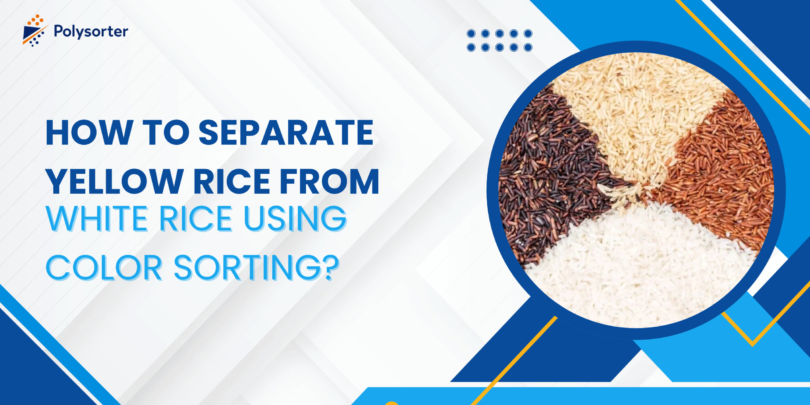
Yellow rice mixed with white rice is a common quality concern in commercial rice processing. Even a small proportion of discolored kernels can affect the appearance, grading consistency, and market value of finished rice.
How to separate yellow rice from white rice using color sorting? The process uses optical cameras to identify unwanted yellow kernels and precisely timed compressed-air jets to remove them from the white rice stream. This automated method allows processors to improve color uniformity while reducing dependence on manual inspection.
However, successful separation involves more than identifying yellow grains. Light discoloration, rice variety, feeding conditions, and rejection sensitivity all influence the final result. Excessively aggressive sorting may also remove acceptable white rice, increasing material losses.
This guide explains how optical rice sorting works, how to optimize yellow rice removal, and how to evaluate sorting equipment before purchasing.
Why Yellow Rice Needs to Be Separated from White Rice
White rice is generally expected to have a clean, uniform appearance. When yellow or discolored kernels appear in a batch, they can reduce visual consistency and make it more difficult to meet customer specifications.
What Causes Yellow Discoloration in Rice?
Storage conditions: High temperatures, unsuitable moisture levels, and prolonged storage may promote changes in grain color.
Heat exposure: Excessive drying temperatures or unfavorable storage conditions can contribute to discoloration.
Grain deterioration: Aging and other physical or chemical changes may cause kernels to develop yellowish or darker appearances.
Raw material variation: Differences in harvesting, storage, and processing history can create color inconsistencies within the same batch.
However, not every yellow-colored kernel is defective. Parboiled rice, for example, naturally differs in appearance from conventional polished white rice. Sorting criteria should always reflect the intended rice variety and finished-product standard.
Why Is Yellow Rice Removal Important?
For commercial rice processors, separating unwanted yellow grains improves finished-rice color uniformity, supports consistent grading, reduces visible discoloration before packaging, helps meet buyer-specific appearance requirements, and supports higher-value white rice grades.
It is also important to distinguish visual quality from food safety. Yellow discoloration does not automatically indicate mycotoxin contamination, and optical sorting cannot directly measure invisible toxins. When contamination is suspected, appropriate testing and food-safety controls remain necessary.

How Optical Rice Sorting Detects and Removes Yellow Grains
A modern rice color sorter combines controlled illumination, optical imaging, intelligent classification, and high-speed air ejection. The process can be divided into five stages.
Step 1: Uniform Rice Feeding
Rice enters the sorting machine through a feeding system and moves along vibrating feeders and sorting channels. The feeding mechanism distributes kernels into a consistent material flow, helping the optical system inspect individual grains. If too much rice enters simultaneously, overlapping kernels may reduce detection reliability. Stable feeding is therefore essential for accurate separation.
Step 2: Optical Detection of Yellow Rice
As rice passes through the inspection area, cameras capture images under controlled lighting conditions. The system examines visible characteristics, including color, brightness, shape, and surface appearance. Clearly yellow kernels are usually easier to distinguish from white rice. Light yellow or cream-colored grains present a greater challenge because their appearance may closely resemble acceptable kernels. Full-color imaging and suitable recognition algorithms can help identify these subtle differences.
Step 3: Intelligent Image Classification
The captured images are analyzed according to predefined acceptance and rejection criteria. For example, a sorting program may be configured to retain normal white kernels while rejecting light yellow, dark yellow, and visibly discolored grains. Advanced image-recognition systems can evaluate multiple features simultaneously, allowing more flexible classification than simple brightness-based detection. However, the actual capability depends on the installed optical system, software configuration, and characteristics of the rice being processed.
Step 4: Precision Air-Jet Rejection
Once an unwanted kernel is identified, the control system determines when to activate the appropriate ejector. A short burst of compressed air redirects the selected grain into a reject channel, while acceptable rice continues toward the finished-product outlet. Accurate rejection depends on stable material movement, correct ejector timing, and suitable compressed-air conditions.
Step 5: Collection and Secondary Sorting
After separation, the machine produces accepted and rejected material streams. The accepted stream contains rice that meets the selected optical criteria. The reject stream contains detected yellow grains and may also include some acceptable rice. Where necessary, secondary sorting can recover good kernels from the reject stream or provide additional purification. The objective is to achieve the required finished-rice quality without unnecessarily sacrificing product recovery.
How to Improve Yellow Rice Separation Efficiency
Effective yellow rice separation requires suitable machine settings and consistent material preparation. The following practices help processors improve results under real production conditions.
Prepare Rice Before Color Sorting
For polished white rice, optical sorting is commonly performed after the main cleaning, milling, and polishing operations. Removing large impurities, excessive dust, and foreign materials before sorting helps maintain stable feeding and reliable optical inspection. A cleaner, more consistent feed also reduces unnecessary interference during image recognition.
Adjust Detection Sensitivity Carefully
Detection sensitivity determines how strictly the machine distinguishes acceptable white rice from unwanted yellow kernels. Higher sensitivity may remove more lightly discolored grains. However, it can also increase the rejection of acceptable rice. Lower sensitivity may improve product recovery but allow some borderline yellow kernels to remain. The appropriate setting depends on the target rice grade and acceptable residual discoloration. For premium white rice, stricter rejection criteria may be justified. For standard commercial grades, a balanced setting may provide better overall value.
Match Feeding Rate to Sorting Requirements
Increasing throughput does not always improve production efficiency. Excessive feeding can create overlapping grains and reduce inspection reliability, especially when yellow discoloration is subtle. Operators should identify a feeding rate that maintains the required finished-product quality during continuous operation.
How to Measure Yellow Rice Removal Efficiency
Sorting performance should be evaluated using measurable results rather than visual appearance alone. Three indicators are particularly important.
1. Yellow Rice Removal Rate
Removal Rate (%) = [(Y_in – Y_out) / Y_in] × 100
Y_in = mass of yellow rice entering the sorter. Y_out = mass of yellow rice remaining in the accepted output.
For example, if a batch contains 10 kg of yellow rice before sorting and 1 kg remains in the accepted product, the yellow rice removal rate is 90%. These values must represent actual yellow-rice masses, not simply percentages measured in different-sized samples.
2. Good Rice Recovery Rate
Good Rice Recovery (%) = (W_out / W_in) × 100
W_in is the incoming acceptable white-rice mass and W_out is the acceptable white-rice mass retained after sorting.
3. Actual Processing Throughput
Throughput measures the total feed processed per hour under the selected sorting conditions. For reliable comparisons, processors should record all three indicators using representative samples and consistent test conditions.
| Performance Indicator | Main Purpose | Desired Outcome |
| Yellow rice removal rate | Measures defect removal | Higher removal |
| Residual yellow rice content | Evaluates finished-rice purity | Meets target specification |
| Good rice recovery | Measures acceptable-rice retention | Higher recovery |
| Actual throughput | Measures processing capacity | Meets production demand |
A machine should not be judged solely by its highest removal rate. The most suitable configuration balances finished-product purity, acceptable-rice recovery, and sustainable production capacity.
Choosing a Rice Color Sorter for Yellow Rice Separation
When selecting a rice color sorting machine, buyers should prioritize actual yellow-rice separation performance rather than relying only on general technical specifications.
Ability to Detect Light Yellow Kernels
Not all yellow rice is equally easy to identify. Dark yellow grains often have a clear visual difference from white rice, while slightly yellowed kernels may be difficult to distinguish. Buyers should test equipment using representative samples containing both light and dark yellow rice. The evaluation should determine whether the system can reject unwanted discoloration without removing excessive amounts of acceptable white rice.
Sorting Performance at Required Throughput
A machine may perform well during a small demonstration but produce different results at full production capacity. Buyers should therefore confirm sorting performance at the feeding rate required by their processing line. Testing should include stable operation, residual yellow-rice content, and acceptable-rice losses.
Primary and Secondary Sorting Capability
Some applications require only one sorting pass. Others benefit from additional sorting when strict quality standards or improved reject recovery are important. Secondary sorting can reduce good-rice losses by recovering acceptable kernels from the primary reject stream. However, the additional equipment or processing capacity must be justified by measurable recovery benefits.
Practical Equipment Comparison
| Evaluation Factor | Basic Sorting Requirement | More Demanding Sorting Requirement |
| Yellow discoloration | Clearly visible yellow grains | Light and dark yellow grains |
| Optical recognition | Reliable color differentiation | Detection of subtle color variations |
| Sorting target | Standard commercial appearance | Strict finished-rice uniformity |
| Recovery control | Acceptable product loss | Greater emphasis on minimizing good-rice rejection |
| Sorting stages | Primary sorting may be sufficient | Secondary sorting may be beneficial |
| Performance testing | Basic sample evaluation | Detailed purity, recovery, and throughput testing |
These are application requirements rather than guaranteed performance categories. Before purchasing, processors should request sample testing using their actual rice varieties and quality specifications. This provides a more meaningful basis for equipment selection than comparing advertised accuracy figures alone.
Common Yellow Rice Sorting Problems and Solutions
Even properly configured optical sorting equipment may require adjustment when rice characteristics or operating conditions change. The following table summarizes common problems and practical corrective actions.
| Sorting Problem | Possible Cause | Recommended Action |
| Light yellow rice remains in the accepted stream | Insufficient sensitivity or limited color contrast | Refine recognition settings and verify optical detection capability |
| Excessive white rice enters the reject stream | Overly strict rejection settings or grain overlap | Adjust sensitivity and inspect feeding conditions |
| Sorting quality decreases at high throughput | Excessive material density | Reduce feeding rate or evaluate higher-capacity equipment |
| Results vary between rice batches | Differences in variety or discoloration | Use appropriate sorting programs and retest samples |
| Rejection becomes inconsistent | Dirty optical components, unstable air supply, or ejector issues | Inspect and maintain the relevant systems |
Operators should change one major parameter at a time and evaluate the results before making further adjustments. This approach makes it easier to identify the actual cause of a sorting problem. For demanding quality requirements, repeated sampling is more reliable than judging performance from a single short test.
Frequently Asked Questions About Yellow Rice Sorting
1. Can a rice color sorter completely remove yellow rice?
A rice color sorter can remove a high proportion of visibly yellow kernels, but complete removal cannot be guaranteed. Performance depends on discoloration severity, optical detection capability, feeding conditions, and the selected rejection criteria.
2. Can light yellow rice be separated from white rice?
Yes, provided the optical system can reliably distinguish the color difference. Light yellow grains are more challenging than strongly discolored kernels and may require advanced recognition settings and careful sample testing.
3. Is yellow rice always unsafe to eat?
No. Yellow discoloration can result from several factors and does not automatically indicate contamination. However, abnormal rice should be evaluated according to applicable food-quality and safety requirements. Color sorting does not replace laboratory testing.
4. Where should a rice color sorter be installed?
For polished white rice, color sorting is commonly positioned after the main milling and polishing stages and before final packaging. The exact location depends on the processing-line configuration and product requirements.
5. Can one rice color sorter remove both yellow and chalky rice?
Yes. Suitable optical sorting systems can distinguish yellow and chalky kernels using visible characteristics. Simultaneous removal depends on the machine’s recognition capabilities and selected sorting configuration.
6. Does higher sorting sensitivity always produce better results?
No. Higher sensitivity may increase yellow-rice removal, but it can also cause more acceptable white rice to enter the reject stream. The optimal setting balances finished-product quality with good-rice recovery.
7. Is secondary sorting necessary for yellow rice removal?
Not always. Secondary sorting is useful when the reject stream contains recoverable white rice or when additional purification is required. Its value should be assessed through actual recovery and quality measurements.
8. How should buyers compare rice color sorting machines?
Buyers should conduct representative sample tests and compare residual yellow-rice content, yellow-rice removal rate, acceptable-rice recovery, and actual throughput under equivalent operating conditions.
Conclusion: Achieving Reliable Yellow Rice Separation
Understanding how to separate yellow rice from white rice using color sorting helps processors improve product appearance while maintaining efficient rice recovery.
Optical sorting systems identify unwanted discoloration through image recognition and remove selected kernels using precisely controlled air jets. However, successful separation also depends on consistent feeding, suitable recognition settings, and realistic quality targets.
For equipment buyers, the most reliable selection method is to evaluate actual rice samples and compare measurable sorting results under normal production conditions.
PolySorter provides rice color sorting solutions for commercial rice processors seeking reliable yellow rice removal and consistent finished-product quality. Contact PolySorter to discuss your rice samples, processing capacity, and suitable sorting solutions.