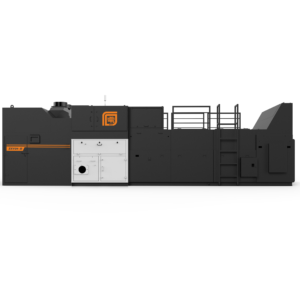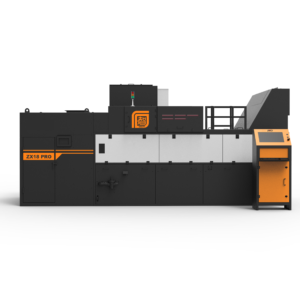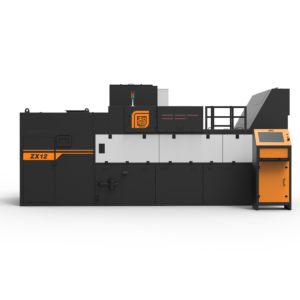
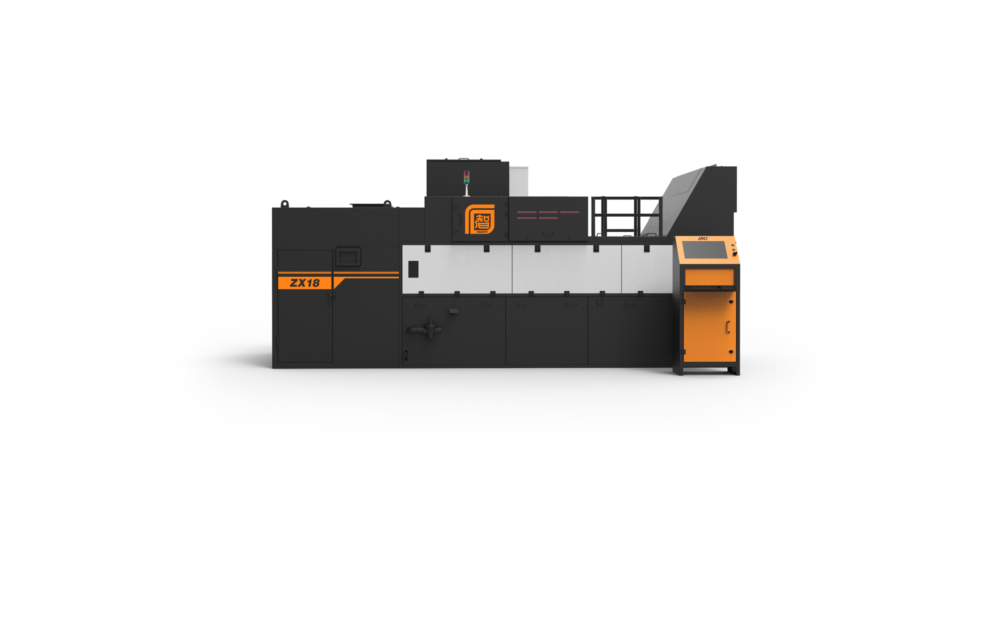
| Technical Parameter | ZX18 |
|---|---|
| Sorting Technology | X-ray Transmission (XRT) |
| Detection Width | 1800 mm |
| Processing Capacity | 30–60 T/H |
| Air Consumption | 13–17 m³/min |
| Ore Particle Size | 15–50 mm |
| Conveyor Belt Speed | 2–3 m/s |
| Machine Weight | 8500 kg |
| Dimensions (L × W × H) | 5530 × 2630 × 2779 mm |
The ZX18 XRT Sorting Machine is an intelligent ore sorting solution designed to improve mineral processing efficiency through automated waste rock rejection and ore pre-concentration. Using X-ray Transmission (XRT) technology, the machine evaluates differences in X-ray attenuation between individual ore particles, helping mining operations separate valuable mineral-bearing material from low-grade waste before grinding and further beneficiation.
With an 1800 mm detection width and a nominal processing capacity of 30–60 tons per hour, the ZX18 is designed for continuous mineral processing operations. It handles ore particles in the standard 15–50 mm size range and is typically installed after medium and fine crushing, before the material enters the grinding circuit.
Unlike conventional visible-light sorting equipment, which primarily evaluates surface appearance, XRT detection provides information about the transmission characteristics of individual particles. This offers an important advantage when valuable minerals and surrounding gangue exhibit limited visible differences but sufficient X-ray attenuation contrast.
For mining operators seeking to reduce unnecessary processing, improve the quality of mill feed, and make better use of available resources, the ZX18 provides a practical approach to sensor-based ore separation.
The ZX18 uses X-ray Transmission technology to analyze mineral-bearing particles as they move through a controlled detection and separation process. Different materials attenuate X-rays according to their composition, density, and thickness. By measuring these differences, the detection system generates information that helps distinguish particles with different mineral characteristics.
The sorting process combines controlled material feeding, XRT detection, intelligent classification, and pneumatic ejection. Each stage works together to identify target particles and separate them from the main material stream without interrupting continuous operation.
Ore enters the machine through a feeding system and is distributed across a moving conveyor belt. As particles pass through the detection area, an X-ray source transmits radiation through the material. Detectors measure the transmitted signal and provide information for particle classification.
The recognition system evaluates these measurements against established sorting criteria. Unlike surface-based optical inspection, XRT detection can provide useful information when mineral differences are not clearly visible externally. However, successful separation still requires sufficient differences in X-ray attenuation between the particles being classified.
The recognition software processes detection data and determines whether individual particles should remain in the accepted material stream or be rejected. Sorting parameters can be adjusted according to ore characteristics and the intended separation objective.
For example, an operation focused on removing barren rock may use different classification thresholds from a project prioritizing maximum valuable mineral recovery. This flexibility allows operators to balance waste rejection, concentrate quality, and mineral recovery according to their processing requirements.
After the recognition system classifies each particle, the control system calculates its position and coordinates the pneumatic ejection mechanism with conveyor movement. High-frequency air valves release precisely timed bursts of compressed air to redirect selected particles into the reject stream, while accepted material continues toward downstream processing.
The effectiveness of this separation process depends on stable feeding, accurate particle tracking, and consistent air pressure. By coordinating detection, classification, and ejection within a continuous material flow, the ZX18 supports automated waste rejection without interrupting the overall mineral processing operation.
A major advantage of the ZX18 is its ability to remove identifiable waste rock before material enters energy-intensive mineral processing stages. Mined ore often contains a combination of valuable mineral-bearing particles, low-grade material, and barren rock. Sending the entire material stream through grinding and beneficiation can increase operating costs without providing equivalent mineral value.
Sensor-based pre-concentration helps address this problem by separating suitable waste particles earlier in the process. The resulting material stream may contain a higher proportion of valuable minerals, allowing downstream equipment to process less unwanted material.
Grinding requires substantial energy and places continuous mechanical demands on processing equipment. When XRT sorting removes a meaningful proportion of waste rock before milling, the remaining material stream becomes smaller, reducing the quantity of material that must pass through downstream grinding equipment.
This can lower energy consumption, equipment wear, and associated treatment requirements. The actual savings depend on the waste rejection rate, ore characteristics, and overall plant configuration, so performance should be evaluated under representative operating conditions.
Pre-concentration can increase the average grade of accepted material when low-grade particles are successfully separated from mineral-rich ore. Higher-grade feed may improve the efficiency of subsequent beneficiation processes by reducing the proportion of unwanted material entering the circuit.
However, feed grade improvement should always be considered alongside valuable mineral recovery. Rejecting more material does not automatically produce a better economic result if excessive valuable minerals are lost in the rejected stream. The sorting strategy must balance concentrate quality, waste rejection, and recovery.
Some mineral deposits contain significant quantities of low-grade material that are expensive to process using conventional methods. Where sufficient sorting contrast exists, XRT pre-concentration may help recover valuable mineral-bearing particles while rejecting material with limited economic value.
This can support more efficient use of mineral resources and potentially improve the viability of selected low-grade ore deposits. The ZX18 operates as a pre-concentration system and does not replace grinding, flotation, or other downstream mineral recovery processes.
The ZX18 XRT Sorting Machine can be evaluated for metallic and non-metallic mineral processing applications where valuable ore and waste rock exhibit distinguishable X-ray transmission characteristics. Its effectiveness depends on mineral composition, particle size, mineral distribution, and the degree of separation between valuable and unwanted material.
Different deposits may require different classification strategies, even when they contain the same principal mineral. Understanding the relationship between valuable mineral content and X-ray attenuation is therefore an important part of evaluating sorting suitability.
Potential applications include lead-zinc, copper, tungsten, tin, and antimony ores. For lead-zinc deposits, XRT sorting may help separate mineral-bearing particles from lower-grade gangue before further concentration, reducing the quantity of unwanted material entering downstream processing.
Copper ore applications require particular attention to mineralization characteristics. Where valuable minerals are finely disseminated throughout individual rock particles, separation may be more challenging than in deposits with clearly differentiated mineral-bearing and waste particles. Tungsten and other suitable non-ferrous mineral deposits may also benefit from preliminary waste rejection when their X-ray attenuation characteristics support reliable classification.
Iron and manganese ores are additional potential applications. In suitable deposits, differences between mineral-bearing particles and surrounding waste rock can provide the contrast required for sensor-based separation.
Pre-concentration may reduce the quantity of low-grade material entering downstream processing while helping maintain more consistent feed quality. The achievable result depends on mineral composition, gangue distribution, and the degree to which individual particles can be classified according to their valuable mineral content.
The ZX18 can also be considered for selected non-metallic minerals, including fluorite, phosphate ore, and barite. These applications often focus on rejecting gangue, improving feed quality, or recovering valuable mineral-bearing particles from mixed material streams.
Sorting suitability depends on the X-ray attenuation contrast between valuable minerals and gangue, as well as particle size and mineral distribution. Deposits with limited particle-level differentiation may present greater separation challenges, even when they contain the same principal mineral.
The ZX18 is designed for installation after medium and fine crushing and before grinding. At this stage, suitable waste particles can be removed before the remaining ore enters energy-intensive downstream treatment.
A typical processing arrangement may follow this sequence:
Raw Ore → Crushing → Screening → XRT Sorting → Grinding → Beneficiation
Effective integration requires careful consideration of feed preparation, throughput, compressed air supply, material discharge, and equipment access. The sorting machine should operate as part of a coordinated processing system rather than as an isolated piece of equipment.
The standard ore particle size range for the ZX18 is 15–50 mm. Upstream crushing and screening should provide material within the appropriate size range while limiting excessive fines and oversized particles.
A controlled feed distribution supports stable detection and reduces the likelihood of particle overlap. The feeding system should also deliver material consistently across the detection width to make effective use of the available sorting area and maintain reliable particle recognition.
The ZX18 has a nominal processing capacity of 30–60 T/H. Actual throughput depends on ore density, particle size distribution, feeding conditions, and the sorting quality required.
An operation processing relatively uniform material may achieve different operating conditions from a plant handling highly variable particle sizes or complex mineralization. When planning a production line, the sorting machine should be matched to upstream crushing capacity and downstream processing requirements rather than selected solely according to its maximum nominal throughput.
The ZX18 uses pneumatic ejection technology and has a nominal compressed air consumption of 13–17 m³/min. A suitable air supply system must provide adequate flow and stable operating conditions for the ejection mechanism.
Plant designers should also consider conveyor integration, material transfer points, concentrate and waste discharge arrangements, and maintenance access. Appropriate dust management and stable feeding conditions are important for maintaining reliable industrial operation.
The ZX18 incorporates radiation protection measures designed for industrial XRT sorting operations. Its protective enclosure and shielding structure help limit radiation exposure during normal equipment operation. The XRT sorting system is designed to maintain a radiation dose rate below 1 μSv/h under specified measurement conditions, supported by shielding and safety protection measures.
The machine also incorporates safety interlocks and intelligent monitoring functions to support controlled operation. Routine maintenance focuses on the conveyor, feeding system, detection components, compressed air supply, and pneumatic ejection valves. Regular inspection and proper operation help maintain sorting performance while supporting a safe working environment.
Radiation safety performance should be verified against the equipment’s applicable test documentation and local installation requirements.
Selecting an XRT ore sorting machine involves more than comparing detection width and processing capacity. Mining operators should evaluate whether the equipment can achieve a useful separation between valuable mineral-bearing material and waste rock under actual production conditions.
The ZX18 is particularly relevant for operations seeking automated pre-concentration before grinding, but its economic value depends on ore characteristics, the intended sorting objective, and the integration of the equipment into the processing line.
The first step is to determine whether valuable mineral-bearing particles and waste rock exhibit sufficient X-ray attenuation contrast. Mineral composition, density-related characteristics, particle thickness, and mineral distribution all influence the detection response.
Particle liberation is equally important. If valuable minerals are distributed throughout nearly every particle, rejecting waste without losing valuable material may be difficult. Understanding these characteristics helps determine whether useful particle-level separation is achievable.
Different mining projects have different priorities. Some operations aim to reject the greatest practical quantity of barren rock, while others focus on improving concentrate grade while maintaining high valuable mineral recovery.
These objectives require different sorting thresholds and should be evaluated together. A high waste rejection rate alone is not enough to demonstrate successful sorting performance if the rejected material contains excessive valuable minerals.
The ZX18 is designed for nominal throughput between 30 and 60 tons per hour. Before selecting the machine, operators should compare this range with the required production capacity, expected feed conditions, and available operating hours.
The plant must also provide suitable crushing, screening, material handling, and compressed air infrastructure. A coordinated production line helps maintain stable material flow and allows the sorting machine to operate within its intended conditions.
Before selecting the ZX18, mining operators should evaluate representative ore samples under defined sorting conditions. A practical test compares the incoming feed with the accepted and rejected material streams to determine whether XRT separation can meet the project’s processing objectives.
The evaluation should focus on six key performance indicators:
These results help establish suitable sorting thresholds and reveal the trade-off between waste rejection and mineral recovery. Combined with the project’s operating costs and downstream processing requirements, they provide a practical basis for assessing the potential economic value of the ZX18.
The ZX18 has a nominal processing capacity of 30–60 T/H. Actual throughput varies with ore characteristics, particle size distribution, feeding conditions, and sorting requirements. Representative material testing can help establish a suitable operating rate.
The standard particle size range is 15–50 mm. Upstream crushing and screening should prepare material within the appropriate range to support stable feeding and reliable sorting.
Yes, when the particles exhibit sufficient differences in X-ray attenuation. XRT technology does not rely solely on visible color, although materials with similar transmission characteristics may still be difficult to separate.
The machine can improve the average grade of accepted material when suitable low-grade particles are rejected. Actual grade improvement and valuable mineral recovery depend on ore characteristics and should be established through testing.
The ZX18 is typically installed after medium and fine crushing and before grinding. This allows suitable waste rock to be removed before downstream processing, potentially reducing the amount of material requiring further treatment.
Yes. Its pneumatic ejection system requires a suitable compressed air supply, with nominal air consumption of 13–17 m³/min. Stable air delivery is important for consistent particle separation.
Ore suitability depends on X-ray attenuation contrast, particle size, and mineral distribution. The most useful evaluation compares concentrate grade, reject grade, mass rejection, and valuable mineral recovery under representative sorting conditions.
The ZX18 XRT Sorting Machine provides mining operators with an intelligent solution for ore pre-concentration and automated waste rock rejection. By combining X-ray detection, intelligent classification, and precision pneumatic separation, it can help reduce unnecessary downstream processing and support more efficient mineral resource utilization. PolySorter works with mining companies and mineral processing businesses to evaluate ore sorting requirements and develop suitable equipment solutions. Contact our team to discuss your ore characteristics, required processing capacity, and project objectives, or arrange sample testing to assess the potential benefits of XRT sorting for your operation.