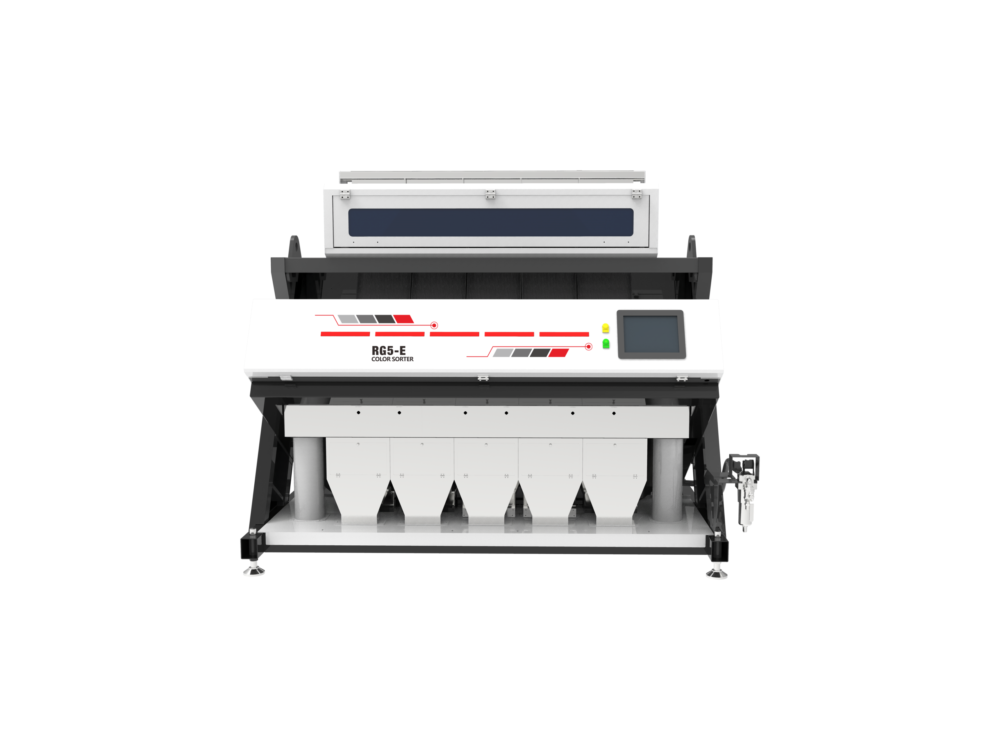
| Parameter | Specification |
| Model | RG5-E |
| Machine Type | Rice Color Sorter Machine |
| Sorting Technology | Optical / Visible-Light Sorting |
| Throughput | 5.1-6 t/h |
| Sorting Accuracy | >99.99% |
| Voltage / Frequency | 220 V / 50 Hz |
| Power | 3.7 kW |
| Weight | 1280 kg |
| Dimensions (L × W × H) | 2348*1610*1887 mm |
| Typical Sorting Applications | Yellow Rice, Dark Yellow Rice, Chalky Rice, Discolored Rice, Broken Rice |
| Application | Commercial Rice Processing and Quality Sorting |
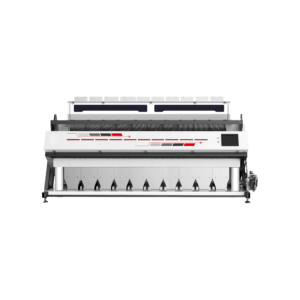
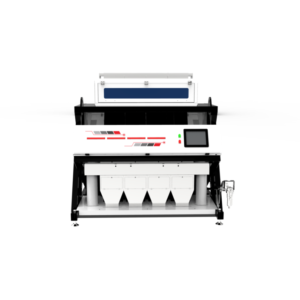
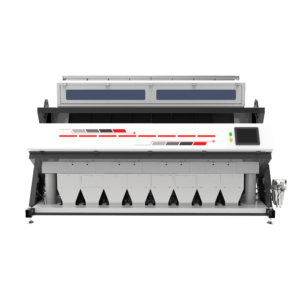
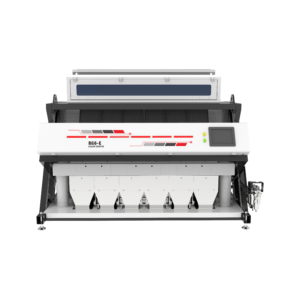
The RG5-E Rice Color Sorter Machine is designed for commercial rice processors that need reliable optical sorting at a practical production capacity. With a rated throughput of 5.1–6 tons per hour, it provides a balanced option for rice processing lines where matching sorter capacity to actual production is more important than simply choosing the largest available machine.
The RG5-E uses visible-light optical recognition to evaluate differences in color, shape, texture, and other visible characteristics. It can be configured for sorting yellow grains, chalky rice, discoloration, broken grains, visible surface irregularities, and other visually distinguishable material according to the required finished-product standard.
For processors handling different rice varieties or changing incoming quality, adjustable sorting criteria make it possible to adapt the machine from one production batch to another. This combination of moderate commercial capacity and flexible optical quality control makes the RG5-E particularly suitable for rice mills operating around the 5–6 t/h range.
A higher-capacity color sorter is not automatically the better choice. For many commercial rice processors, the more important consideration is whether sorting capacity matches the actual flow of the production line.
The RG5-E is rated at 5.1–6 t/h, making it a practical option for facilities whose cleaning, milling, grading, conveying, and packaging equipment operates around this output range.
Correct capacity matching helps keep the sorting stage aligned with the rest of the line. An undersized sorter can restrict production, while substantially oversized equipment may provide little practical benefit when surrounding equipment cannot supply or handle the additional throughput.
The RG5-E therefore occupies a useful position within the RG-E range. It provides commercial-scale optical sorting without requiring processors to move directly to a substantially higher-capacity configuration.
This is also useful for facilities making a moderate production upgrade. Instead of selecting capacity far beyond realistic requirements, processors can match the sorting stage to both current output and planned production growth.
Rice quality varies between varieties, suppliers, storage conditions, and production batches. The RG5-E allows processors to configure optical sorting criteria according to the visible characteristics of the incoming material and the desired finished product.
Yellow and darkened grains can reduce the visual consistency of finished rice.
The optical recognition system identifies selected color differences and separates grains that fall outside the configured acceptance criteria.
Chalkiness and other visible color variations can also be included in the sorting criteria.
Depending on production requirements, processors can configure the machine to address individual characteristics or combined sorting tasks. This flexibility is useful when incoming material contains several visible quality variations rather than one isolated defect.
Localized spots, uneven coloration, and other visible surface differences can be evaluated when they provide sufficient optical contrast.
Recognition of particularly small or subtle surface features depends on factors such as their size, contrast, orientation, and visibility during optical inspection. Representative material testing is therefore useful when a processor has a specific surface-defect requirement.
Not every sorting requirement involves removing a conventional defect. Some processors may need to separate material according to grain integrity or other visible characteristics.
When broken grains or other materials present recognizable visual differences, the RG5-E can use these characteristics as part of the configured sorting criteria.
Foreign material can also be separated when it presents sufficient visible differences from the surrounding rice.
Characteristics such as color, shape, size, texture, and surface appearance can provide information for optical recognition. Materials that cannot be reliably distinguished through visible characteristics may require a different detection technology.
The RG5-E combines several optical sorting functions to maintain consistent quality control within its intended production range.
Instead of relying only on a simple color threshold, the recognition system evaluates multiple visible characteristics, including color, shape, texture, and area.
This provides greater flexibility when selected material differs from acceptable rice in more than one visible feature.
Reliable optical recognition depends on how consistently rice passes through the inspection area.
The balanced feeding system helps distribute material more uniformly, reducing excessive concentration and overlapping. This provides better conditions for image acquisition and classification.
Once selected material is identified, the system coordinates recognition with information about its position and movement.
Accurate positioning allows rejection to focus more precisely on the selected material. This helps improve separation while limiting unnecessary removal of acceptable rice into the reject stream.
Incoming rice conditions are not always identical. Rice variety, supplier, storage condition, and batch quality can change the visible characteristics of the material.
Adjustable sorting criteria allow operators to respond to these changes without applying one fixed sorting standard to every production batch.
The main value of the RG5-E lies in combining commercial sorting capacity with practical production-line matching.
For rice processors operating around 5–6 t/h, the machine provides enough sorting capacity to support normal production without automatically moving to a substantially larger configuration.
This makes it particularly relevant for facilities upgrading from lower-capacity sorting equipment, processors handling multiple rice batches, and production lines where optical sorting is used as a quality-control stage before final grading or packaging.
The RG5-E also provides flexibility when raw-material conditions change. Operators can adjust sorting criteria according to the actual batch while precise recognition and targeted rejection help balance finished-product quality with usable product recovery.
Rather than treating maximum throughput as the only selection criterion, the RG5-E gives processors an option designed around a more practical question: how much sorting capacity does the complete production line actually need?
The RG5-E can be integrated as an optical quality-control stage within a commercial rice processing line, typically after major cleaning and milling processes and before final grading or packaging, depending on the plant layout.
Its 5.1–6 t/h rated throughput makes it particularly relevant when the surrounding equipment operates within a similar capacity range.
When evaluating the RG5-E, processors should consider:
For a line operating consistently around 5–6 t/h, the RG5-E may provide a more appropriate capacity match than moving directly to an 8–12 t/h configuration.
The RG5-E is rated at 5.1–6 tons per hour. Actual throughput can vary according to rice characteristics, incoming material condition, the proportion of unwanted material, sorting requirements, and required finished-product quality.
Start with the continuous throughput of the complete rice processing line.
The RG5-E is rated at 5.1–6 t/h, compared with 8.5–10 t/h for the RG8-E and 10.2–12 t/h for the RG10-E.
A larger sorter is not automatically the better choice. The selected model should match upstream and downstream equipment capacity as well as realistic plans for production growth.
The multi-feature optical recognition system evaluates visible characteristics including color, shape, texture, and area. This allows visible spots, localized discoloration, and other surface irregularities to be included in the sorting criteria when sufficient optical contrast is available.
For particularly small or subtle targets, representative material testing is recommended because recognition performance depends on the actual visibility of the target feature.
The RG5-E combines multi-feature recognition with precise material positioning and targeted rejection.
By identifying selected material more accurately and coordinating the rejection position, the system helps limit unnecessary removal of acceptable rice. Actual product recovery depends on incoming material conditions and configured sorting criteria.
Evaluate your current and target throughput, rice variety, incoming material quality, main sorting targets, required finished-product standard, and surrounding equipment capacity.
For applications involving specific or subtle sorting targets, representative rice samples can help evaluate whether the RG5-E and its capacity range are appropriate for the application.
The RG5-E Rice Color Sorter Machine is designed for processors that need dependable optical quality control at approximately 5.1–6 t/h without unnecessarily moving to a higher-capacity configuration.
Its combination of multi-feature optical recognition, balanced feeding, adjustable sorting criteria, and precise targeted rejection supports commercial rice processing where capacity matching, sorting consistency, and product recovery all matter.
If you are planning a new rice processing line or replacing an existing sorter, send PolySorter your rice type, representative sample photos, current and target throughput, main sorting requirements, and desired finished-product quality.
Contact PolySorter to evaluate whether the RG5-E is the right capacity for your rice processing line and request a quotation.