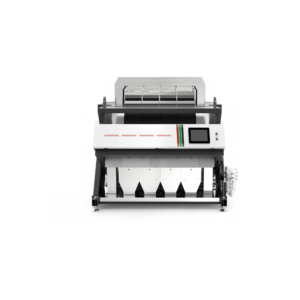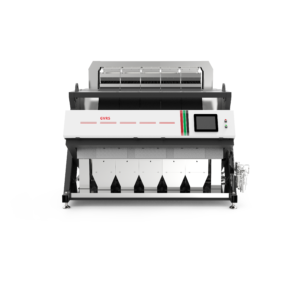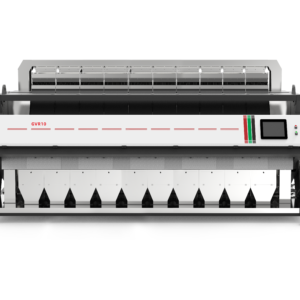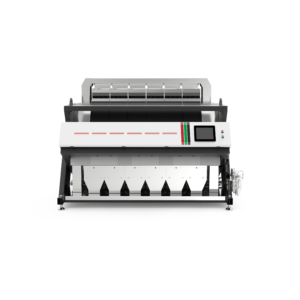
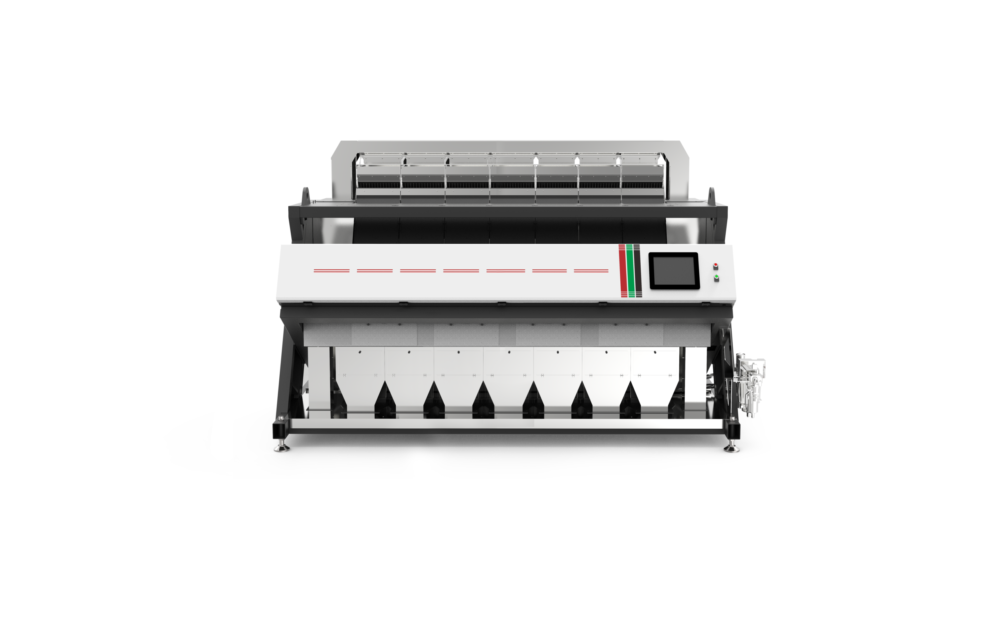
| Product Name | GVR SERIES FLAKE COLOR SORTER |
| Model | GVR7 |
| SENSOR TECHNOLOGY | Dual full-color camera, Long-life LED light |
| Throughput(T/h) | 2.8-5.6 |
| Air Consumption (m3/min) | <3.5 |
| Voltage (V/hz) | 220/50 |
| Power (kW) | 5.2 |
| Weight (kg) | 1750 |
| Dimension (mm) | 3120*1829*1887 |
| APPLICATION | Color sorting of PET flakes Color sorting of PE flakes with customizable sorting solutions Color sorting for other plastic flakes, such as PP, PE, PVC, PC, PA. PS. etc. Effective removal of impurities such as springs and wood chips |
The GVR7 Plastic Color Sorter Machine is a seven-channel optical sorting solution designed for high-throughput plastic flake recycling. Featuring a wide sorting configuration, dual full-color camera technology, and a processing capacity of 2.8–5.6 T/H, the GVR7 helps recycling facilities achieve consistent color separation while maintaining efficient material flow.
Designed for PET, PE, PP, PVC, PC, PA, PS, and other suitable plastic flakes, the machine combines precise optical detection with high-speed pneumatic rejection to remove unwanted colored, black, and opaque flakes. Its adjustable sorting settings support different recycling applications, from clear PET purification to mixed-color plastic flake classification.
For recycling facilities seeking to improve product consistency and automate color separation, the GVR7 offers a practical solution that integrates into commercial plastic recycling lines.
Plastic recycling plants often receive materials with inconsistent colors, irregular shapes, and varying levels of contamination. Even after crushing and washing, unwanted colored flakes may remain mixed with the target material.
For example, clear PET flakes may contain green, blue, yellow, or white-blue pieces. Similarly, recycled HDPE streams may contain red, blue, green, clear, and white flakes that need to be separated into different color fractions.
These differences can affect the appearance and commercial suitability of recycled materials, particularly when downstream processors require consistent feedstock.
The GVR7 addresses this challenge through automated optical inspection and color-based separation.
As plastic flakes pass through the detection area, the machine identifies visible differences between accepted and unwanted materials. Its pneumatic rejection system then redirects selected flakes into a separate collection stream.
This process supports more consistent color separation while reducing dependence on manual inspection.
Typical applications include:
The GVR7 can be configured for different color separation tasks according to the incoming material and required finished-product specifications.
Rather than limiting the machine to one fixed application, operators can adjust sorting criteria to accommodate different recycling batches.
The GVR7 combines dual full-color camera technology, long-life LED illumination, and high-speed pneumatic rejection to deliver continuous color separation for plastic recycling applications.
As prepared plastic flakes enter the sorting system, they are distributed across the feeding channels to support stable material flow. Consistent feeding helps reduce excessive overlap and allows the optical detection system to inspect individual flakes more effectively.
Under controlled LED illumination, the dual full-color cameras capture visible color information from the moving material. The sorting system analyzes these signals in real time and identifies flakes that do not meet the selected color requirements.
Once an unwanted flake is detected, the corresponding high-speed pneumatic ejector activates at the appropriate moment. A short burst of compressed air redirects the identified material into the reject stream, while acceptable flakes continue into the product collection area.
This coordinated process enables the GVR7 to combine continuous material inspection with responsive rejection, helping recycling facilities maintain consistent color separation at industrial processing speeds.
Operators can adjust the sorting criteria according to different materials, color combinations, and finished-product requirements. Actual performance depends on feedstock conditions, material presentation, and the required sorting standard.
Different plastic recycling streams require different color separation strategies. The GVR7 provides configurable optical sorting for applications where target and unwanted materials exhibit detectable visible differences.
PET bottle recycling is a common application for plastic flake color sorting.
After crushing and washing, PET flakes may contain clear, green, blue, yellow, and white-blue material. Depending on the required product grade, some colors must be separated before further processing.
The GVR7 can be configured to recover the desired color fraction while rejecting unwanted flakes.
For example, a recycling facility producing clear PET can use optical sorting to reduce green, blue, yellow, and other visibly different pieces in the accepted product stream.
This helps improve color consistency for downstream processing, including extrusion and pelletizing.
However, optical color purification does not replace the removal of chemically different polymers or other contaminants that cannot be distinguished by visible appearance.
Recycled HDPE from bottles, containers, and packaging can contain a broad mixture of colors.
For some applications, mixed-color HDPE is acceptable. Other applications require more consistent color fractions to achieve the desired appearance of recycled products.
The GVR7 can classify HDPE flakes into selected color groups, including red, blue, green, clear, and white fractions, according to the sorting configuration.
This makes the machine useful for recycling facilities seeking to recover more uniform materials from mixed-color feedstock.
The GVR7 also supports color sorting applications involving PE, PP, PVC, PC, PA, PS, and other suitable plastic flakes.
The machine identifies visible color differences rather than directly determining polymer composition.
For example, it can help separate differently colored PP flakes within a prepared PP stream. However, separating PP from PE when both materials have similar visible appearances generally requires polymer identification or another suitable separation process.
In recycling operations where both material purity and color consistency are important, optical color sorting can work alongside other separation technologies.
The performance of an optical sorting machine depends not only on its detection system but also on the condition of the material entering the equipment.
The GVR7 is designed for commercial recycling facilities that need continuous color separation within a larger processing line.
With a reference throughput of 2.8–5.6 T/H, it can support a range of industrial plastic flake recycling applications.
Actual processing capacity varies according to feedstock characteristics, contamination levels, sorting requirements, and operating conditions.
A typical plastic recycling process may include preliminary separation, crushing, washing, drying, and optical sorting.
Proper preparation helps reduce the influence of dust, moisture, and material overlap during inspection.
The GVR7 is generally best positioned where the flakes have been prepared sufficiently for stable feeding and reliable optical detection.
A recycling plant should evaluate the GVR7 according to its normal operating throughput rather than maximum capacity alone.
Higher feed rates may increase material overlap and reduce the opportunity for accurate individual flake inspection.
Operators therefore need to balance processing capacity, output purity, and material recovery.
For facilities handling changing feedstock, suitable sorting settings may vary between production batches.
The GVR7 can be incorporated into an existing recycling line as a dedicated color purification stage.
A typical arrangement may follow this sequence:
Plastic Waste → Preliminary Separation → Crushing → Washing → Drying → GVR7 Color Sorting → Further Processing
Depending on the application, the machine may operate before extrusion, pelletizing, or other downstream recycling stages.
Additional sorting passes can be considered when the required output purity cannot be achieved through a single pass under the selected operating conditions.
The final line configuration should reflect the incoming material, required output specifications, and available production capacity.
Selecting an optical sorting machine involves more than comparing processing capacity.
Recycling companies also need to consider material characteristics, required color purity, operating conditions, and how the equipment fits into the existing production process.
The GVR7 combines industrial processing capacity with adjustable optical color separation, making it suitable for facilities that need consistent results across different plastic flake applications.
Automated optical inspection helps maintain a repeatable color acceptance standard throughout production.
By identifying and removing unwanted colored flakes, the GVR7 can improve the visual consistency of recycled materials.
The machine supports different color separation requirements for PET, HDPE, PP, PE, and other suitable plastic flakes.
Operators can adjust sorting criteria according to the feedstock and desired product fraction.
With a reference throughput of 2.8–5.6 T/H, the GVR7 offers a practical capacity range for commercial recycling operations.
The appropriate operating rate should be determined according to the required purity and recovery performance.
Automated optical inspection and pneumatic rejection can reduce reliance on labor-intensive manual color separation.
This is particularly valuable when recycling facilities process large quantities of relatively small plastic flakes.
More uniform color fractions can help downstream processors maintain consistent feedstock appearance.
This is especially relevant for recycling operations producing flakes for extrusion, pelletizing, or other recycled plastic manufacturing processes.
For buyers comparing different sorting equipment, the GVR7 should be evaluated using representative material samples and realistic production requirements.
Factors such as incoming contamination, flake size, desired color fractions, throughput, and acceptable material loss all influence the final equipment selection.
The GVR7 is designed for color-based sorting of PET, PE, PP, PVC, PC, PA, PS, and other suitable plastic flakes. Its performance depends on detectable visible differences between accepted and rejected materials.
Yes. The machine can identify and reject visibly different colored flakes, including green, blue, yellow, and other unwanted colors, according to the selected sorting criteria.
The GVR7 has a reference throughput of 2.8–5.6 T/H. Actual capacity depends on the material, contamination level, feeding conditions, and required sorting performance.
The GVR7 primarily separates materials according to visible color and appearance. When different polymers have similar colors, additional polymer identification technology may be necessary.
Yes. The machine can be integrated into an existing recycling process when the material preparation, feeding system, compressed air supply, installation space, and downstream handling are compatible.
Buyers should provide the plastic type, flake size, incoming material condition, expected throughput, target color fractions, and required output purity. Representative samples can also help evaluate sorting performance.
The GVR7 Plastic Color Sorter Machine provides an efficient solution for recycling facilities seeking more consistent plastic flake colors and reliable commercial processing capacity. Combining dual full-color camera technology, long-life LED illumination, and automated pneumatic rejection, the machine supports flexible color separation for PET, HDPE, PP, PE, and other suitable plastic recycling applications. Contact PolySorter with your material details, processing capacity, and required output quality to discuss the GVR7 and determine an appropriate sorting configuration for your recycling line.